
Southern hawker
Aeshna cyanea · Darners
A medium-large, fast-flying dragonfly common around gardens, ponds and slow waterways in much of Europe, distinctive for its green and blue markings.
!Is the southern hawker dangerous?
No. Not dangerous. Southern hawkers do not have venom harmful to people. They can bite if handled roughly; bites are uncommon and cause only brief, minor pain or skin puncture. Wash any bite with soap and water and treat minor wounds as needed.
Pets
Generally harmless to cats and dogs. Pets might catch dragonflies but these insects are not toxic; ingestion could cause mild transient mouth or gastrointestinal irritation in small pets.
📖Overview
The Southern hawker (Aeshna cyanea) is a common dragonfly of the family Aeshnidae found across much of Europe into parts of western Asia. It frequents ponds, lakes, canals, ditches and garden water features with nearby vegetation. Adults are strong fliers that hunt flying insects and are often seen patrolling territories among reeds, hedges and trees. Larvae (nymphs) are aquatic predators that live in submerged vegetation for one to three years before emerging as adults.
🔍How to identify a southern hawker
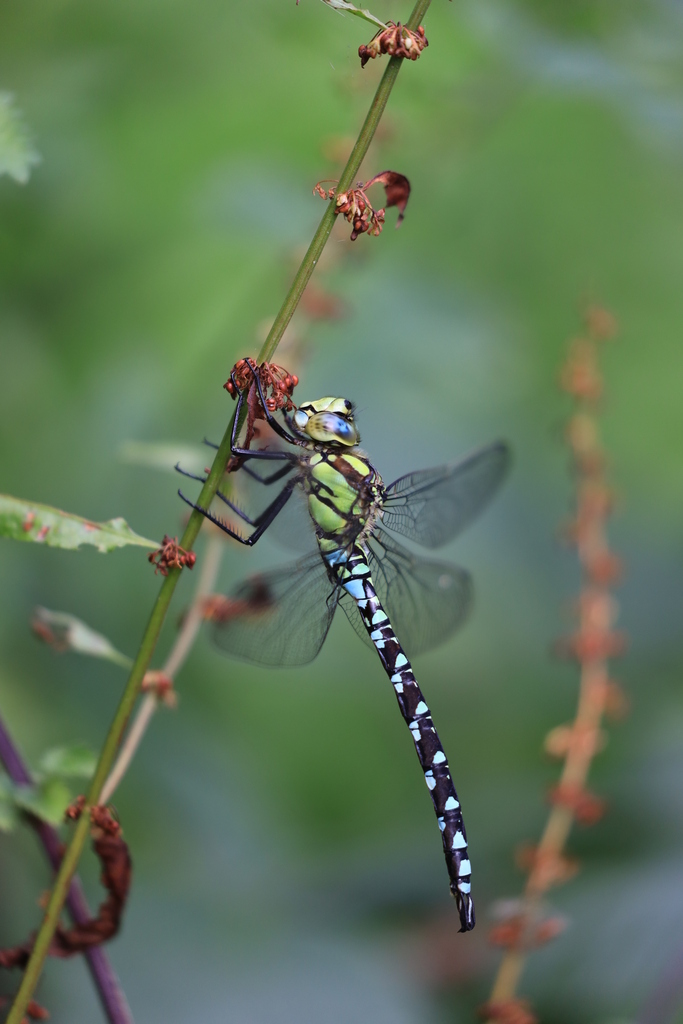
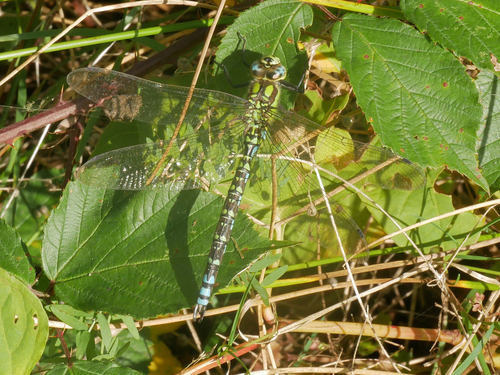
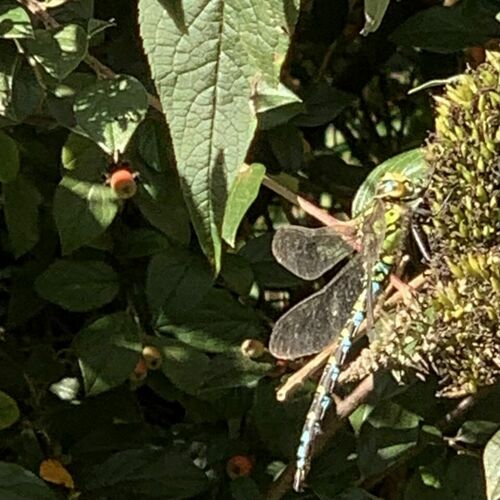
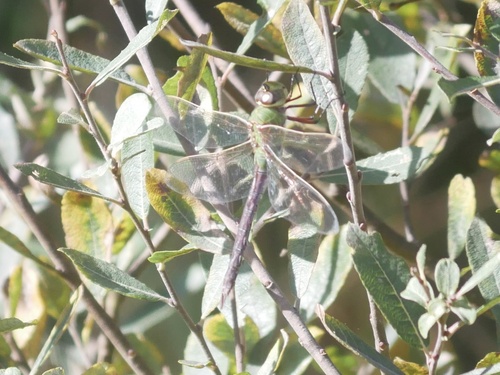
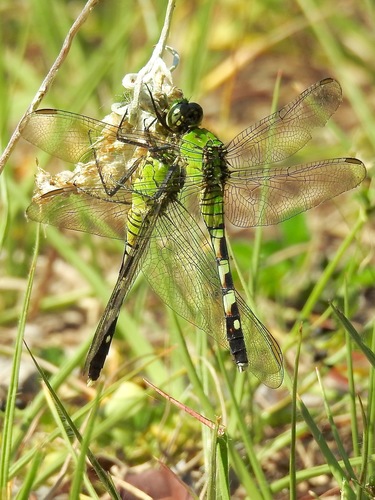
Adults are large dragonflies with a long abdomen and a wingspan of about 95-110 mm. The thorax is dark brown with two broad green stripes on top and green panels on the sides. Males have paired apple-green spots along the abdomen, turning blue on the last few segments, where they merge into bands; females are brown with green spots. Eyes are large and meet on top of the head. Wings are clear with a small dark pterostigma near the tip.
- Dark thorax with two broad green stripes on top; abdomen with green spots (blue towards the tip in males)
- Large eyes that meet at the top of the head
- Clear wings with a small dark pterostigma near each tip; wings held outstretched when perched
- Size and fast, patrolling flight typical of darners
Lookalikes
Brown hawker Aeshna grandis
Brown hawker has a more brownish thorax and larger amber patches at the wing base; Southern hawker is greener with blue abdominal spots.
Migrant hawker Aeshna mixta
Migrant hawker is smaller, with a yellow 'golf-tee' mark on abdominal segment 2 and only tiny stripes on top of the thorax; Southern hawker has broad green thoracic stripes and solid bands (not paired spots) on the last two segments.
↻Life cycle
Egg
Laid in submerged or emergent plant stems and soft plant tissue; eggs hatch into aquatic larvae.
Larva (nymph)
Aquatic, predatory stage that lives among submerged vegetation for 1-3 years, molting multiple times while hunting small aquatic invertebrates and tadpoles.
Adult (imago)
Terrestrial flying stage that emerges from the final larval exuvia; adults feed on flying insects, mate and the female lays eggs back in water.
🍃Diet and predators
Young eat
Aquatic invertebrates, mosquito larvae, small crustaceans and tadpoles
Adults eat
Flying insects such as flies, mosquitoes, gnats, midges and other small flying prey captured on the wing
Predators of the young
Fish, larger aquatic invertebrates, frogs and newts
Predators of adults
Birds, spiders (when resting), bats and larger dragonflies
🌱Effect on plants and gardens
Does not feed on plants; adults are predators of flying insects and larvae are aquatic predators. They do not damage gardens or crops and are beneficial for controlling nuisance flies and mosquitoes.
📍Where and when to find it
Adults: flying or perched on vegetation near ponds, lakes, ditches, canals and garden ponds. Larvae: among submerged plants and detritus in the same water bodies.
Best time
May to October in most of its range; midday and afternoon on warm, sunny days are best for observing active hunting adults.
Observation tips
Look along vegetated pond margins and hedgerows. Use a telephoto or zoom lens to avoid disturbing them; approach slowly and photograph from eye level for profile shots.
✨Fun facts
- Southern hawkers often hunt along hedgerows and even inside gardens, making them familiar to people.
- They are strong fliers and can hover, dart and fly rapidly while hunting mid-air prey.
- Southern hawkers are curious and will often fly up to inspect people walking near ponds.
?Frequently asked questions
Are Southern hawkers dangerous?
No — they are not venomous or poisonous to people. They are harmless predators of flying insects.
Do Southern hawkers bite?
They can deliver a defensive bite if handled, but bites are rare and cause only minor, short-lived pain.
Why is a Southern hawker in my house?
They chase flying insects and may follow them indoors, or they may enter through open windows while hunting. They do not infest homes.
How do I get rid of a Southern hawker in my house?
Guide it gently to an open window or door using a soft container or piece of paper; avoid swatting. It will fly away once outdoors.
Where do Southern hawkers live?
They live near standing or slow-moving fresh water with plenty of vegetation across much of Europe and nearby regions.
📷Photos of the southern hawker
More dragonflies & damselflies
This guide was written with AI assistance and fact-checked, last updated 2026-10-10. Identification from photos is never certain: don't handle insects you can't identify, and get medical advice for bites, stings or allergic reactions. More about the southern hawker: iNaturalist, Wikipedia.