
Banded garden spider
Argiope trifasciata · Orb-weaver spiders
A common daytime orb-weaver with a striking banded abdomen that builds vertical webs in gardens and fields; not aggressive and only a mild bite risk to people.
!Is the banded garden spider dangerous?
Only mildly. Bites are rare and usually occur only if the spider is trapped against skin or handled roughly. A bite can cause local pain, redness and swelling for a few hours to a day; serious reactions are uncommon. First aid: wash the area with soap and water, apply a cold pack to reduce swelling, and seek medical care if symptoms worsen, spread, or if there are signs of severe allergic reaction.
Pets
Generally not dangerous to pets. A bite to small pets might cause localized pain or minor swelling, but clinically significant effects are rare. If a pet is bitten and shows unusual behavior, excessive swelling, vomiting or weakness, consult a veterinarian.
📖Overview
Argiope trifasciata is a medium-sized orb-weaver found across much of the world. Females build large, vertical orb webs in open sunny spots such as gardens, field edges and shrubby areas and sometimes add a white zigzag silk stabilimentum. They capture flying insects and are important insect predators in gardens. Females are much larger than males and are most noticeable in late summer and autumn when mature. They are not aggressive toward people; bites are uncommon and generally cause only mild, short-lived local pain and swelling.
Behaviorally, A. trifasciata sits in the center of its web facing downward and repairs or rebuilds the web daily. Mating and egg-laying occur late in the season; egg sacs are usually attached to vegetation and females may guard nearby. The spider helps control pest insects and is generally tolerated in yards and farms for its beneficial role.
🔍How to identify a banded garden spider
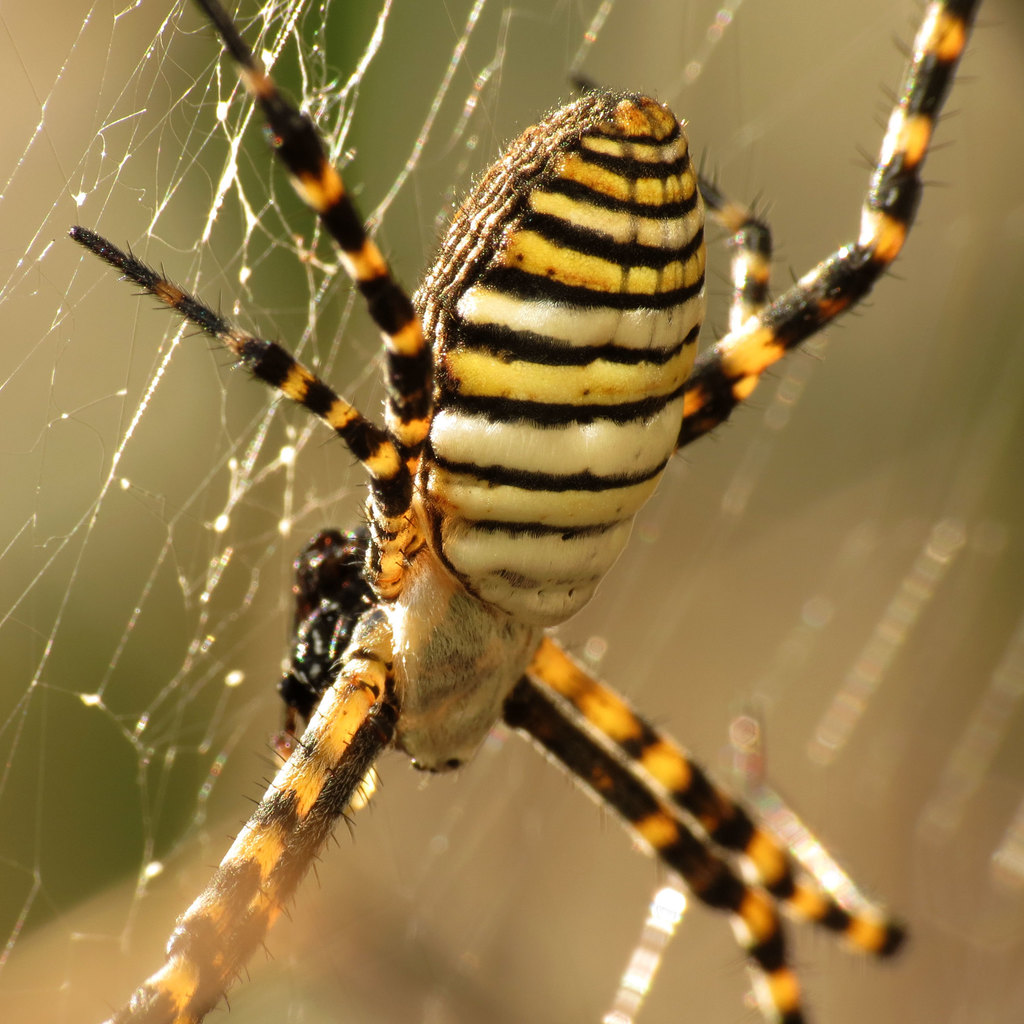
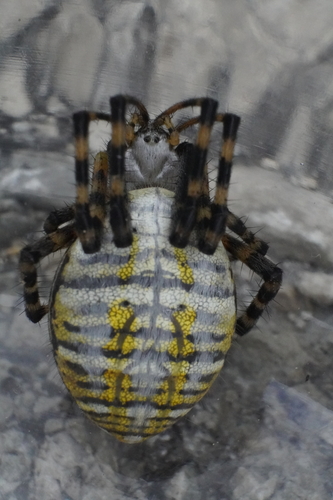
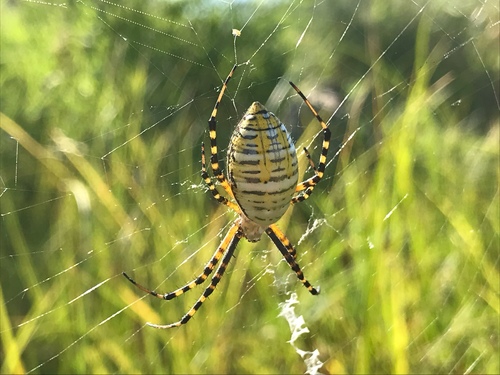
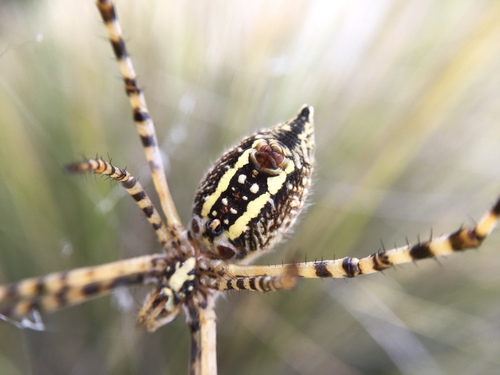
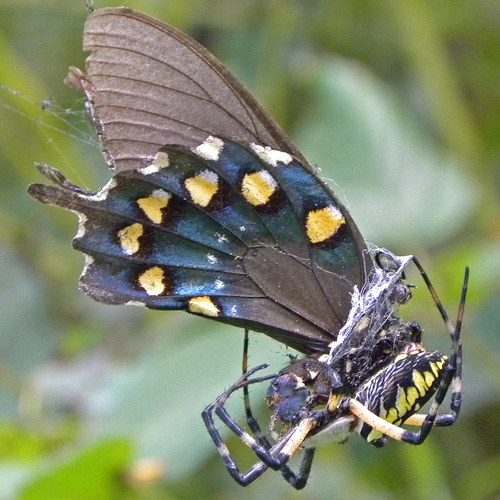
Females have an oval abdomen that tapers to a point at the rear, marked with many thin, alternating transverse bands of silvery white, yellow and black. The cephalothorax is covered with silvery hairs, and the legs are banded pale and dark. Some individuals add a white zigzag stabilimentum (silk decoration) to the web, though it is often small or absent. Males are much smaller, slimmer, and less boldly patterned. Eyes are arranged in two rows typical of orb-weavers.
- Many thin transverse bands of silver, yellow and black across an oval abdomen that tapers to a point.
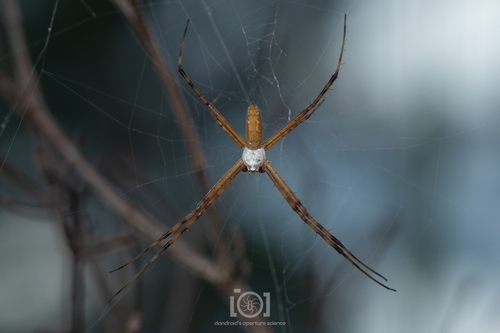
- Large vertical orb web, sometimes with a small white zigzag stabilimentum near the center.
- Silvery or hairy cephalothorax and legs, with females noticeably larger and more rounded than males.
Lookalikes
Yellow garden spider Argiope aurantia
A. aurantia is larger, with bold black and bright yellow patches rather than many thin bands, and usually builds a heavy zigzag stabilimentum; A. trifasciata has finer, more numerous bands and a more pointed abdomen.
Wasp spider Argiope bruennichi
A. bruennichi (mainly Europe and Asia) has fewer, bolder black and yellow transverse stripes like a wasp; A. trifasciata has many thin silver, yellow and black bands.
↻Life cycle
Egg sac
Females lay one or more silk egg sacs late in the season; sacs are attached to vegetation and may be guarded or hidden in leaf litter.
Spiderling and juvenile
Spiderlings hatch and disperse (ballooning is possible) and go through multiple molts as juveniles, building small orb webs until reaching maturity.
Adult
Adults mate, females lay eggs and maintain larger webs; adults are most evident in summer and autumn before dying back in colder regions.
🍃Diet and predators
Young eat
Small flying insects and other tiny arthropods captured in small orb webs.
Adults eat
Flying insects such as flies, bees, moths and small grasshoppers captured in large orb webs.
Predators of the young
Small insectivorous birds, predatory insects and parasitoid wasps.
Predators of adults
Birds, wasps (including spider-hunting wasps), larger spiders and small mammals; parasites and pathogens can also affect them.
🌱Effect on plants and gardens
Feeds on flying herbivorous insects and can reduce pest insect numbers in gardens and crops; does not feed on plants.
📍Where and when to find it
Look for adults on large vertical orb webs in gardens, hedgerows, field edges and low shrubs; egg sacs are on vegetation or hidden in leaf litter.
Best time
Best observed from late spring through autumn, especially summer and early fall during daylight hours.
Observation tips
Approach slowly to photograph; use a longer lens to avoid disturbing the web. Early morning dew can highlight web structure and the stabilimentum.
✨Fun facts
- Many Argiope species add a white silk 'stabilimentum' to their webs; its exact purpose is debated (prey attraction, web camouflage, or predator warning).
- Females are significantly larger than males — a common trait in orb-weaver spiders.
- Spiderlings can disperse by 'ballooning', releasing silk threads that catch the wind to carry them to new locations.
?Frequently asked questions
Do banded garden spiders bite?
They can bite if handled or trapped, but bites are uncommon and usually cause only mild, short-lived pain and swelling.
Are banded garden spiders dangerous to people?
Only mildly. They are not considered dangerous; bites are rare and usually cause only mild local pain and swelling, and they are beneficial predators.
Why is there a big web in my garden?
Female banded garden spiders build large orb webs in sunny, open spots to catch flying insects; the web is their hunting tool and is often rebuilt daily.
How do I get rid of a banded garden spider?
The easiest humane method is to wait until dusk and gently remove the web and relocate the spider outdoors using a container and a piece of cardboard. Avoid spraying insecticide unless necessary; sealing entry points keeps spiders out of the house.
Will these spiders harm my pets or children?
They are unlikely to harm healthy pets or children; bites are rare and usually mild. Supervise small children to prevent handling and teach them to observe from a distance.
📷Photos of the banded garden spider

More spiders
This guide was written with AI assistance and fact-checked, last updated 2026-10-10. Identification from photos is never certain: don't handle insects you can't identify, and get medical advice for bites, stings or allergic reactions. More about the banded garden spider: iNaturalist, Wikipedia.