
Wasp spider
Argiope bruennichi · Orb-weaver spiders
A distinctive yellow-and-black orb-weaver common in grasslands and gardens; females build large vertical webs with a white zig-zag stabilimentum.
!Is the wasp spider dangerous?
Only mildly. Wasp spiders are venomous to their insect prey but not dangerous to people. Bites are rare and usually occur only if the spider is handled or trapped against skin; they generally cause localized pain, redness and swelling similar to a bee or wasp sting. Seek medical advice if there are signs of a severe allergic reaction, increasing pain, spreading redness, or infection.
Pets
Not a significant risk to dogs or cats. A curious pet that paws at a spider could receive a defensive bite causing brief local pain or swelling; serious effects are not expected.
📖Overview
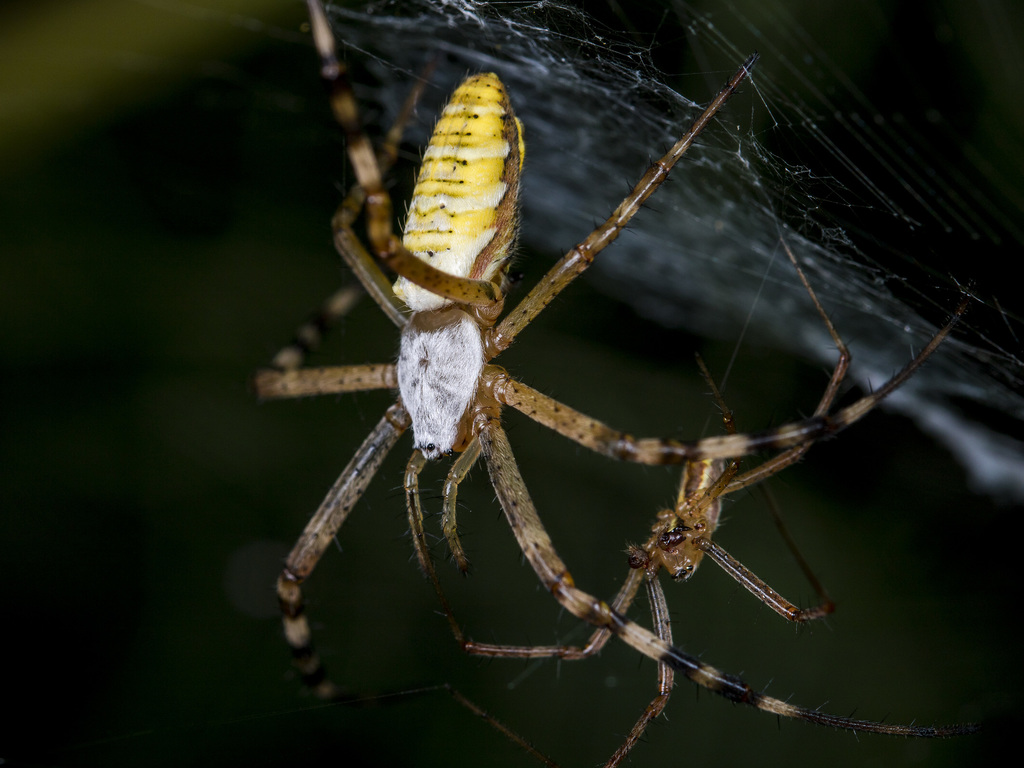
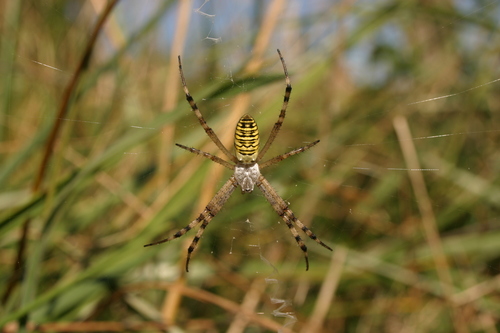
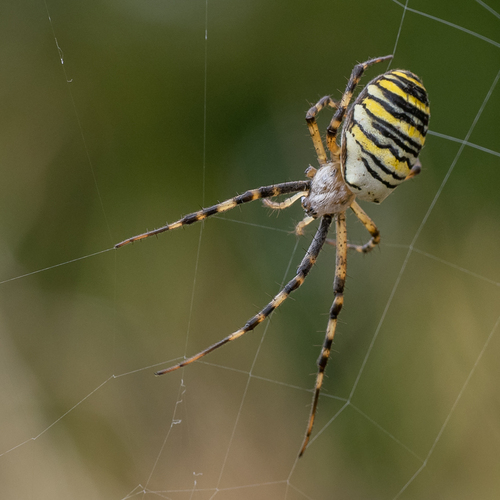
Argiope bruennichi is a striking orb-weaving spider found across Europe, parts of Asia and North Africa. Females are notably larger and show bright yellow and black banding on the abdomen that resembles a wasp. They build vertical orb webs in low vegetation, often with a conspicuous white zig-zag silk decoration called a stabilimentum. Males are much smaller and live near or on the female's web during mating season.
🔍How to identify a wasp spider
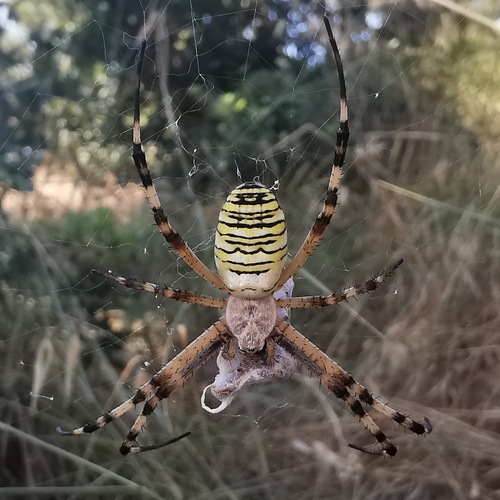
Females have a large, oval abdomen with bold transverse yellow, white and black stripes, a silvery-haired cephalothorax and long pale legs with dark bands. Males are much smaller, slimmer and pale brownish with little of the bold banding. The web often includes a central dense white silk decoration (stabilimentum) in a zig-zag pattern.
- Bold transverse yellow and black (wasp-like) bands on the abdomen of females.
- Large vertical orb web often with a conspicuous white zig-zag stabilimentum in the centre.
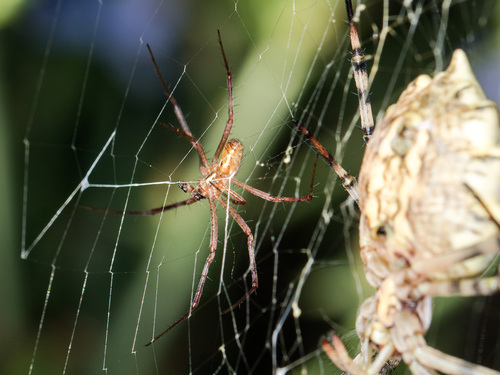
- Marked sexual size dimorphism: females much larger (roughly 11-17 mm) and more brightly coloured than males (about 4-6 mm).
Lookalikes
Banded garden spider Argiope trifasciata
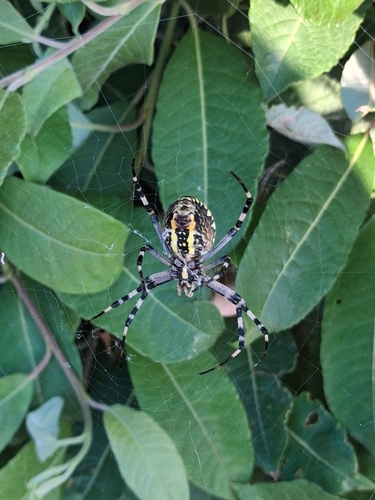
Abdomen has many thin silver, yellow and black bands and is more pointed at the rear; found mainly in the Americas and other warm regions.
Lobed argiope Argiope lobata
Larger, with a silvery-white abdomen that has deep lobes along the sides instead of yellow-and-black stripes; mainly Mediterranean and warmer regions.
↻Life cycle
Egg
Females lay eggs in a brown, urn-shaped silken sac attached to vegetation in autumn. Spiderlings hatch before winter but stay inside the sac until spring.
Juvenile (spiderling)
Young spiders hatch as spiderlings, disperse by ballooning on silk threads, and go through several moults while growing in the vegetation.
Adult
Adults appear in mid to late summer. Females build and maintain large orb webs; males approach cautiously to mate, and the female often eats the male afterwards.
🍃Diet and predators
Young eat
Small flying or jumping insects such as gnats, small flies and aphids.
Adults eat
Larger flying insects including flies, grasshoppers, bees and wasps captured in the orb web.
Predators of the young
Birds, larger predatory insects and spiders, parasitoids and parasitoid wasps.
Predators of adults
Birds, wasps that attack spiders, larger spiders and small mammals; some birds may avoid the conspicuous adult females.
🌱Effect on plants and gardens
Wasp spiders do not damage plants; they are predators of flying and jumping insects and can help reduce pest insect numbers in gardens.
📍Where and when to find it
Look for their vertical orb webs in low vegetation, shrubs, garden borders, meadow edges and hedgerows; adults are easiest to spot on the web.
Best time
July to September during daylight hours when webs are maintained and prey capture is active.
Observation tips
Approach slowly and photograph from a distance to avoid disturbing the web. Early morning with dew on the web can make the web and stabilimentum especially photogenic.
✨Fun facts
- The white zig-zag silk band in the web is called a stabilimentum; researchers have proposed several functions, including making the web more visible to prevent large animals from accidentally destroying it or attracting prey.
- Females are much larger than males — a dramatic example of sexual size dimorphism in spiders.
- Spiderlings disperse by 'ballooning': releasing silk threads to be carried on the wind to new locations.
?Frequently asked questions
Do wasp spiders bite?
They can bite if handled or trapped against skin, but bites are uncommon. Symptoms are usually mild (localized pain, redness and swelling) similar to a bee sting.
Are wasp spiders dangerous to humans?
Only mildly. Their venom is effective on insects but not dangerous to healthy humans; a bite causes brief local pain and swelling at most. Seek medical attention for severe allergic reactions or signs of infection.
Why is a wasp spider in my garden?
Gardens and meadows provide the low vegetation and plentiful flying insects wasp spiders need for anchoring their webs and catching prey.
How do I get rid of a wasp spider?
If removal is desired, gently relocate the spider by encouraging it onto a container and moving it to nearby vegetation. Destroying webs or regular disturbance will encourage it to move away. Pesticides are unnecessary and harm beneficial insects.
Do wasp spiders eat bees?
Yes, adults can capture bees and wasps in their webs, though captured stinging insects are often wrapped in silk quickly to reduce risk to the spider.
📷Photos of the wasp spider
More spiders
This guide was written with AI assistance and fact-checked, last updated 2026-10-10. Identification from photos is never certain: don't handle insects you can't identify, and get medical advice for bites, stings or allergic reactions. More about the wasp spider: iNaturalist, Wikipedia.