
Spinybacked orbweaver
Gasteracantha cancriformis · Orb-weaver spiders
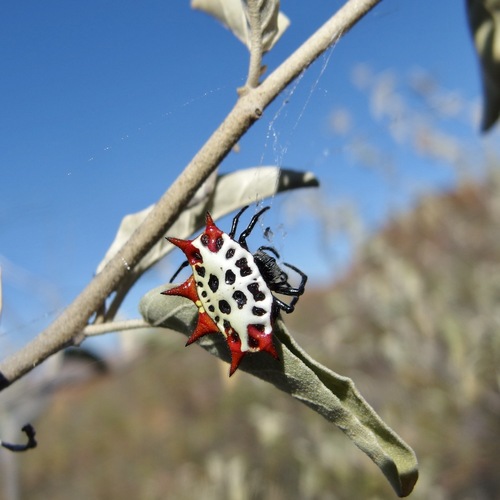
A small, day-active orb-weaver with a wide, hard, spiny abdomen in bright colours; common in gardens and edges across the Americas.
!Is the spinybacked orbweaver dangerous?
Only mildly. Not dangerous to people. Like most orb-weavers, it has venom for subduing prey; bites to humans are rare, cause at most minor local pain, redness or swelling in sensitive individuals. Clean the area, apply a cold pack and seek medical advice if symptoms worsen or if there is an allergic reaction.
Pets
Bites to pets are uncommon; small dogs or cats might notice local pain or temporary swelling if bitten. Seek veterinary advice if a pet shows unusual behaviour after contact.
📖Overview
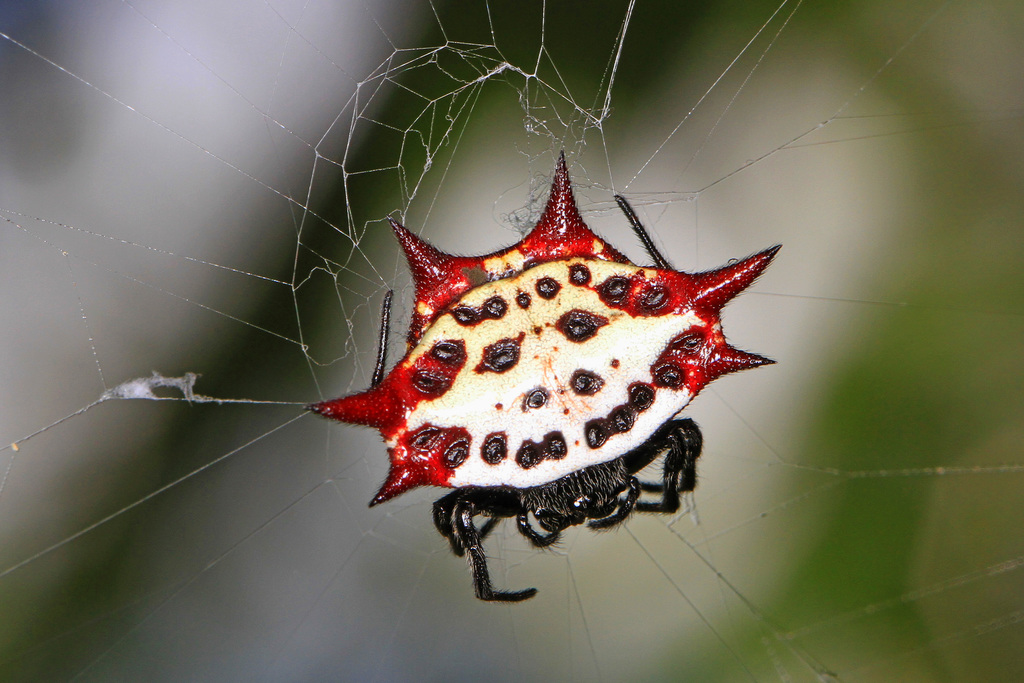
Gasteracantha cancriformis is a distinctive orb-weaver spider notable for its flattened, hard abdomen bearing three pairs of prominent spines. Females are much larger and more conspicuously coloured than males. They build small to medium-sized orb webs in shrubs, garden edges and woodland clearings to catch flying insects. This species is widespread from the southeastern United States through the Caribbean and Central and South America.
🔍How to identify a spinybacked orbweaver
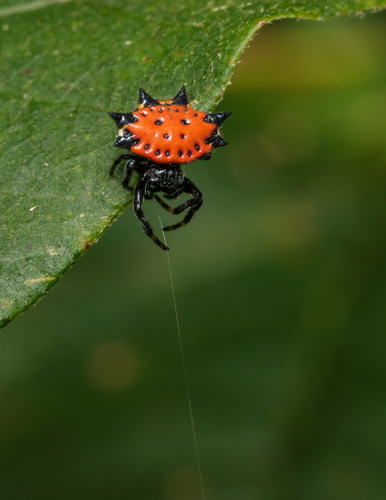
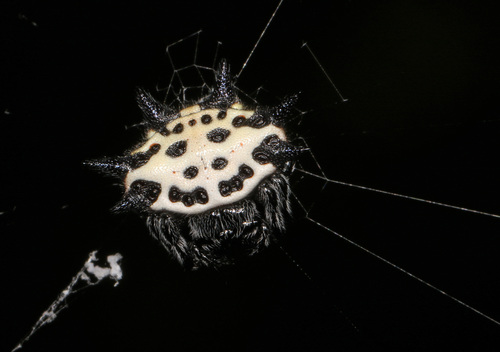
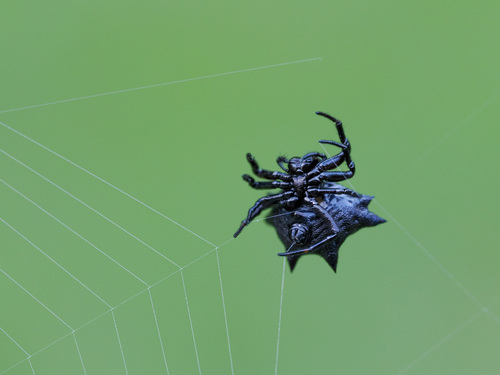
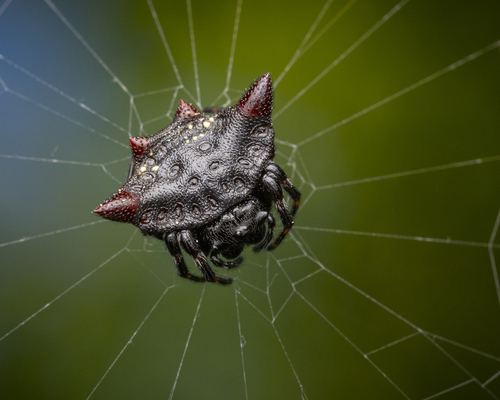
Females have a broad, hard, often brightly coloured abdomen that is wider than long and bears six stout spines (three pairs) projecting from the sides and rear. Colour morphs include white, yellow, orange and red abdomens often with contrasting black spots or margins. The cephalothorax and legs are comparatively small and darker, and males are much smaller, slimmer and less colourful, lacking the pronounced abdomen of females.
- Wide, flattened abdomen with three pairs of stout spines (six spines total)
- Brightly coloured dorsal abdomen (white, yellow, orange or red) often with black spots or margins
- Small body with orb web spun in low shrubs or garden edges; females much larger and more conspicuous than males
Lookalikes
Arrow-shaped micrathena Micrathena sagittata
Arrow-shaped micrathena has a yellow-and-red, arrowhead-shaped abdomen that is longer than wide, with spines pointing backward rather than out to the sides.
Spined micrathena Micrathena gracilis
Micrathena has a more elongated, helmet-like abdomen and longer slender spines; colour patterns and spine placement differ from Gasteracantha.
↻Life cycle
Egg sac
Females lay eggs in a silken sac attached to vegetation; sacs contain dozens to a few hundred eggs and are usually attached to the underside of leaves near the web; the female dies soon after egg-laying.
Spiderling (juvenile)
Young spiders hatch and disperse by ballooning (silk thread carried by wind) or by walking; they moult several times as they grow.
Adult
Adults build orb webs to capture prey and mate; females develop the full spiny, hardened abdomen while males remain smaller and more cryptic.
🍃Diet and predators
Young eat
Small flying insects and other tiny arthropods captured in webs
Adults eat
Flying insects such as flies, mosquitoes, small moths and other small arthropods caught in orb webs
Predators of the young
Predatory insects (wasps), birds and other spiders
Predators of adults
Birds, wasps, small mammals and larger predatory spiders
🌱Effect on plants and gardens
Does not eat plants; helps control flying insect populations and is generally beneficial in gardens.
📍Where and when to find it
Look for small orb webs in shrubs, hedges and garden edges. Females are often seen sitting in the centre or at the web margin; egg sacs may be attached to nearby foliage.
Best time
Warm months and daylight hours; in warm climates they can be found year-round.
Observation tips
Approach slowly and photograph from the side to capture the spiny abdomen. Use a macro lens or phone close-up and include surrounding foliage for scale.
✨Fun facts
- Gasteracantha cancriformis is highly variable in colour — white, yellow, orange and red morphs can occur even in the same local population.
- Females have the dramatic spiny abdomen; males are much smaller and often go unnoticed.
- Young spiderlings may disperse by 'ballooning', releasing silk threads to be carried by the wind to new locations.
?Frequently asked questions
Are spinybacked orbweavers dangerous?
No. They have mild venom for subduing prey but are not dangerous to people; bites are rare and usually cause only minor local effects.
Do spinybacked orbweavers bite?
Bites are uncommon. If bitten, expect minor pain, redness or swelling in most cases; seek medical care only if symptoms worsen or if allergic reaction occurs.
Why is there one in my house?
They build small orb webs near vegetation and lights that attract insects. An individual may wander inside or be near windows, porches or indoor plants where insects are available.
How do I get rid of them?
They are beneficial predators. To remove one, gently relocate it outdoors on a stick or cup. Reduce outdoor lighting at night and trim vegetation near buildings to make the area less attractive if removal is desired.
Where does this spider live?
In warm regions from the southeastern United States through the Caribbean, Central America and South America, typically in garden edges, shrubs and open woodlands.
📷Photos of the spinybacked orbweaver
More spiders
This guide was written with AI assistance and fact-checked, last updated 2026-10-10. Identification from photos is never certain: don't handle insects you can't identify, and get medical advice for bites, stings or allergic reactions. More about the spinybacked orbweaver: iNaturalist, Wikipedia.