
Wasp spider vs Banded garden spider
These two are easy to mix up. Here's how to tell a wasp spider from a banded garden spider, and whether either one bites or stings.
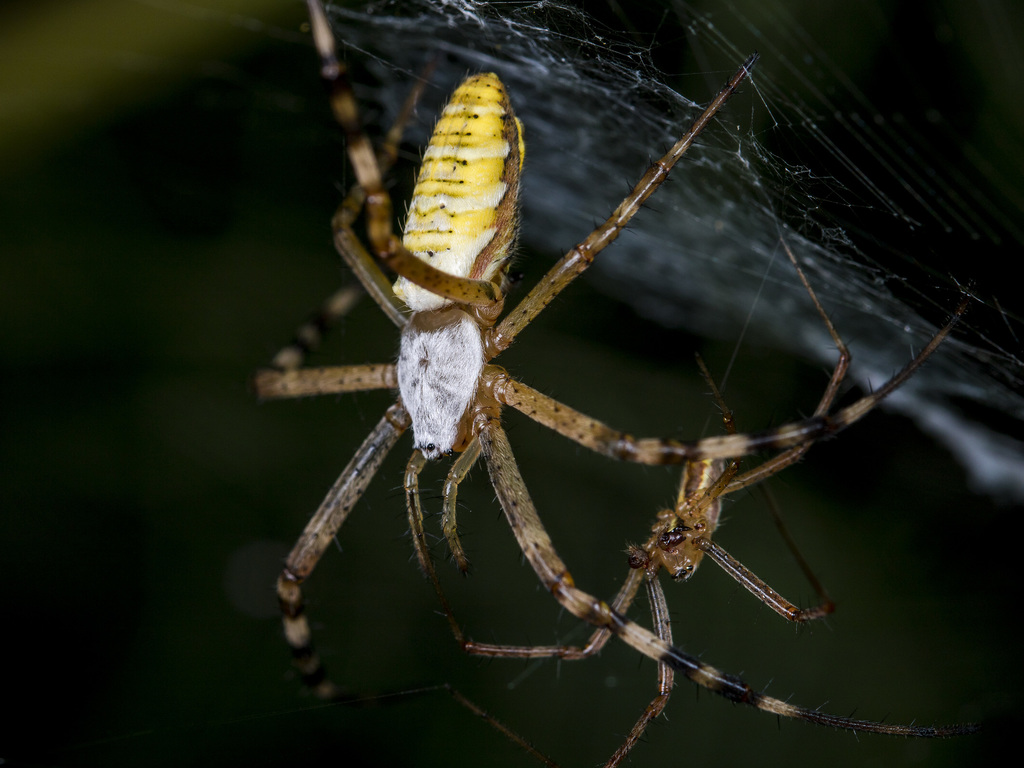
Wasp spider
Argiope bruennichi
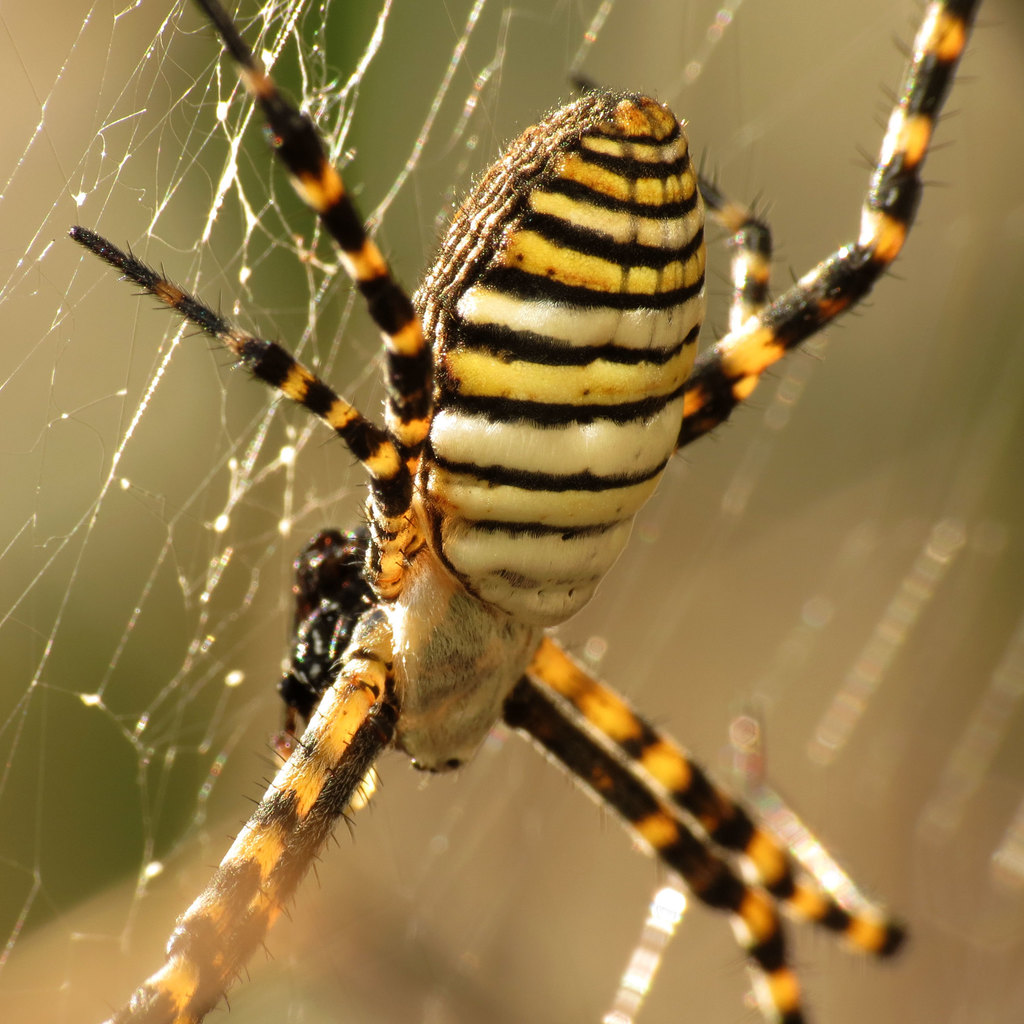
Banded garden spider
Argiope trifasciata
≠The key differences
Abdomen has many thin silver, yellow and black bands and is more pointed at the rear; found mainly in the Americas and other warm regions.
A. bruennichi (mainly Europe and Asia) has fewer, bolder black and yellow transverse stripes like a wasp; A. trifasciata has many thin silver, yellow and black bands.
⚖︎Side by side
| Wasp spider | Banded garden spider | |
|---|---|---|
| To humans | Mild bite | Mild bite |
| Size | Females about 11-17 mm body length; males about 4-6 mm body length | Females about 15-25 mm body length; males about 4-6 mm |
| Colours | Yellow, Black, Silvery white, Dark brown | Yellow, Black, Silver, White |
| Family | Araneidae | Araneidae |
| Habitat | Low vegetation, grassland margins, meadows, gardens, hedgerows and wasteland where they can anchor vertical orb webs. | Open sunny areas—gardens, field edges, roadsides, hedgerows and shrubby groundcover where they can anchor large orb webs. |
| Range | Native to Europe, North Africa and much of temperate Asia; its range has expanded northward in recent decades and it is now common in many parts of Europe. | Nearly worldwide: throughout North America (including southern Canada), Central and South America, and parts of Europe, Africa, Asia and Pacific islands. |
| Active | Mainly summer to early autumn; most visible and largest from July to September. Females sit in the web during the day. | Late spring to autumn, most conspicuous in summer and early fall; active during daylight hours (diurnal). |
| Pest? | No | No |
🔍How to spot a wasp spider
- Bold transverse yellow and black (wasp-like) bands on the abdomen of females.
- Large vertical orb web often with a conspicuous white zig-zag stabilimentum in the centre.
- Marked sexual size dimorphism: females much larger (roughly 11-17 mm) and more brightly coloured than males (about 4-6 mm).
🔍How to spot a banded garden spider
- Many thin transverse bands of silver, yellow and black across an oval abdomen that tapers to a point.
- Large vertical orb web, sometimes with a small white zigzag stabilimentum near the center.
- Silvery or hairy cephalothorax and legs, with females noticeably larger and more rounded than males.
?Frequently asked questions
What is the difference between a wasp spider and a banded garden spider?
Abdomen has many thin silver, yellow and black bands and is more pointed at the rear; found mainly in the Americas and other warm regions. A. bruennichi (mainly Europe and Asia) has fewer, bolder black and yellow transverse stripes like a wasp; A. trifasciata has many thin silver, yellow and black bands.
Is a wasp spider or a banded garden spider more dangerous?
Wasp spider: Mild bite. Banded garden spider: Mild bite. Wasp spiders are venomous to their insect prey but not dangerous to people. Bites are rare and usually occur only if the spider is trapped against skin or handled roughly.
Identification from photos is never certain: don't handle insects you can't identify, and get medical advice for bites, stings or allergic reactions.