
Dark fishing spider vs Six-spotted fishing spider
These two are easy to mix up. Here's how to tell a dark fishing spider from a six-spotted fishing spider, and whether either one bites or stings.

Dark fishing spider
Dolomedes tenebrosus
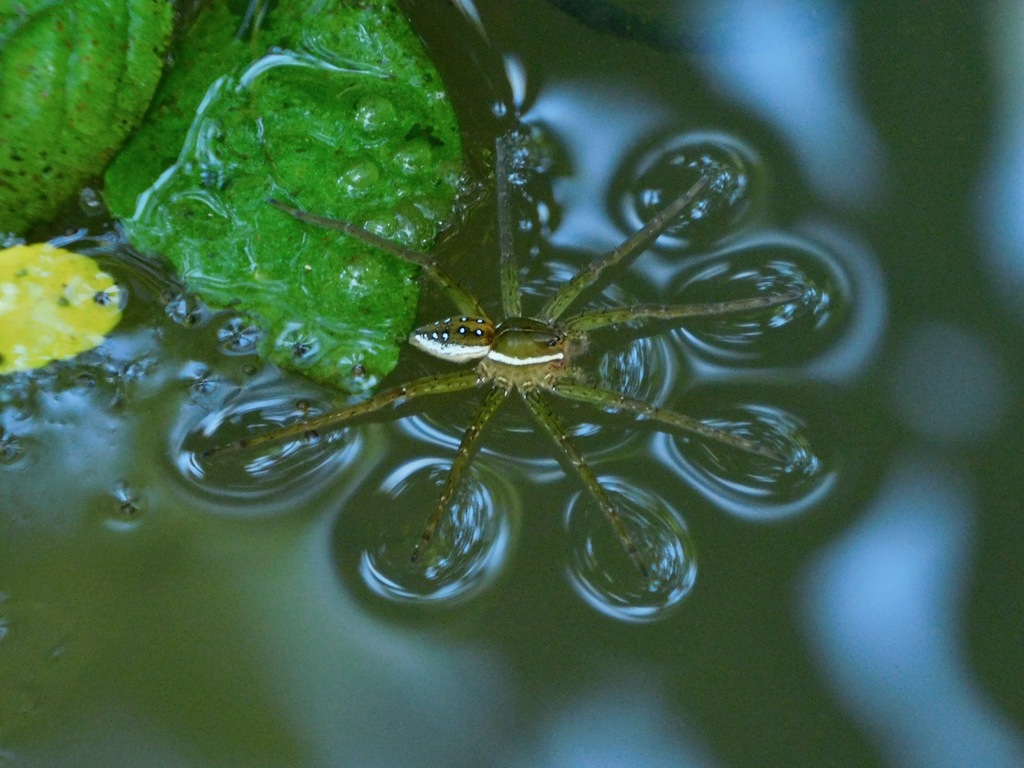
Six-spotted fishing spider
Dolomedes triton
≠The key differences
D. triton lives on the water surface of ponds and has a pale stripe along each side of the body and rows of white spots on the abdomen; D. tenebrosus is darker, more mottled and often found away from water.
D. tenebrosus is generally darker, more terrestrial and often found under bark or in houses rather than directly at water edges; D. triton has more aquatic habits and different abdominal patterning.
⚖︎Side by side
| Dark fishing spider | Six-spotted fishing spider | |
|---|---|---|
| To humans | Mild bite | Mild bite |
| Size | Body length: females about 15-26 mm, males 7-13 mm; legspan up to about 90 mm | Body length about 12-22 mm (males smaller, females larger); legspan commonly 40-70 mm |
| Colours | Dark brown, Medium brown, Tan, Cream | Brown, Tan, Cream, Black |
| Family | Pisauridae | Pisauridae |
| Habitat | Woodland edges, stone walls, rock piles, stream margins, and human structures such as basements, garages and porches. | Freshwater margins: ponds, lakes, marshes, slow streams, and wetland vegetation |
| Range | Eastern and central North America (United States and southern/central Canada). | Widespread in eastern and central North America; also reported in parts of Canada and the northern United States |
| Active | Late spring through autumn; mainly nocturnal. | Spring through autumn; often most active at dusk and night but also hunts during the day |
| Pest? | No | No |
🔍How to spot a dark fishing spider
- Large, long-legged spider with a flattened body and legspan up to about 90 mm.
- Distinct pale dorsal banding or chevrons on a dark brown abdomen and lighter markings on the carapace.
- Habitat at woodland edges, rock walls, or near human structures; often found hiding in cracks during the day.
- Eye pattern and hunting posture typical of Pisauridae: legs extended forward and sideways when at rest.
🔍How to spot a six-spotted fishing spider
- Large, long-legged spider typically found at pond or stream margins, often on emergent vegetation or rocks
- Pale stripe along each side of the body and six dark spots on the underside of the cephalothorax
- Holds legs outstretched parallel to the water surface when hunting; can run on water and detect ripples
- Females carry egg sacs in their jaws (chelicerae) and later guard a silk nursery web
?Frequently asked questions
What is the difference between a dark fishing spider and a six-spotted fishing spider?
D. triton lives on the water surface of ponds and has a pale stripe along each side of the body and rows of white spots on the abdomen; D. tenebrosus is darker, more mottled and often found away from water. D. tenebrosus is generally darker, more terrestrial and often found under bark or in houses rather than directly at water edges; D. triton has more aquatic habits and different abdominal patterning.
Is a dark fishing spider or a six-spotted fishing spider more dangerous?
Dark fishing spider: Mild bite. Six-spotted fishing spider: Mild bite. Bites are uncommon. Not considered dangerous.
Identification from photos is never certain: don't handle insects you can't identify, and get medical advice for bites, stings or allergic reactions.