
Hickory tussock moth vs White-marked tussock moth
These two are easy to mix up. Here's how to tell a hickory tussock moth from a white-marked tussock moth, and whether either one bites or stings.
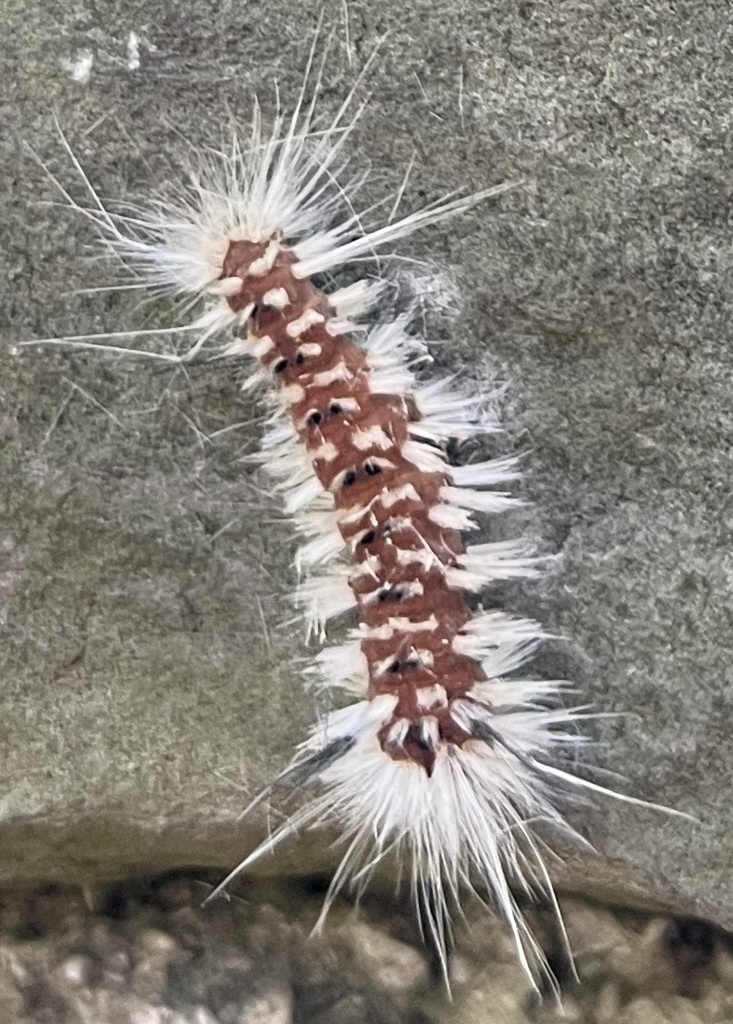
Hickory tussock moth
Lophocampa caryae
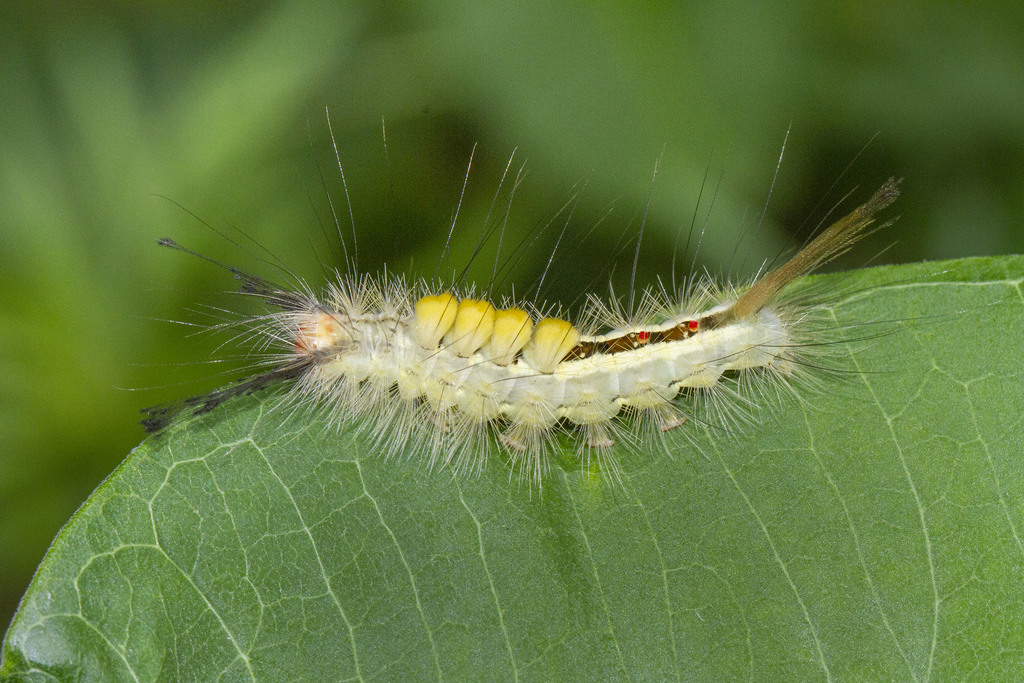
White-marked tussock moth
Orgyia leucostigma
≠The key differences
Orgyia caterpillars have a red head, four white to yellow toothbrush-like dorsal tussocks and red spots on the back; adult females are wingless and males are gray-brown.
⚖︎Side by side
| Hickory tussock moth | White-marked tussock moth | |
|---|---|---|
| To humans | Irritating hairs | Irritating hairs |
| Size | Wingspan 37-55 mm | Male wingspan 20-35 mm; female body length about 10-18 mm (flightless, wing-reduced) |
| Colours | White, Black, Buff, Yellow-orange | Brown, White, Yellow, Orange, Black |
| Family | Erebidae | Erebidae |
| Habitat | Deciduous woodlands, forest edges, urban and suburban areas with host trees such as hickory and walnut | Deciduous and mixed forests, orchards, shade trees and urban landscapes where host trees and shrubs occur |
| Range | Native to eastern and central North America, from southern Canada through much of the United States where host trees occur | Native to North America: widespread across eastern and central Canada and the United States, west to the Great Plains, with scattered records farther west. |
| Active | Adults fly in late spring to early summer; caterpillars are seen mostly from midsummer to autumn. Adults are nocturnal; larvae are active by day and night | Larvae active in late spring and summer (region-dependent). Adults typically appear for a short period in summer; one generation per year in most of its range, sometimes two in warmer regions. |
| Pest? | Yes | Yes |
🔍How to spot a hickory tussock moth
- Look for a white, fuzzy caterpillar with a black head, a line of black tufts down the back and long black hair pencils near the front and rear.
- Adults are tan to golden-brown moths with rows of pale cream spots on the forewings and pale hindwings.
- Caterpillars often occur on hickory, walnut or other hardwood leaves and may be found singly or in small groups on branches.
🔍How to spot a white-marked tussock moth
- Look for hairy caterpillars with a red head, four white toothbrush-like tufts in a row on the back, and long black hair pencils at the front and rear.
- Adult males: small moth with mottled brown-gray wings and a small white spot near the rear corner of each forewing.
- Adult females: wingless, stout and grayish-white, usually found sitting on their cocoon or egg mass.
- Check for white, frothy egg masses on old cocoons on tree bark, fences or under eaves in fall and winter.
?Frequently asked questions
What is the difference between a hickory tussock moth and a white-marked tussock moth?
Orgyia caterpillars have a red head, four white to yellow toothbrush-like dorsal tussocks and red spots on the back; adult females are wingless and males are gray-brown.
Is a hickory tussock moth or a white-marked tussock moth more dangerous?
Hickory tussock moth: Irritating hairs. White-marked tussock moth: Irritating hairs. The caterpillar's hairs can cause mechanical irritation: red, itchy bumps or a rash for some people after handling or brushing against them. Caterpillar hairs are urticating and can cause skin irritation, rashes or eye irritation in sensitive people.
Identification from photos is never certain: don't handle insects you can't identify, and get medical advice for bites, stings or allergic reactions.