
Question mark vs Eastern comma
These two are easy to mix up. Here's how to tell a question mark from an eastern comma, and whether either one bites or stings.
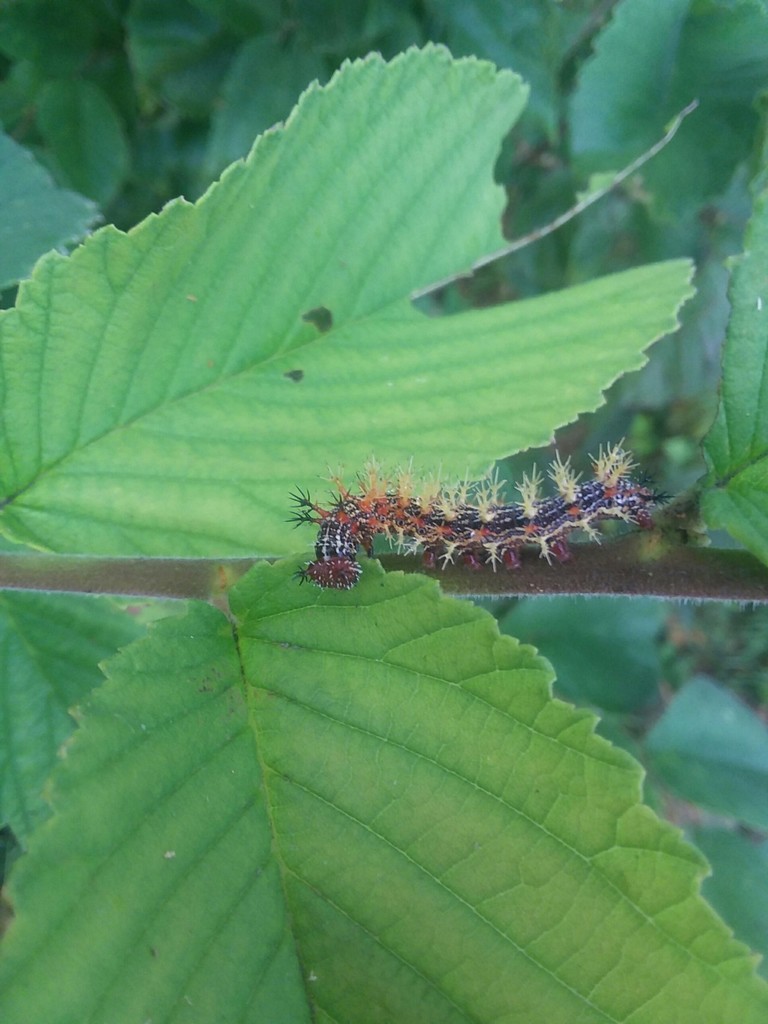
Question mark
Polygonia interrogationis

Eastern comma
Polygonia comma
≠The key differences
Eastern Comma has a single silver 'comma' shaped mark without the separate dot; wing shape and coloration are similar but the silver marking is the clearest field distinction.
Question mark is larger and its silver underside mark is a curved line plus a separate dot (like a question mark); on the upperside it has an extra dark dash on the forewing that the Eastern comma lacks.
⚖︎Side by side
| Question mark | Eastern comma | |
|---|---|---|
| To humans | Non-toxic | Non-toxic |
| Size | About 5.5-7.5 cm wingspan | Wingspan 4.5-6.5 cm |
| Colours | Orange-brown, Dark brown, Black, Grey-brown (underside), Silver (marking) | Orange-brown, Dark brown, Black, Silver, Pale yellow |
| Family | Nymphalidae | Nymphalidae |
| Habitat | Deciduous woodlands, forest edges, riparian areas, parks and suburban gardens | Woodland edges, clearings, hedgerows, riparian corridors, suburban gardens and parks. |
| Range | Found across much of North America: from southern Canada through the continental United States; more common east of the Rockies but present in parts of the west | Widespread across much of Canada and the United States (primarily eastern and central North America), with range limits dependent on local climate and host plants. |
| Active | Spring through fall; adults are diurnal and most active on warm, sunny days | Active spring through autumn; adults may be seen on warm days in late winter from hibernation. Diurnal, most active in mid-morning to early afternoon on sunny days. |
| Pest? | No | No |
🔍How to spot a question mark
- Look for ragged, irregular wing margins typical of anglewings.
- Upperside orange-brown with dark borders and spots; underside brownish, leaf-like.
- Check underside of hindwing for a small silvery mark shaped like a question mark (a curved silver mark plus a small dot).
- Wingspan about 5.5-7.5 cm; flight is quick and erratic.
🔍How to spot an eastern comma
- Ragged, scalloped wing edges typical of anglewing butterflies.
- Upperwing orange-brown with darker markings and small submarginal spots.
- Underside of hindwing shows a small silvery comma-shaped mark.
- When wings closed, mottled brown/gray underside provides excellent leaf-like camouflage.
?Frequently asked questions
What is the difference between a question mark and an eastern comma?
Eastern Comma has a single silver 'comma' shaped mark without the separate dot; wing shape and coloration are similar but the silver marking is the clearest field distinction. Question mark is larger and its silver underside mark is a curved line plus a separate dot (like a question mark); on the upperside it has an extra dark dash on the forewing that the Eastern comma lacks.
Is a question mark or an eastern comma more dangerous?
Question mark: Non-toxic. Eastern comma: Non-toxic. Question mark butterflies do not sting or bite people. Eastern commas do not bite or sting and are not poisonous.
Identification from photos is never certain: don't handle insects you can't identify, and get medical advice for bites, stings or allergic reactions.