
White-marked tussock moth
Orgyia leucostigma · Tussock moths
A North American tussock moth whose hairy caterpillars can defoliate trees and cause skin irritation; adult females are flightless.
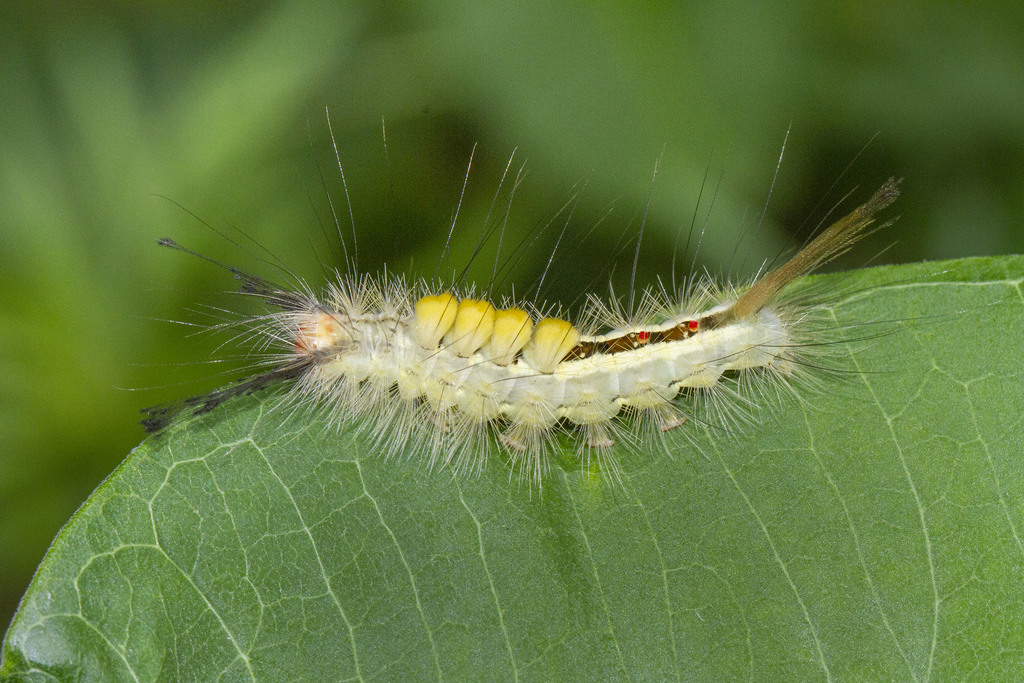
!Is the white-marked tussock moth dangerous?
Only mildly. Caterpillar hairs are urticating and can cause skin irritation, rashes or eye irritation in sensitive people. Wash affected skin with soap and water, avoid rubbing, and remove hairs with tape if needed. Seek medical advice for severe reactions or eye exposure. Adult moths do not bite or sting.
Pets
Pets that handle or bite caterpillars may get hairs on their nose or mouth causing irritation; severe allergic reactions in pets are uncommon but consult a veterinarian if symptoms develop.
📖Overview
Orgyia leucostigma is a small moth in the tussock moth group known for its distinctive, hairy larvae (tussock caterpillars) and sexually dimorphic adults. Males are winged and fly to find females; females are largely wingless, wing-reduced and remain near their pupation site to mate and lay eggs. The species feeds on a wide range of deciduous trees and shrubs and can reach outbreak densities that cause noticeable defoliation in forests, orchards and urban trees. The caterpillars' hairs are irritating to human skin and can cause rashes in sensitive people.
🔍How to identify a white-marked tussock moth
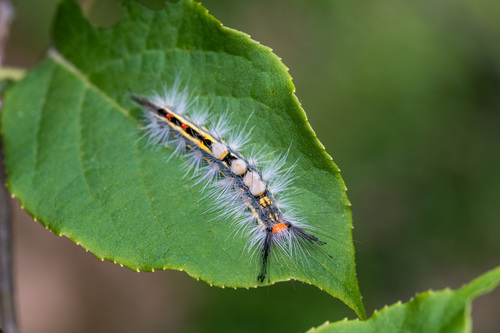
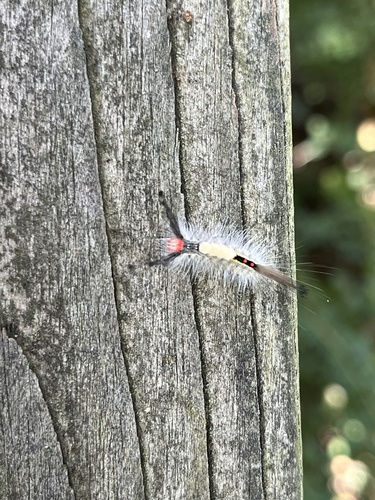
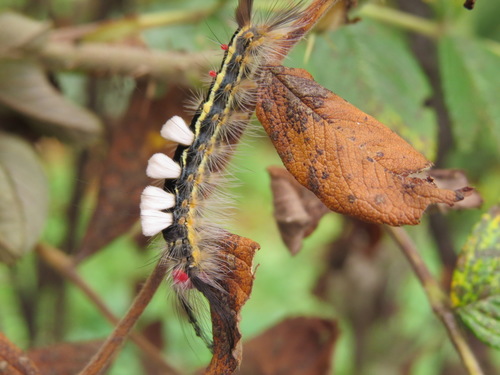
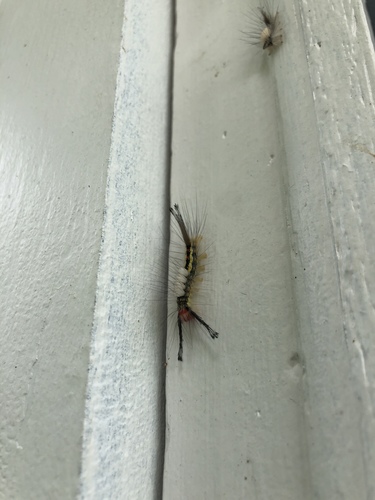
Adult males are slender, with a wingspan around 25-35 mm and mottled gray-brown forewings that show a small white spot near the rear corner of each forewing. Males have feathery (bipectinate) antennae. Adult females are flightless: stout, with only tiny wing stubs, and grayish-white. Larvae (caterpillars) are very distinctive: about 25-35 mm when mature, with a bright red head, four white or cream toothbrush-like tufts in a row along the back, two long black hair pencils projecting forward near the head and one at the rear, yellow stripes along the sides and small red glands on the back. Caterpillar hairs are loosely attached and can cause irritation.
- Look for hairy caterpillars with a red head, four white toothbrush-like tufts in a row on the back, and long black hair pencils at the front and rear.
- Adult males: small moth with mottled brown-gray wings and a small white spot near the rear corner of each forewing.
- Adult females: wingless, stout and grayish-white, usually found sitting on their cocoon or egg mass.
- Check for white, frothy egg masses on old cocoons on tree bark, fences or under eaves in fall and winter.
Lookalikes
Rusty tussock moth Orgyia antiqua
Also found in North America; males have rusty-orange wings with a white spot near the rear corner, and caterpillars have a dark gray to black head instead of red.
Western tussock moth Orgyia vetusta
Larvae and adults similar but O. vetusta occurs mainly in western North America; check range and subtle pattern differences.
Spongy moth Lymantria dispar
Also a defoliator (formerly called gypsy moth), but its caterpillars lack the white toothbrush tufts of Orgyia species and have paired blue and red spots along the back.
↻Life cycle
Egg
Females lay masses of eggs on top of their cocoon and cover them with a white frothy material mixed with their hairs; eggs overwinter in these masses and hatch in spring.
Larva (tussock caterpillar)
Hairy caterpillars feed on leaves through spring and summer, growing through several instars; mature larvae are the main defoliating stage and are most noticeable.
Pupa (cocoon)
Larvae pupate within a loose cocoon woven with their hairs, often attached to bark, foliage or structures; pupae develop into adults in about two weeks.
Adult (moth)
Winged males fly to find the sedentary, wing-reduced females; mating occurs near the emergence site and females lay the overwintering egg masses.
🍃Diet and predators
Young eat
Leaf tissue of a wide range of deciduous trees and shrubs (generalist feeder).
Adults eat
Adults do not feed; their mouthparts are reduced and they live only briefly to mate and lay eggs.
Predators of the young
Birds, predatory insects (wasps, beetles), spiders, and parasitic wasps and flies (parasitoids).
Predators of adults
Males are taken by insectivorous birds and bats; parasitoids and predators can attack pupae and stationary females.
🌱Effect on plants and gardens
Larvae feed on a wide variety of deciduous trees and shrubs including oak, apple, maple, willow, birch and many ornamental species. Heavy infestations can cause partial to complete defoliation; repeated severe defoliation stresses trees and may reduce growth.
How to get rid of white-marked tussock moths
Scrape off egg masses (on old cocoons on bark, fences and buildings) in fall and winter and destroy them; wear gloves. Handpick caterpillars on small trees. For heavy infestations, spray young larvae with Bacillus thuringiensis kurstaki (Btk) following label directions. Natural enemies and disease usually collapse outbreaks within a year or two, so broad-spectrum insecticides are rarely needed.
📍Where and when to find it
Look for larvae on the leaves and twigs of host trees and shrubs, especially oaks, maples and fruit trees. Egg masses are often on bark, under loose bark, on fence posts, or under eaves. Adults are short-lived; males are attracted to light.
Best time
Best months: late spring through summer for caterpillars; short adult flight period in summer. Time of day: larvae feed during day and night but are easier to spot in daylight.
Observation tips
Wear gloves when handling caterpillars or egg masses. Photograph larvae on leaves for identification; search tree trunks and branches for egg masses in fall and winter.
✨Fun facts
- Female white-marked tussock moths are essentially flightless and mate while remaining near their pupation site.
- The caterpillar's loose hairs are a defense: they detach easily and can deter predators or cause irritation.
- Egg masses overwinter covered in a white frothy coating mixed with female hairs, which helps protect the eggs.
?Frequently asked questions
Do white-marked tussock moths bite?
No. Adults do not bite. Caterpillars do not bite either, but their hairs can irritate the skin.
Will the caterpillars sting me?
They do not sting with a needle-like organ, but their urticating hairs can cause itching, rash or mild dermatitis on contact.
Why are these caterpillars on my trees?
They are feeding on the leaves. Orgyia leucostigma is a generalist that uses many common shade trees and shrubs as hosts.
How can I get rid of them in my yard?
For small infestations handpick and destroy caterpillars and egg masses (wear gloves). Apply Bacillus thuringiensis kurstaki to young larvae, or use approved insecticides if necessary. Remove egg masses in fall or winter. Encourage natural predators and parasitoids.
Are they dangerous to my pets or children?
Only mildly. They are not venomous, but caterpillar hairs can irritate skin and mucous membranes. Keep children and pets from handling caterpillars; wash skin promptly if contact occurs.
When will I see these moths or caterpillars?
Larvae are most visible in late spring and summer, with adult moths appearing for a short period in summer; timing varies with latitude and local climate.
📷Photos of the white-marked tussock moth
More butterflies & moths
This guide was written with AI assistance and fact-checked, last updated 2026-10-10. Identification from photos is never certain: don't handle insects you can't identify, and get medical advice for bites, stings or allergic reactions. More about the white-marked tussock moth: iNaturalist, Wikipedia.