
Clouded yellow
Colias crocea · Whites and sulfurs
A medium-sized migratory yellow butterfly whose caterpillars feed mainly on legumes and adults sip nectar from flowers.
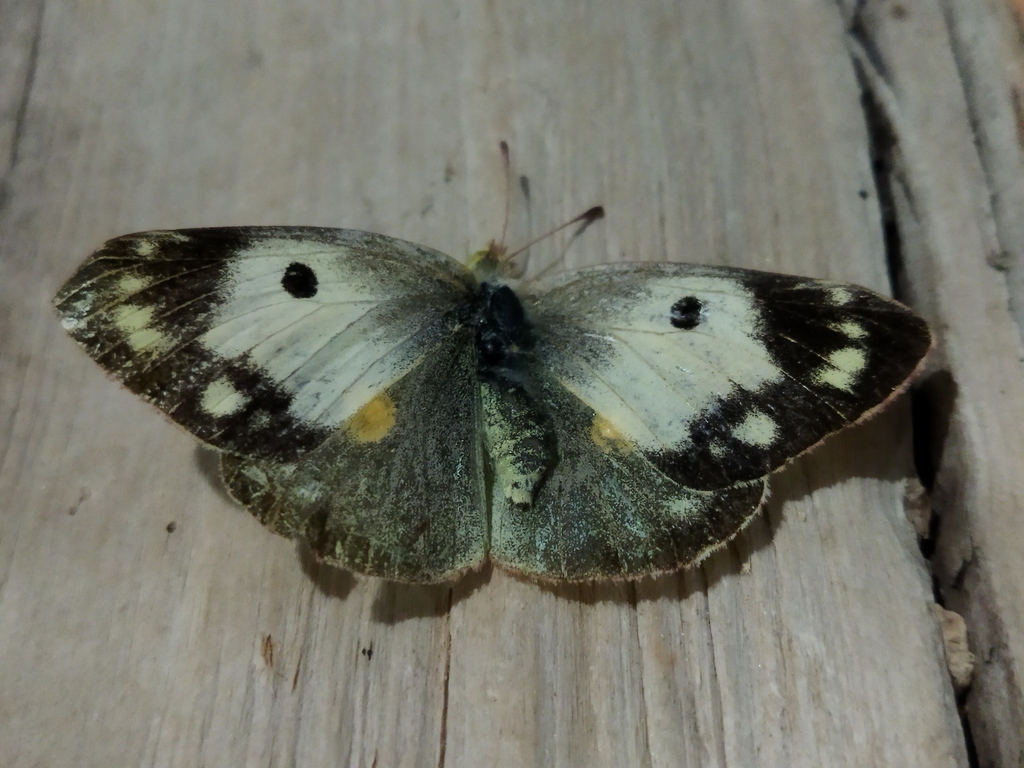
!Is the clouded yellow dangerous?
No. Clouded yellows are harmless to people. They do not bite or sting. Handle butterflies gently if necessary; oils and pressure from fingers can damage their wings.
Pets
Not toxic to pets. Caterpillars feed on legumes but are not known to be poisonous; however, pets eating large amounts of any insect can sometimes cause mild stomach upset.
📖Overview
Colias crocea, the clouded yellow, is a widespread Palearctic butterfly known for strong, sometimes long-distance migrations and multiple broods per year. Adults are active in warm months and are commonly seen flying low over fields, meadows and roadside verges. The species' caterpillars eat plants in the pea family (Fabaceae), so they are often found where clovers, vetches and alfalfa grow. Populations are generally stable and the species is not dangerous to people.
🔍How to identify a clouded yellow
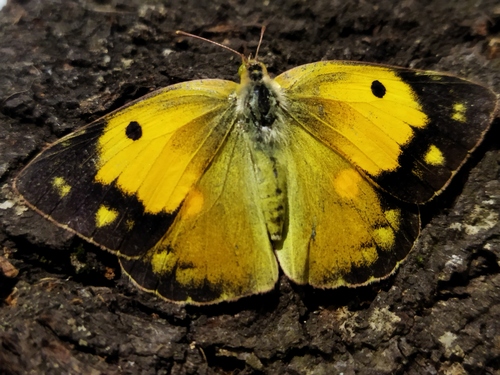
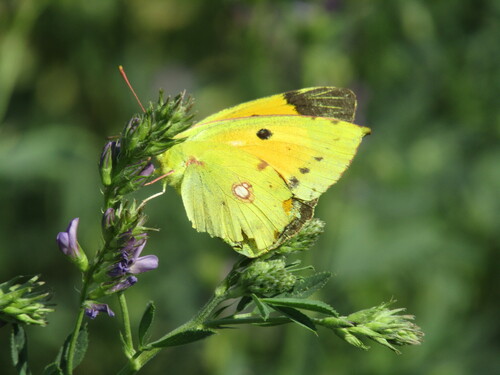
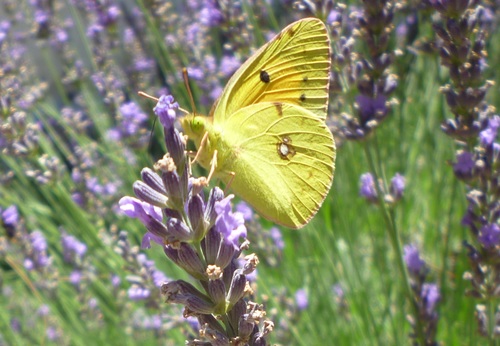
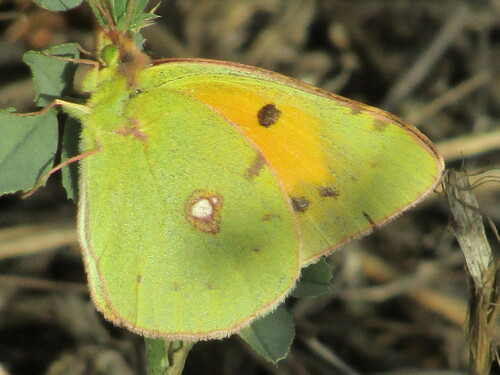
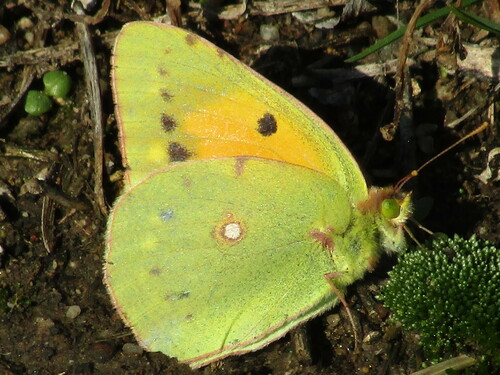
Adults have deep orange-yellow upper wings with a broad dark (black-brown) border and a black discal spot on each forewing; they almost always settle with wings closed. Females have yellow spots within the dark border, and some females (form helice) are pale whitish-cream instead of orange. The underside of the hindwing is greenish-yellow with a silvery-white central spot ringed in pink-red (often doubled like a figure of eight). Wingspan is medium for a butterfly and flight is rapid and direct.
- Bright yellow to orange upperwings with a broad dark brown or black border and a round black discal spot on the forewing.
- Underside of hindwing is greenish-yellow with a silvery-white central spot ringed in pink-red.
- Females have yellow spots within the dark wing border; a pale whitish female form (helice) also occurs.
- Strong rapid flight low over flowers and legumes; size medium with wingspan about 46-54 mm.
Lookalikes
Pale clouded yellow Colias hyale
Colias hyale males are pale lemon-yellow rather than deep orange-yellow, with a narrower dark border; females are whitish and easily confused with the pale helice form of the clouded yellow.
Common brimstone Gonepteryx rhamni
Brimstone has more leaf-shaped wings and lacks the dark border and round discal spot; its wing shape and pale underside distinguish it.
Clouded yellow complex (other Colias species) Various Colias spp.
Many Colias species are similar; local field guides and underside pattern, timing and distribution are the best ways to separate them.
↻Life cycle
Egg
Small round eggs are laid singly or in small groups on the leaves or stems of host legumes.
Larva (caterpillar)
Green caterpillars with light striping feed on the leaves of clovers, vetches and alfalfa. They grow through several instars over 2-4 weeks depending on temperature.
Pupa (chrysalis)
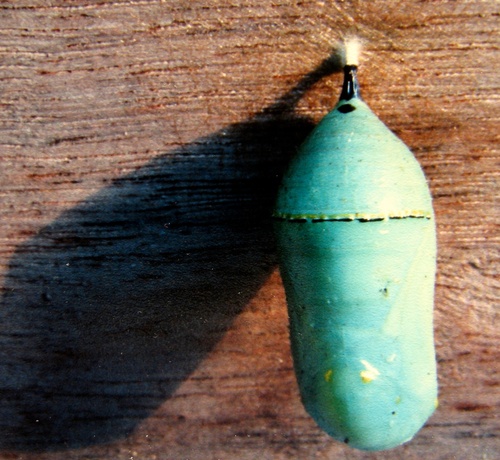
The chrysalis is attached to vegetation and lasts about 1-3 weeks before the adult emerges; duration varies with season.
Adult (butterfly)
Adults emerge, mate and females lay eggs. There are multiple broods in a warm year; individuals may migrate.
🍃Diet and predators
Young eat
Leaves of legume plants (Fabaceae) such as clover, vetch, alfalfa, sainfoin and related species.
Adults eat
Nectar from a variety of flowers: thistles, knapweeds, marigolds, scabious and other nectar-rich wildflowers.
Predators of the young
Parasitoid wasps and flies, predatory bugs, birds and small mammals.
Predators of adults
Insectivorous birds, dragonflies and spiders; battered and worn adults are more vulnerable.
🌱Effect on plants and gardens
Caterpillars feed mainly on Fabaceae (clovers, vetches, sainfoin, alfalfa and related legumes). In large numbers they can defoliate small patches of host plants but they are rarely a serious agricultural pest.
📍Where and when to find it
Adults: nectaring on wildflowers in meadows, field margins, roadside verges and coastal grassland. Larvae: on leaves of clovers, vetches and other legumes.
Best time
Best months April to October in most of their range; mid-morning to mid-afternoon on sunny days.
Observation tips
Look for fast-flying yellow butterflies low over flower-rich areas; a field guide or photos of the underside can help confirm identification when individuals settle.
✨Fun facts
- Clouded yellows are famous for seasonal migrations; large influxes into northern Europe are commonly noticed in warm years.
- Males and females often differ in intensity of yellow vs orange coloring; female forms can be quite variable.
- The caterpillars' host plants are members of the pea family, making many farmland edges and meadows ideal habitat.
?Frequently asked questions
Are clouded yellows dangerous?
No. They are harmless to people and do not sting or bite.
Do clouded yellows eat my garden plants?
Caterpillars feed on legumes like clover and vetch. They rarely cause serious damage to gardens, but can chew leaves on small patches of host plants.
Why is a clouded yellow in my house?
Adults sometimes enter houses during warm, sunny weather while searching for nectar or when attracted to light; they are accidental visitors and can be gently released outdoors.
How can I attract clouded yellows to my garden?
Plant nectar-rich flowers (thistles, knapweeds, scabious) and include legumes like clover or vetch as caterpillar food; provide sunny sheltered spots.
How do I get rid of clouded yellow caterpillars?
Mechanical removal (hand-picking) is effective for small numbers. Because they are not usually major pests, chemical control is rarely necessary. Encourage natural predators and parasitoids for control.
When is the best time to see clouded yellows?
During warm months from spring to autumn, typically April to October depending on location; they are active in daylight, especially on sunny days.
📷Photos of the clouded yellow
More butterflies & moths
This guide was written with AI assistance and fact-checked, last updated 2026-10-10. Identification from photos is never certain: don't handle insects you can't identify, and get medical advice for bites, stings or allergic reactions. More about the clouded yellow: iNaturalist, Wikipedia.