
Western tiger swallowtail
Papilio rutulus · Swallowtail butterflies
A large yellow-and-black swallowtail common in western North America; caterpillars feed on willows, poplars and cottonwoods and adults visit many flowers.
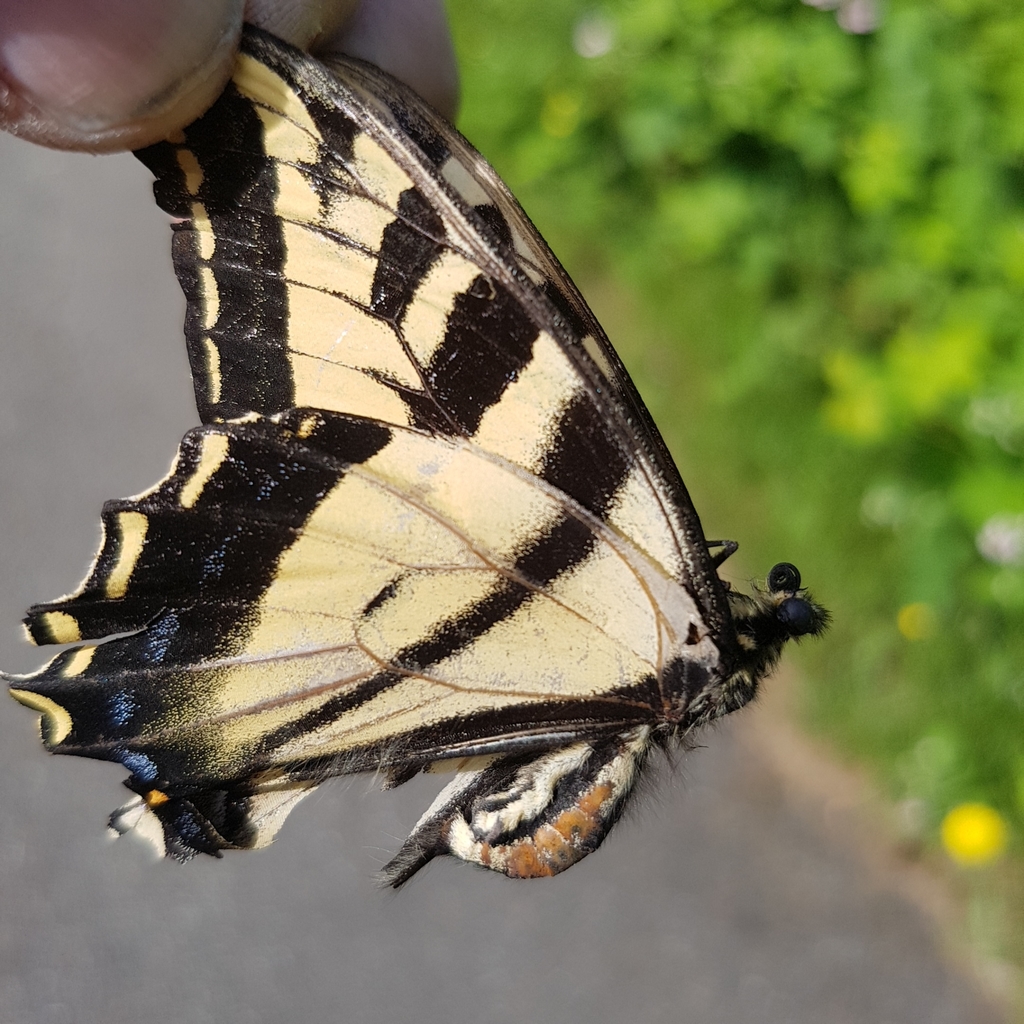
!Is the western tiger swallowtail dangerous?
No. Adults and caterpillars are not poisonous or dangerous to people. Caterpillars may regurgitate a small amount of plant juices if handled; wash hands if that happens. Do not handle butterflies roughly to avoid damage to their wings.
Pets
Not toxic to pets. Curiosity from pets may injure the insect; supervise pets around caterpillars or chrysalises.
📖Overview
Papilio rutulus is a widespread swallowtail butterfly of western North America. It is common along rivers, in parks, gardens, riparian woodlands and suburban areas where host trees such as willows and cottonwoods grow. Adults are strong fliers that feed on nectar from a wide variety of flowering plants. Caterpillars are conspicuous on host trees and go through a bird-dropping mimic stage before developing green forms with eye spots. The species has one brood per year in much of its range, with a second or partial third brood in warmer areas such as lowland California.
🔍How to identify a western tiger swallowtail
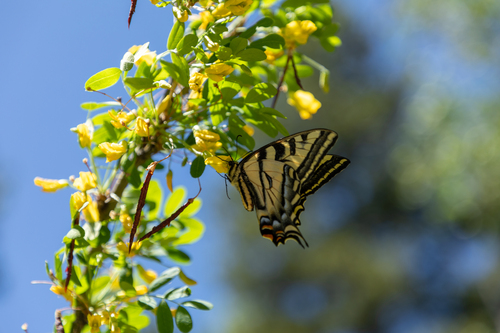
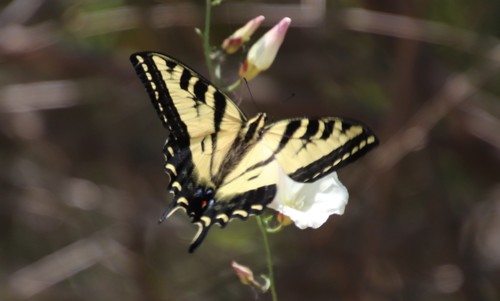
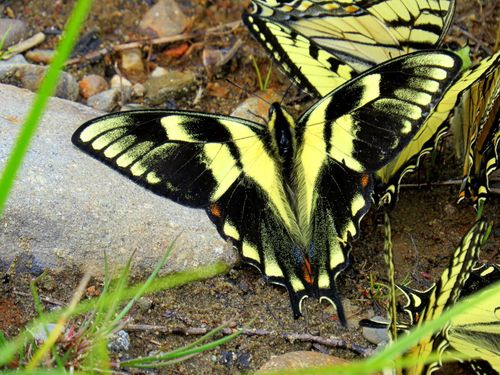
Adult western tiger swallowtails are large (wingspan about 70-100 mm) and yellow with bold black tiger-like striping and a scalloped black edge on both fore- and hindwings. Hindwings have a row of blue scaling near the margin and often an orange eyespot near the tail. Males and females are similar though females may show more blue on the hindwing. The caterpillar early instars mimic bird droppings (brownish/white mottled); later instars are bright green with large false eye spots and a dorsal stripe. The chrysalis is smooth, brown or green, and hangs upright attached at the cremaster.
- Large yellow butterfly with bold black 'tiger' stripes on forewings and hindwings
- Blue scaling band on the hindwing and one or more orange eyespots near the tail
- Distinctive swallowtail 'tails' on the hindwings
- Caterpillars: early instars resemble bird droppings; later instars green with prominent eye spots
Lookalikes
Eastern tiger swallowtail Papilio glaucus
Eastern species with similar pattern; range does not overlap broadly in the west. Papilio glaucus females often show more extensive dark (melanic) form in some areas.
Canadian tiger swallowtail Papilio canadensis
Smaller and paler; found farther north and in colder climates. Check size, flight time and location to separate.
Two-tailed swallowtail Papilio multicaudata
Also western but usually has two tails on each hindwing and different pattern details; P. multicaudata is more common in drier inland habitats.
↻Life cycle
Egg
Females lay single eggs on the upper surfaces of host plant leaves. Eggs hatch in about 4-10 days depending on temperature.
Larva (caterpillar)
Caterpillars pass through several instars. Early instars resemble bird droppings; later instars turn green with large false eyes and feed actively on host leaves for several weeks.
Pupa (chrysalis)
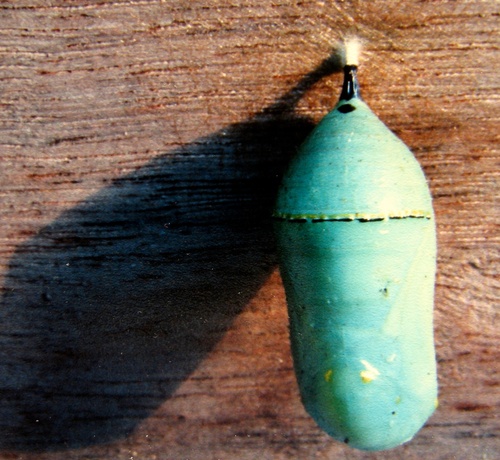
The chrysalis is attached upright and can be green or brown, matching surroundings; pupal stage lasts about 10-20 days or longer if overwintering as a chrysalis.
Adult
Adults emerge, mate, and females lay eggs on suitable host trees. Adults feed on nectar, sap flows and sometimes on moist ground for minerals.
🍃Diet and predators
Young eat
Leaves of willows (Salix), poplars and cottonwoods (Populus), occasionally other native trees and shrubs
Adults eat
Nectar from a wide variety of flowers (thistles, milkweed, redbud, phlox, ceanothus), tree sap and overripe fruit
Predators of the young
Birds, predatory wasps, spiders and parasitic flies and wasps
Predators of adults
Birds, dragonflies, mantids and occasionally spiders
🌱Effect on plants and gardens
Larvae feed mainly on willows (Salix), poplars and cottonwoods (Populus), sometimes on cherries and other native trees. Feeding rarely causes serious harm to large trees but can defoliate small saplings in heavy local outbreaks.
📍Where and when to find it
Look for adults at nectar flowers, along streams and river corridors, and near host trees (willow, poplar) where larvae feed. Check upper leaf surfaces for eggs and undersides for young caterpillars.
Best time
Best months spring through early fall; warm, sunny daytime hours are when adults are most active.
Observation tips
Photograph resting butterflies from a slight distance to avoid startling them; to observe caterpillars check host tree branches and new foliage. Use a zoom lens or macro carefully to capture detail without touching the insect.
✨Fun facts
- Caterpillars mimic bird droppings when young to avoid predators, then switch to bright green eye-spotted forms.
- Western tiger swallowtails are frequent visitors to gardens and are attracted to bright, flat-topped flowers.
- Chrysalises can overwinter, allowing a generation to emerge the following spring.
?Frequently asked questions
Are Western tiger swallowtails poisonous?
No. They are not poisonous or dangerous to people or pets.
Do Western tiger swallowtail caterpillars bite?
They do not bite people. If handled they may regurgitate a small amount of plant material as a defense, which is harmless.
Why is a tiger swallowtail in my garden?
Adults visit gardens for nectar. If you have nectar plants or nearby host trees like willows and poplars, butterflies will come to feed and lay eggs.
How can I get rid of caterpillars on my trees?
Control is rarely necessary. For small numbers handpick caterpillars and relocate them. For larger outbreaks, pruning affected branches or using Bacillus thuringiensis kurstaki (Btk) targeted to caterpillars can be effective; follow label directions and avoid harming non-target species.
Where do they live and when will I see them?
They live across western North America in riparian areas, parks and gardens. Expect to see adults from spring through early autumn, most often on warm sunny days.
📷Photos of the western tiger swallowtail
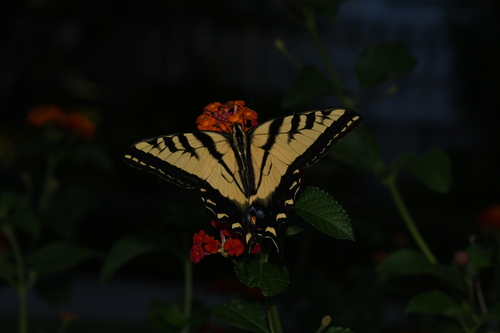
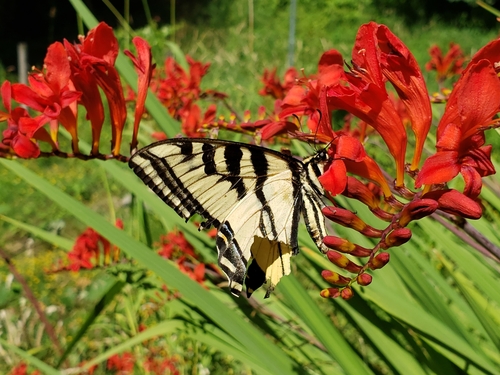
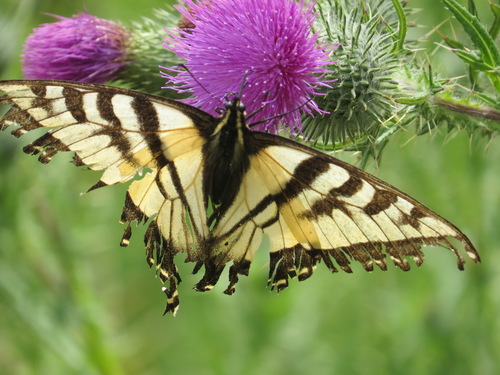
More butterflies & moths
This guide was written with AI assistance and fact-checked, last updated 2026-10-10. Identification from photos is never certain: don't handle insects you can't identify, and get medical advice for bites, stings or allergic reactions. More about the western tiger swallowtail: iNaturalist, Wikipedia.