
Snowberry clearwing
Hemaris diffinis · Clearwing hawk moths
A day-flying sphinx moth that hovers like a hummingbird while feeding on flowers; common across much of North America.
!Is the snowberry clearwing dangerous?
No. Snowberry clearwing moths do not sting or bite in normal situations. They may be startled into contact when hovering at flowers but are harmless. No special first aid is needed if touched; wash hands if desired.
Pets
Not toxic to pets. Curious pets may bat at or eat a moth; occasional ingestion could upset a pet's stomach but these moths are not poisonous.
📖Overview
Hemaris diffinis is a diurnal sphinx moth noted for its swift, hummingbird-like flight and mostly clear wings. Adults visit garden flowers for nectar and are active on warm, sunny days in late spring through summer. The caterpillars feed on a variety of shrubs and small trees (including snowberry, honeysuckle and dogbane). Pupae overwinter in cocoons near the ground.
This species is widespread across much of North America, common in gardens, woodland edges, meadows and suburban areas. It is harmless to people and livestock and is valued as a pollinator of tubular flowers.
🔍How to identify a snowberry clearwing
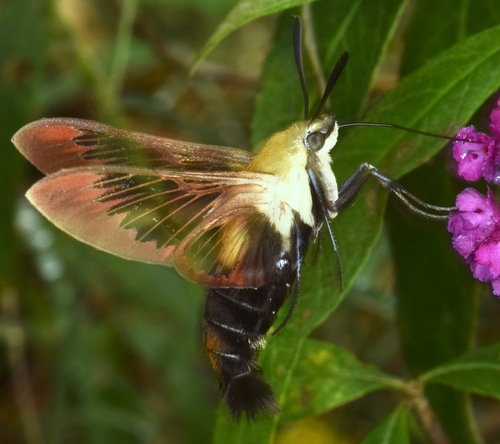
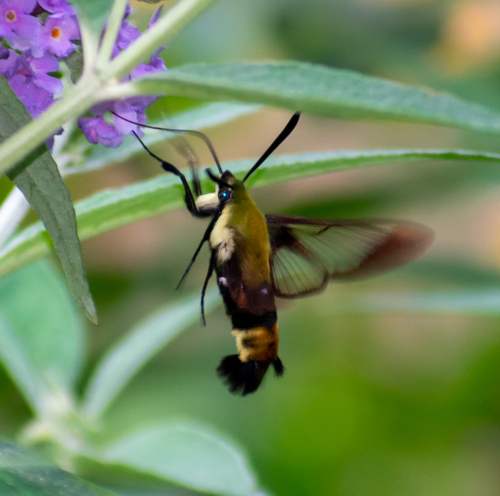
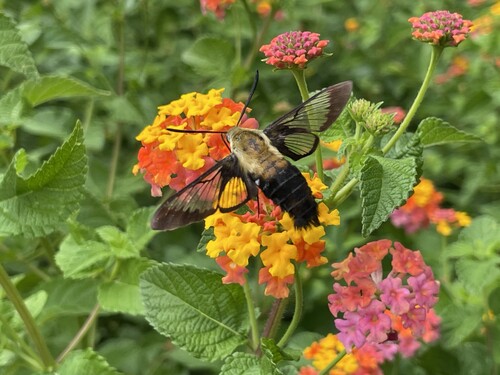
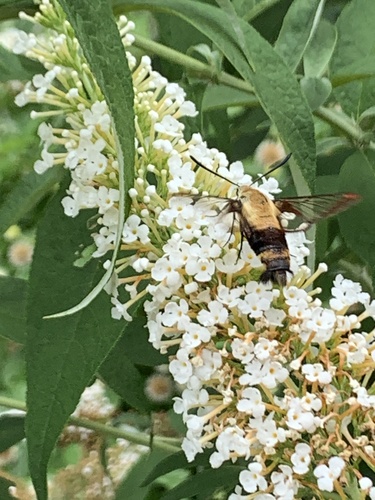
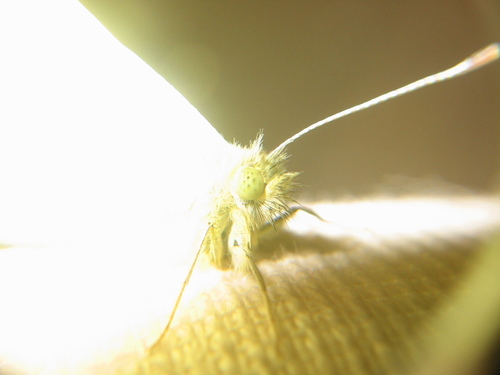
Adults have stout, sometimes fuzzy bodies resembling small bumblebees or hummingbirds when hovering. The forewings and hindwings have large transparent (clear) panels where scales are absent, bordered by hairlike and colored scales. The thorax is golden-yellow to olive-yellow and the abdomen is black with yellow bands, giving a bumblebee-like look; the legs are black and a black band runs from the eye along the side of the thorax. Antennae are thickened and slightly hook-tipped as typical for sphinx moths.
- Clear windows on both forewings and hindwings: large transparent panels lacking scales
- Diurnal, fast hovering flight like a small hummingbird while feeding at flowers
- Fuzzy, stout body with a golden-yellow thorax, black-and-yellow banded abdomen and black legs
- Thickened, hooked antennae tips typical of sphinx moths
Lookalikes
Hummingbird clearwing Hemaris thysbe
H. thysbe is very similar but has an olive-green thorax, a dark red-brown abdomen with yellowish patches, and pale (yellowish) legs; H. diffinis has black legs and a black stripe running from the eye along the side of the thorax.
Slender clearwing Hemaris gracilis
Hemaris gracilis is more slender with reddish stripes along the sides of the thorax and pale legs; it is local in eastern North America, mostly in heathland and pine barrens.
↻Life cycle
Egg
Females lay single pale eggs on the underside of host plant leaves. Eggs hatch in about 1 week depending on temperature.
Larva (caterpillar)
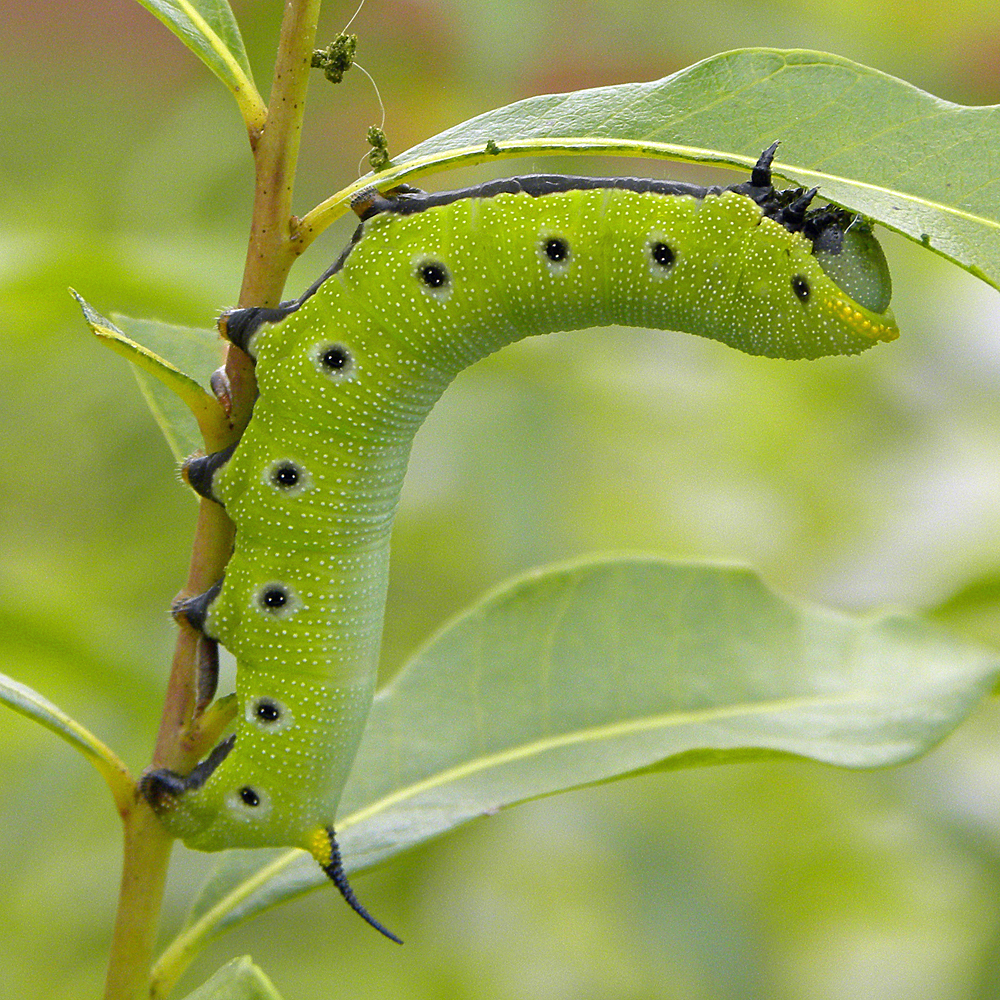
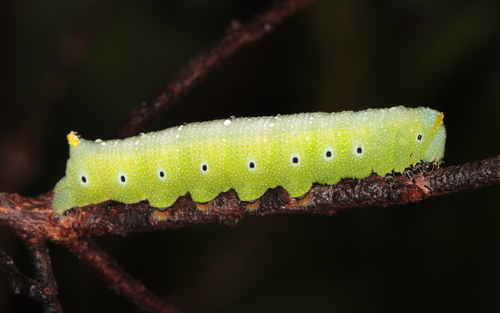
Green, yellow or brown caterpillars with a smooth body and a small 'horn' near the rear (typical of sphinx moth larvae). They feed on host plant leaves and grow through several instars over 2-5 weeks.
Pupa
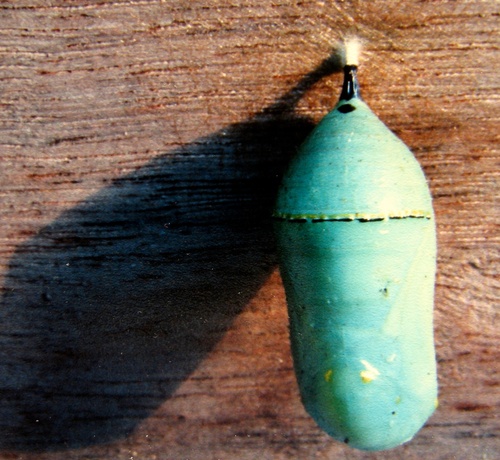
Larvae pupate in a loose cocoon in leaf litter or shallow soil and overwinter as pupae. Pupation lasts until the following spring or early summer.
Adult
Adults emerge with clear-windowed wings and feed on nectar, hovering at flowers like a hummingbird. They mate and begin the next generation.
🍃Diet and predators
Young eat
Leaves of snowberry (Symphoricarpos), honeysuckles (Lonicera), bush honeysuckle (Diervilla) and dogbane (Apocynum)
Adults eat
Nectar from tubular and open flowers (bee balm, phlox, petunia, thistles, clover, trumpet honeysuckle and many garden flowers)
Predators of the young
Birds, predatory wasps, ants and parasitic flies/ wasps
Predators of adults
Birds, spiders, dragonflies and occasionally bats (though day-active adults are mainly taken by birds)
🌱Effect on plants and gardens
Adults pollinate tubular flowers while feeding on nectar. Larvae feed on leaves of shrubs such as snowberry (Symphoricarpos), honeysuckles (Lonicera), bush honeysuckle (Diervilla) and dogbane (Apocynum); usually not abundant enough to harm healthy shrubs.
📍Where and when to find it
Adults: visiting garden flowers, woodland edges and meadows. Larvae: on leaves of host shrubs such as snowberry, honeysuckle and dogbane.
Best time
Best seen from late spring through late summer on warm, sunny days; central day hours into early evening.
Observation tips
Use a telephoto lens or approach slowly—these moths are fast and easily startled. Look for hovering at tubular flowers and inspect host shrubs for smooth green caterpillars.
✨Fun facts
- Hemaris diffinis is often mistaken for a hummingbird or bumblebee because of its size, coloration and hovering feeding style.
- Unlike most moths, snowberry clearwings are primarily day-flying and are attracted to bright, nectar-rich flowers.
- The transparent 'windows' in the wings are the result of missing scales, not actual holes.
?Frequently asked questions
Do snowberry clearwing moths sting?
No. They do not sting or bite and are harmless to people.
Why is a snowberry clearwing in my house?
They are attracted to bright flowers and lights; an adult may enter through open doors or fly in while chasing nectar sources. They are not household pests.
Will their caterpillars damage my shrubs?
Caterpillars eat leaves of shrubs like snowberry and honeysuckle but are rarely abundant enough to cause serious damage on healthy plants.
How can I attract snowberry clearwings to my garden?
Plant nectar-rich, tubular flowers (bee balm, phlox, petunia, honeysuckle) and include host plants such as snowberry or honeysuckle for caterpillars.
How do I get rid of them if I don't want them?
They are beneficial pollinators; if necessary, gently shoo adults out of the house or remove caterpillars by hand from small plantings. Chemical controls are unnecessary for typical encounters.
📷Photos of the snowberry clearwing
More butterflies & moths
This guide was written with AI assistance and fact-checked, last updated 2026-10-10. Identification from photos is never certain: don't handle insects you can't identify, and get medical advice for bites, stings or allergic reactions. More about the snowberry clearwing: iNaturalist, Wikipedia.