
Forest tent caterpillar moth
Malacosoma disstria · Tent caterpillars and lappet moths
A familiar North American moth whose gregarious caterpillars can defoliate broadleaf trees in periodic outbreaks.
!Is the forest tent caterpillar moth dangerous?
Only mildly. Adults are harmless. Caterpillars are not venomous but their hairs can cause mild skin irritation or a rash in sensitive people after contact; avoid handling. First aid: wash skin with soap and water and remove any embedded hairs with tape. Seek medical care for severe allergic reactions.
Pets
Caterpillar hairs can irritate pets' skin or mouths if chewed; do not allow pets to eat large numbers of caterpillars. Severe reactions in pets are uncommon but consult a veterinarian if symptoms occur.
📖Overview
Malacosoma disstria is a small moth species best known for its communal caterpillars. The larvae feed in groups on leaves of many deciduous trees and shrubs and can cause heavy defoliation during outbreak years. Adults are short-lived, do not feed, and primarily exist to mate and lay eggs. Outbreaks tend to be cyclical and can last several years in a region before collapsing due to predators, disease, and parasitoids.
🔍How to identify a forest tent caterpillar moth
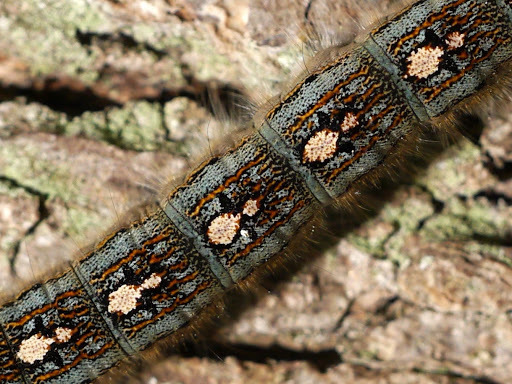
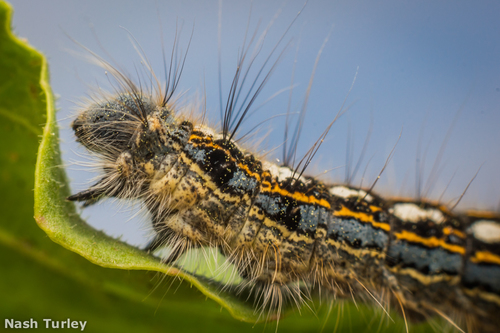
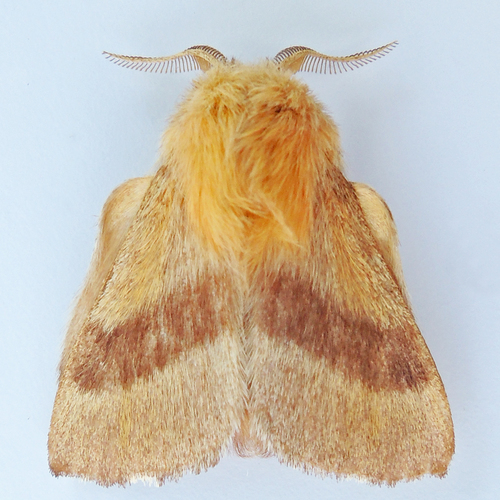
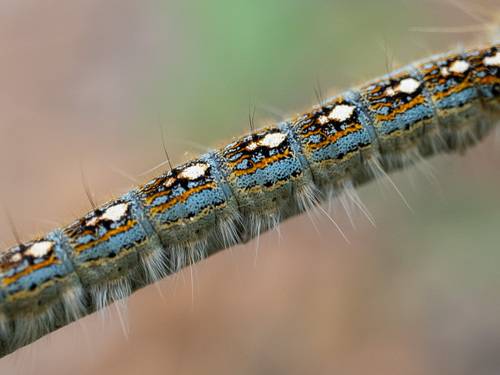
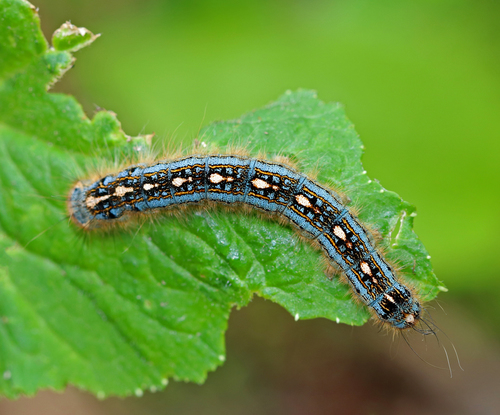
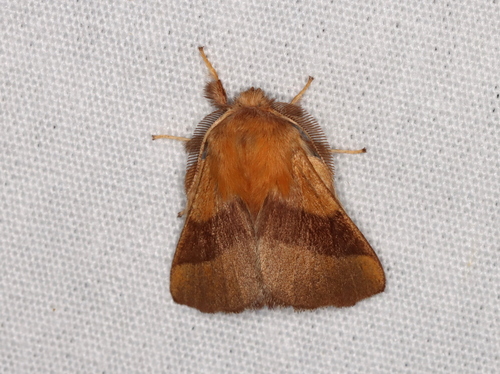
Adult moths are compact and hairy with a wingspan about 25-45 mm. Forewings are buff to tan with two dark oblique lines, the area between them often darker; hindwings are paler and less patterned. Caterpillars are more distinctive: dark bluish-black with a row of white, keyhole- or footprint-shaped spots down the back, pale blue lines along the sides and sparse whitish hairs. Newly hatched caterpillars are social and stay in groups; older larvae move together when foraging.
- Caterpillars have a row of pale, elongated keyhole- or footprint-shaped dorsal spots on a dark body — distinctive for this species.
- Unlike eastern tent caterpillar (Malacosoma americanum), forest tent caterpillar larvae do not build permanent silk tents in branches; they make ground or trunk mats.
- Adults are small brown moths with faint darker lines and a paler median band on the forewings; identification to species is easiest by larval characters.
Lookalikes
Eastern tent caterpillar Malacosoma americanum
Eastern tent caterpillar builds conspicuous silk tents in tree forks and has a prominent white stripe down the center of the back, whereas forest tent caterpillar has keyhole-shaped dorsal spots and no permanent tent.
Fall webworm Hyphantria cunea
Fall webworm creates loose silken webs around foliage late in summer and larvae are pale and hairy, lacking the dark body with keyhole dorsal spots of forest tent caterpillar.
↻Life cycle
Egg
Eggs are laid in a band around small twigs in early to midsummer; each mass contains 100-350 eggs covered with a protective, varnish-like coating and overwinters on the tree.
Larva (caterpillar)
Eggs hatch in spring; larvae feed gregariously on leaves for several weeks, growing through several instars. They form temporary silk mats but do not build the permanent tent structures of eastern tent caterpillars.
Pupa (cocoon)
Mature caterpillars spin silken cocoons in sheltered places where they pupate for about 1-2 weeks before emerging as adults.
Adult (moth)
Adults are short-lived, nocturnal moths that mate and the females lay the next season's egg masses before dying.
🍃Diet and predators
Young eat
Leaves of many deciduous trees and shrubs (oak, aspen, maple, birch, fruit trees and others).
Adults eat
Adults do not feed; they have reduced mouthparts and live only about a week.
Predators of the young
Birds, predatory insects (beetles, wasps), small mammals, and parasitoid flies and wasps; pathogens (nuclear polyhedrosis virus, fungal diseases) can cause crash of outbreaks.
Predators of adults
Bats, nocturnal insectivorous birds, and predatory insects.
🌱Effect on plants and gardens
Feeds on many deciduous trees including oak, aspen, maple, birch, fruit trees and others. Repeated severe defoliation can weaken trees and reduce growth, but most healthy trees survive occasional outbreaks.
How to get rid of forest tent caterpillar moths
Monitor trees in spring. For small infestations remove and destroy egg masses (bands of eggs around twigs) in late winter or early spring, and remove caterpillar groups by hand into soapy water. Bacillus thuringiensis kurstaki (Btk) sprayed on foliage is effective against young caterpillars and safe for most non-targets when used correctly. For large outbreaks consult a professional arborist or local extension service for recommended treatments and timing. Encourage natural enemies—birds, predatory insects and parasitoid wasps—and avoid unnecessary broad-spectrum insecticides.
📍Where and when to find it
Egg masses on small twigs in late winter; larvae feeding in groups on leaves of host trees in spring; pupae in silk cocoons on trunks, branches or leaf litter; adults at night near lights in late spring and early summer.
Best time
Best observed as larvae in spring and early summer (regional timing varies). Adults are best seen at night during the short flight period in late spring to early summer.
Observation tips
Photograph the caterpillars' dorsal pattern for ID. If monitoring for control, check trees for egg bands in late winter and young larvae in early spring before heavy feeding begins.
✨Fun facts
- Outbreaks of forest tent caterpillar occur in cycles and can defoliate thousands of hectares of forest.
- Despite the name, forest tent caterpillars do not build tents; the name comes from tent-building relatives in the same genus.
- Disease agents such as a specific virus or fungal pathogens often end outbreak years by killing large numbers of caterpillars.
?Frequently asked questions
Do forest tent caterpillars sting or bite?
No. They do not sting or bite, but their hairs can cause mild skin irritation or rashes in some people after contact.
Are forest tent caterpillars dangerous to trees?
They can be harmful during large outbreaks because repeated heavy defoliation weakens trees; however most healthy trees recover after one or a few defoliations.
Why are there lots of them on my trees?
Periodic population outbreaks cause high numbers of caterpillars. Overwintered egg masses hatch in spring and synchronized feeding produces visible groupings.
How can I get rid of forest tent caterpillars from my yard?
Remove egg masses in winter, hand-pick caterpillar groups into soapy water, or use Btk sprays applied to leaves when caterpillars are small. For large infestations consult local extension services or an arborist.
Will insecticides kill beneficial insects and birds?
Broad-spectrum insecticides can harm non-target species. Use targeted, timed controls (like Btk early in larval stage) and consider natural predators before applying broad insecticides.
📷Photos of the forest tent caterpillar moth
More butterflies & moths
This guide was written with AI assistance and fact-checked, last updated 2026-10-10. Identification from photos is never certain: don't handle insects you can't identify, and get medical advice for bites, stings or allergic reactions. More about the forest tent caterpillar moth: iNaturalist, Wikipedia.