
Red-shouldered bug
Jadera haematoloma · Rhopalid seed bugs
A small, red-and-black seed-eating bug commonly found on soapberry-family trees; not dangerous but may produce a mild bite if handled.
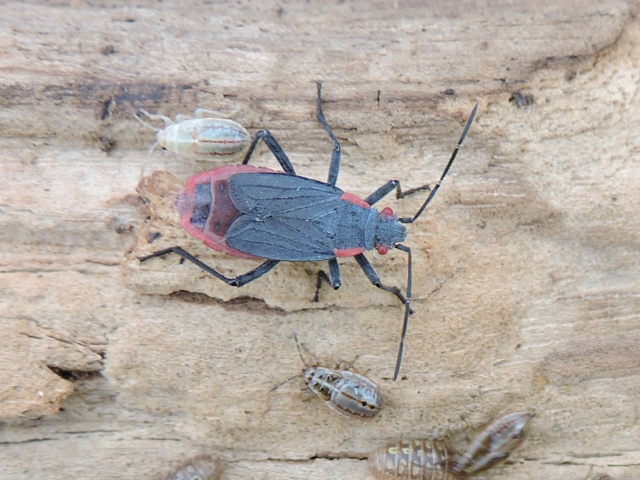
!Is the red-shouldered bug dangerous?
No. Not venomous or poisonous. They do not sting. If handled or crushed they can give a mild, pinprick bite or release an unpleasant odor; treat any minor bite like a small puncture wound (clean with soap and water, apply antiseptic, watch for signs of infection).
Pets
Generally harmless to pets. Large numbers are unpleasant but do not pose a toxic threat. Pets that eat many bugs could have mild digestive upset.
📖Overview
Jadera haematoloma is a seed-eating true bug often found on trees in the soapberry family (Sapindaceae), such as the goldenrain tree and various native soapberry species. Adults and nymphs gather at fruit and seed pods to feed and are often gregarious. They are not venomous or poisonous to people or pets and are mainly of interest ecologically because of their specialized seed diet and sometimes large local aggregations.
These bugs are most active in warm months and may appear in large numbers where host trees are fruiting. They do not cause significant structural damage to homes, but large aggregations can be a nuisance around patio areas, windows and doors where host plants are nearby.
🔍How to identify a red-shouldered bug
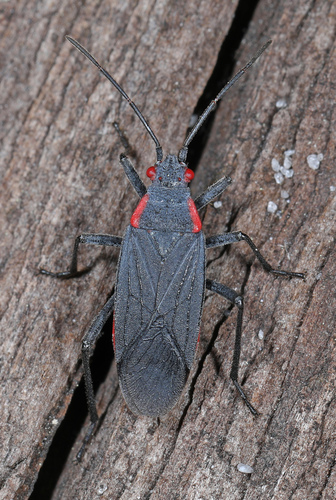
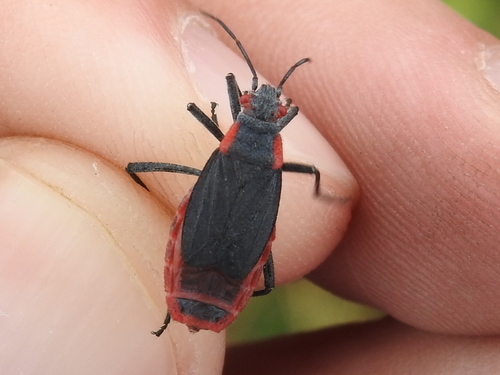
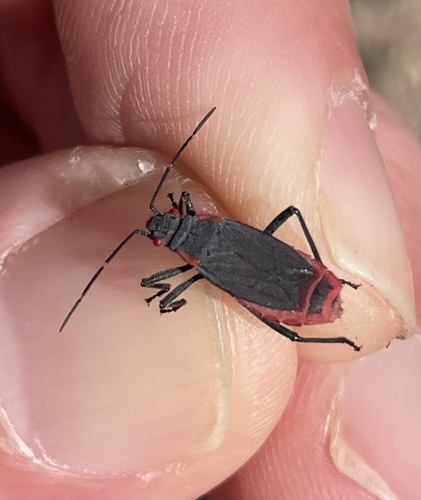
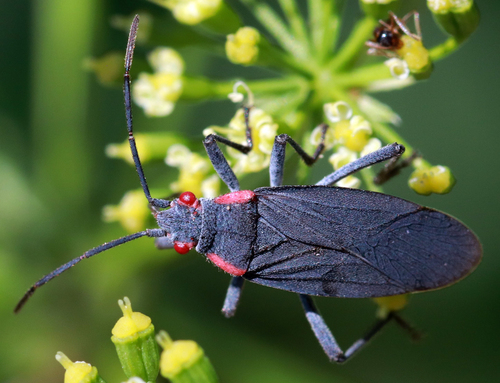
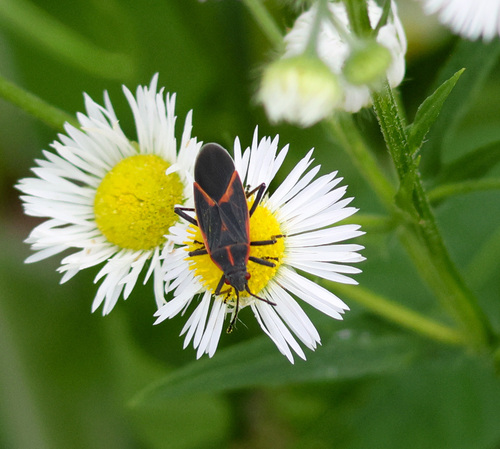
Adults are small, elongated true bugs roughly 8-12 mm long with a distinctive red to orange dorsal area across the 'shoulders' and pronotum contrasted by black or very dark brown wings and abdomen. The head and legs are typically brownish to black. Nymphs are wingless and bright orange-red when young, darkening and developing wing pads through successive instars until they reach the adult pattern.
- Red/orange patch across the pronotum and 'shoulder' area contrasted with black or very dark wings
- Small elongated body 8-12 mm long with visible wing pads (in adults) and a tapered head
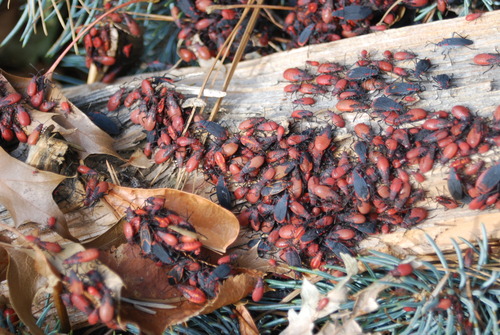
- Nymphs bright orange-red and gregarious on seed pods of soapberry-family plants
- Found feeding on seed pods of goldenrain, soapberry and related host plants
Lookalikes
Boxelder bug Boisea trivittata
Boxelder bugs have red lines on black wings and a different head and pronotum shape; they are associated with maple and boxelder rather than soapberry trees.
Milkweed bug Oncopeltus fasciatus
Milkweed bugs are larger and have a distinctive orange-and-black pattern with a broad orange band across the hemelytra; they feed on milkweed seeds rather than soapberries.
↻Life cycle
Egg
Females lay small clusters of elongate eggs on leaves, bark or near host plant seed pods. Eggs hatch in days to a few weeks depending on temperature.
Nymph (juvenile)
Nymphs are flightless and gregarious, going through five instars. They are bright orange-red when young and develop darker markings and wing pads as they grow.
Adult
Adults have full wings and the characteristic red-shouldered pattern; they fly short distances between host plants and can produce multiple generations per year in warm climates.
🍃Diet and predators
Young eat
Seeds and developing seed tissues of soapberry-family plants
Adults eat
Seeds of soapberry-family plants (Sapindaceae) and occasionally juices from fruit
Predators of the young
Ants, spiders, predatory true bugs and small insectivorous birds
Predators of adults
Birds, predatory insects and spiders
🌱Effect on plants and gardens
Feeds almost exclusively on seeds of trees and shrubs in the soapberry family (Sapindaceae), such as soapberries, balloon vine and goldenrain tree. Heavy feeding can reduce seed viability but bugs rarely cause serious damage to healthy trees.
📍Where and when to find it
Look on seed pods, fruit and branches of soapberry-family trees (goldenrain tree, soapberry, balloon vine). Nymphs cluster on developing pods; adults appear on pods and nearby foliage.
Best time
Late spring through early fall when host plants are fruiting; daytime is best for observation.
Observation tips
Photograph groups on seed pods from several angles to show size and the red-shoulder marking; a macro or phone close-up will capture the orange-red colors well.
✨Fun facts
- They are strongly associated with soapberry-family plants and are a classic example of rapid evolution: in populations that switched to introduced host trees such as goldenrain tree, beak (mouthpart) length changed within a few decades to match the new seed pods.
- Nymphs and adults often feed together in conspicuous groups on seed pods, making them easy to observe.
- Although called a 'soapberry bug' in some regions, Jadera haematoloma is only one of several species that feed on soapberry seeds.
?Frequently asked questions
Are red-shouldered bugs dangerous to people?
No — they are not venomous or poisonous. They do not sting. Handling can occasionally cause a mild bite or an unpleasant smell if crushed.
Do red-shouldered bugs bite?
They can produce a mild, pinprick bite if handled or trapped, but bites are uncommon and not medically significant.
Why are they in my house?
They are attracted to warm sunny surfaces and may wander onto patios, windows or into buildings near host trees, especially when large numbers are present nearby.
How do I get rid of them?
Usually no control is needed. Rake up fallen seeds and pods under host trees, use a vacuum to remove indoor or patio aggregations, and seal cracks and gaps around windows and doors. Removing female (seed-bearing) host trees reduces numbers over time.
Where do red-shouldered bugs live?
On and near soapberry-family trees and shrubs (Sapindaceae) in warm, open habitats, gardens and urban landscapes across the southern United States, Mexico and Central America.
📷Photos of the red-shouldered bug
More true bugs, cicadas & aphids
Bites cause itching
Non-venomous nuisance
Non-toxic
Smelly secretion
Potential disease vector
Painful bite
This guide was written with AI assistance and fact-checked, last updated 2026-10-10. Identification from photos is never certain: don't handle insects you can't identify, and get medical advice for bites, stings or allergic reactions. More about the red-shouldered bug: iNaturalist, Wikipedia.