
Dog-day cicada
Neotibicen canicularis · Cicadas
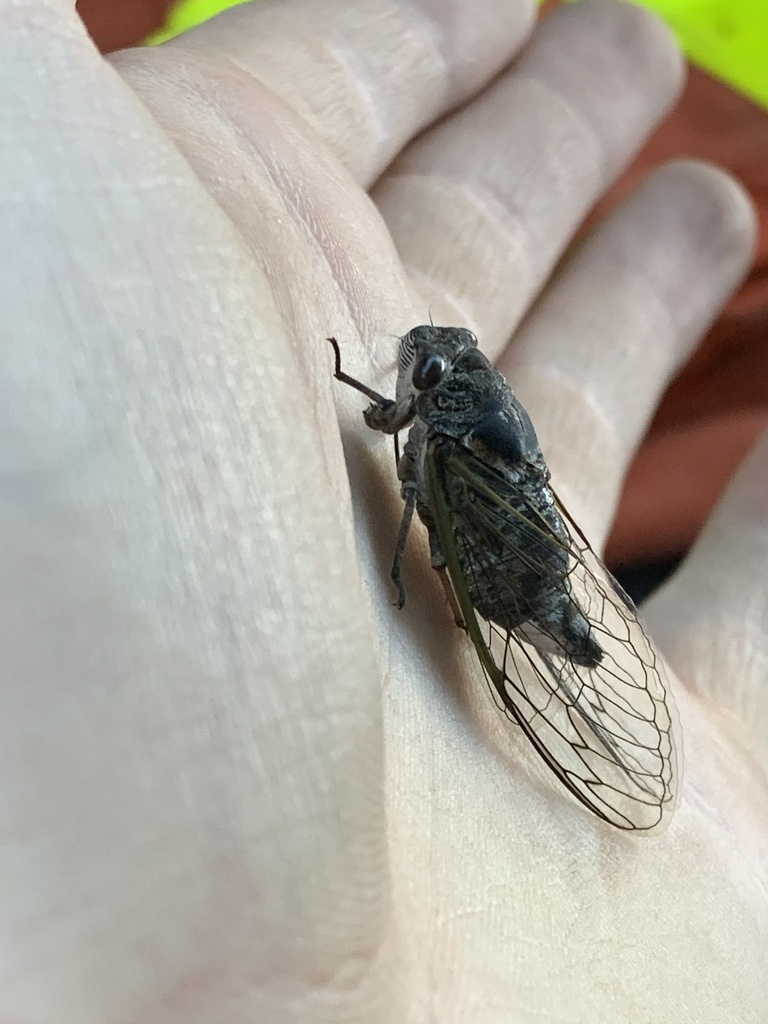
A large, loud summer cicada of eastern North America whose males call from tree branches during the "dog days" of summer.
!Is the dog-day cicada dangerous?
No. Dog-day cicadas do not bite or sting in the sense of venomous insects. They can pinch with their mouthparts if handled roughly, and females use a saw-like ovipositor to cut into twigs when laying eggs (this does not sting people). If handled, wash any minor skin scrape with soap and water. Cicadas are not known to transmit disease to humans.
Pets
Generally harmless to pets. Large numbers may attract predators or scavengers; swallowing large hard-bodied insects can rarely cause mild digestive upset in small pets. Keep small dogs and cats from repeatedly chewing on hard-bodied insects to avoid choking or tooth damage.
📖Overview
Neotibicen canicularis is a widespread annual cicada found across northeastern and north-central North America. Males produce the familiar loud, continuous buzzing call from branches and exposed perches on hot summer days. Nymphs live underground feeding on plant roots for several years before emerging to molt into adults. Adults feed briefly on xylem fluids from woody plants but do little lasting harm in normal numbers.
🔍How to identify a dog-day cicada
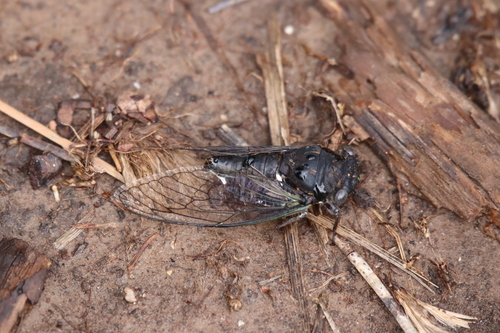
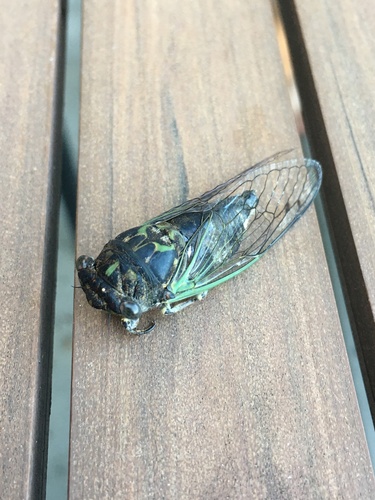
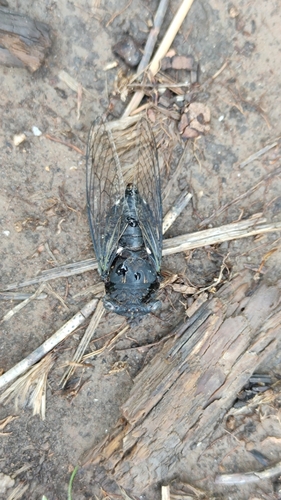
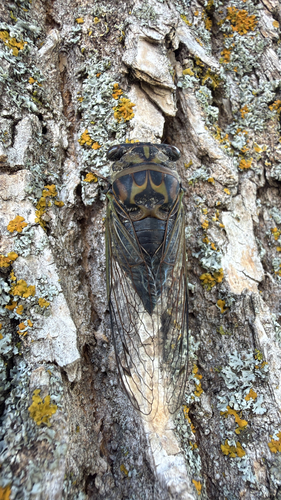
Adults are robust, roughly 2.5-3.5 cm long (body only) with clear, membranous wings that extend past the abdomen. Dorsal coloration is a mottled mix of green, brown and black with a distinct dark central stripe on the head and pronotum; the abdomen often shows dark banding. Wings have brown venation and the forewing has a slightly smoky tint. Males and females look similar externally; males are the ones that sing.
- Large, stout-bodied cicada with clear wings and mottled green-brown dorsal pattern
- Distinct dark central stripe on head and pronotum with lighter lateral markings
- Loud, continuous buzzing call from males heard during hot summer days
- Perches openly on tree branches and trunks in daylight
Lookalikes
Scissor grinder cicada Neotibicen pruinosus
N. pruinosus often has more brown/black overall and a different song (repetitive 'scissor-like' buzz); careful comparison of dorsal markings and local songs is needed.
Linne's cicada Neotibicen linnei
N. linnei is similar in appearance but differs in details of the pronotal markings and has a distinct, pulsing calling song; range overlaps in parts of the eastern U.S.
↻Life cycle
Egg
Laid by females in slits cut into small twigs; eggs hatch in several weeks and tiny nymphs fall to the ground and burrow into soil.
Nymph (underground)
Subterranean nymphs feed on root xylem for multiple years (commonly 2-5 years depending on local conditions) and grow through several instars.
Adult (winged)
Nymphs emerge from soil, climb vegetation, molt to the winged adult stage, mate, lay eggs and die within a few weeks.
🍃Diet and predators
Young eat
Root xylem sap from a variety of woody plants and grasses
Adults eat
Xylem fluids from twigs and branches of trees and shrubs
Predators of the young
Ground predators and parasitic or parasitoid wasps and fungi that attack subterranean stages
Predators of adults
Birds, small mammals, predatory insects (praying mantids, robber flies), spiders, and cicada-killer wasps
🌱Effect on plants and gardens
Adults feed on xylem fluids from twigs and branches but cause little damage in normal numbers. Egg-laying cuts (slits made by the female in small twigs) can cause flagging or cosmetic damage to small branches if cicada densities are very high; young nursery trees are most vulnerable.
📍Where and when to find it
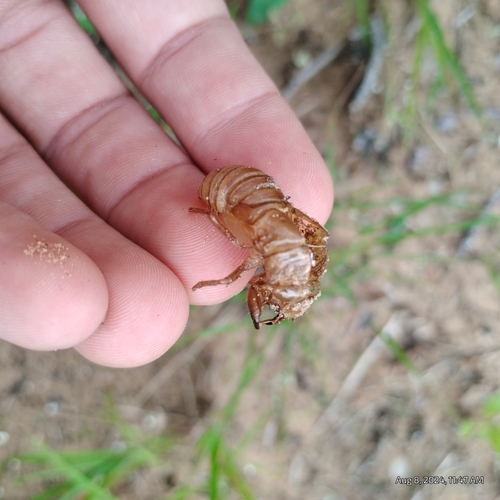
Adults on trunks, branches and in trees; listen for male calls to locate them. Nymphal burrows and shed exuviae (empty skins) on tree bases and stems after emergence.
Best time
Best observed during hot summer months (July-August in many areas), during daytime when males call. Early morning and late afternoon can also be good.
Observation tips
Listen to locate singing males, then approach slowly. Use a telephoto or macro lens to photograph perched adults; be careful when inspecting exuviae to avoid disturbing emerging individuals.
✨Fun facts
- The name 'dog-day' refers to the hot 'dog days' of summer when this cicada is most conspicuous.
- Male dog-day cicadas have powerful sound-producing organs called tymbals; a single male can be extremely loud and their chorus can reach levels that are audible across neighborhoods.
- Despite their short adult lives, cicadas can spend several years as nymphs underground feeding on roots.
?Frequently asked questions
Do dog-day cicadas bite?
No — they are not aggressive and do not bite people for feeding. They have piercing mouthparts for feeding on plant sap, and handling them roughly can result in a harmless pinch.
Can dog-day cicadas sting or are they poisonous?
No. Cicadas do not sting and are not poisonous. They do not transmit diseases to people.
Why are cicadas in my house?
Adults are attracted to lights and may accidentally fly into homes or enter through open doors and windows. Nymphs live underground, not in homes.
Will cicadas kill my trees?
Generally no. Normal cicada numbers cause only minor feeding damage. Heavy egg-laying by very large emergences can cause flagging (broken tips) on small branches of young trees; protect young or valuable specimens with fine netting during peak egg-laying if needed.
How can I get rid of cicadas?
Control is usually unnecessary. For nuisance adults, exclude them with screens, close doors at dusk, or remove attracted lights. Protect young trees with 1 cm mesh netting until adults finish egg-laying. Pesticides are generally ineffective at large scales and not recommended for routine use.
When and where will I see dog-day cicadas?
They are most noticeable in mid to late summer, perched on tree trunks and branches in woodlands, parks and suburban neighborhoods in northeastern and north-central North America.
📷Photos of the dog-day cicada
More true bugs, cicadas & aphids
Bites cause itching
Non-venomous nuisance
Non-toxic
Smelly secretion
Potential disease vector
Painful bite
This guide was written with AI assistance and fact-checked, last updated 2026-10-10. Identification from photos is never certain: don't handle insects you can't identify, and get medical advice for bites, stings or allergic reactions. More about the dog-day cicada: iNaturalist, Wikipedia.