
Jagged ambush bug
Phymata americana · Ambush bugs
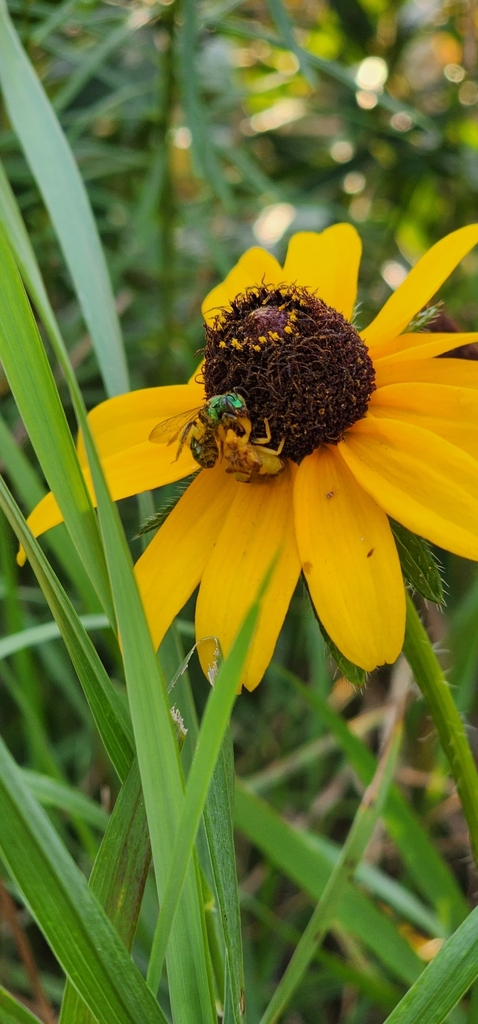
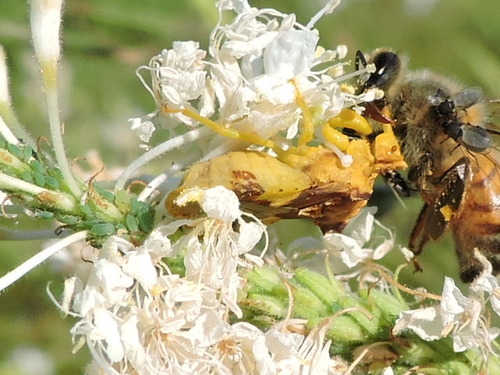
A small, crablike predatory true bug that sits on flowers and captures visiting insects with raptorial forelegs.
!Is the jagged ambush bug dangerous?
Only mildly. Not dangerous to people. If handled or squeezed, Phymata americana can deliver a painful bite with its piercing mouthparts; effects are local pain, possible redness and brief swelling. Clean the area, apply ice to reduce swelling, and seek medical advice if an allergic reaction occurs or symptoms worsen.
Pets
Unlikely to harm pets. A pet that mouths or eats one could get a mild mouth irritation but serious effects are rare.
📖Overview
Phymata americana is a compact, heavily built ambush bug found on flowers where it waits motionless for prey. It uses enlarged, spiny forelegs to seize pollinators and other insects, then consumes them with piercing-sucking mouthparts. These bugs are sit-and-wait predators rather than hunters that chase prey.
They are commonly encountered in meadows, roadsides and garden borders where native wildflowers and shrubs bloom. Both nymphs and adults are predatory and often blend into the flower heads where they ambush bees, flies, moths and small butterflies. They are not social and are usually seen singly on a blossom.
🔍How to identify a jagged ambush bug
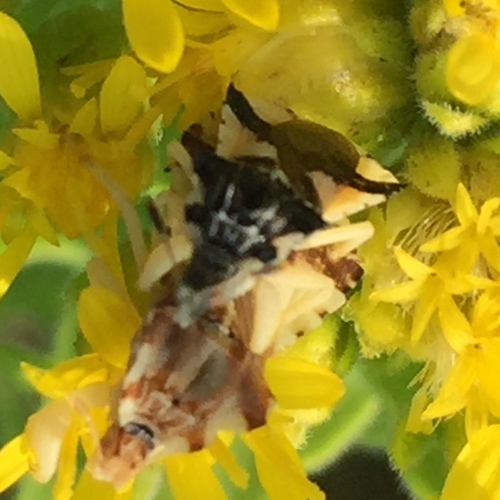
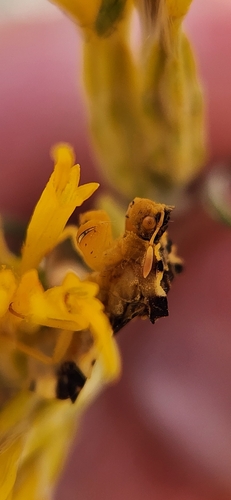
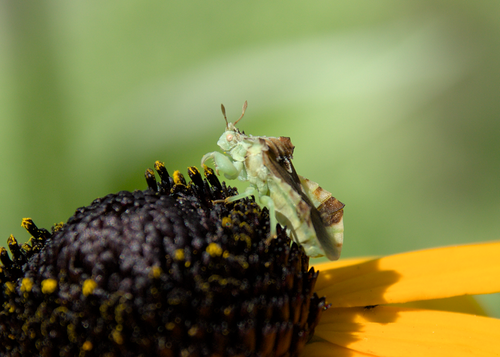
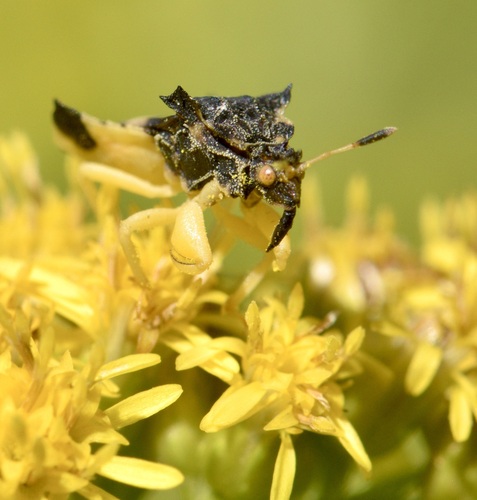
Adults are short, stout and somewhat crablike in posture, with a broad, flattened body and a jagged outline created by projecting lobes on the thorax and abdomen. Typical length is about 8-11 mm. Coloration is variable and often matches the flower they occupy: yellow, white or greenish with brown to blackish markings, often including a dark band across the widened abdomen, that camouflage them among petals and pollen. The raptorial front legs are thick and armed with spines for grasping prey.
- Short, stout body 8-11 mm long with a jagged, lobed outline around the thorax and abdomen
- Raptorial, spiny forelegs held forward like a mantis but shorter and thicker
- Usually sits on flowers and matches flower color (yellow, white or greenish with dark markings), blending with petals or pollen
- No long slender 'neck' — appears broad and crablike from above
Lookalikes
Pennsylvania ambush bug Phymata pennsylvanica
Very similar in habit; P. pennsylvanica tends to have differing pattern of dorsal markings and may occur more commonly in northern parts of range. Careful comparison of body markings and region helps separate them.
Other Phymata species Phymata spp.
Many Phymata species are similar in shape and behavior; species-level ID often requires close inspection of color pattern and sometimes genitalia for confirmation.
↻Life cycle
Egg
Females lay clusters of eggs on stems, leaves or flower heads. Eggs are fixed in place and hatch after days to weeks depending on temperature.
Nymph
Nymphs resemble small wingless adults and are predatory from the first instar. They develop through several molts while feeding on flower visitors.
Adult
Fully winged adults continue ambush predation and reproduce; they are most conspicuous on flowers during the bloom season, especially late summer.
🍃Diet and predators
Young eat
Small flying insects and other flower visitors such as flies, small bees, wasps and moths
Adults eat
Same as juveniles: predatory on pollinators and other insects visiting flowers
Predators of the young
Spiders, predatory insects and small insectivorous birds
Predators of adults
Birds, larger predatory insects and spiders; camouflage reduces detection
🌱Effect on plants and gardens
They do not feed on plants; instead they prey on insects that visit flowers. They can reduce numbers of small pollinators or pest insects but are overall considered part of healthy flower-site ecology.
📍Where and when to find it
Look on the heads of composite flowers (like goldenrod, aster family), umbellifers and other open blooms. Nymphs and adults both appear on flowers during the day.
Best time
Late spring through early fall when flowers are in bloom; daytime when pollinators are active.
Observation tips
Approach flowers slowly and scan for a small, crablike insect with forward-facing spiny front legs. Use a macro lens and keep background flowers in frame to show camouflage.
✨Fun facts
- Ambush bugs can capture prey much larger than themselves, including bees several times their mass.
- They often match the color of the flowers they sit on so well they appear to be part of the bloom.
?Frequently asked questions
Do jagged ambush bugs bite?
Yes, they can bite if handled or crushed. The bite is a defensive piercing with local pain and redness; it is only mildly harmful and not dangerous to people.
Are ambush bugs poisonous?
No, they are not poisonous to humans. They use saliva to subdue prey but do not inject medically significant venom into people.
Why is there an ambush bug on my flowers?
They sit on flowers to ambush pollinators and other insects that visit for nectar or pollen. Flowers are hunting sites that attract their prey.
How can I get rid of ambush bugs in my garden?
They are beneficial predators and usually do not need removal. If you must remove them, pick them off by hand using gloves or a stick and relocate them, or prune affected blooms. Avoid broad insecticide sprays if you want to conserve beneficial insects.
Where do jagged ambush bugs live?
They live on flowering plants in meadows, gardens, roadsides and edges of fields across much of North America.
📷Photos of the jagged ambush bug
More true bugs, cicadas & aphids
Bites cause itching
Non-venomous nuisance
Non-toxic
Smelly secretion
Potential disease vector
Painful bite
This guide was written with AI assistance and fact-checked, last updated 2026-10-10. Identification from photos is never certain: don't handle insects you can't identify, and get medical advice for bites, stings or allergic reactions. More about the jagged ambush bug: iNaturalist, Wikipedia.