
Glassy-winged sharpshooter
Homalodisca vitripennis · Leafhoppers and sharpshooters
A large, day-active leafhopper that feeds on xylem sap and spreads the plant pathogen Xylella fastidiosa, responsible for serious crop diseases.
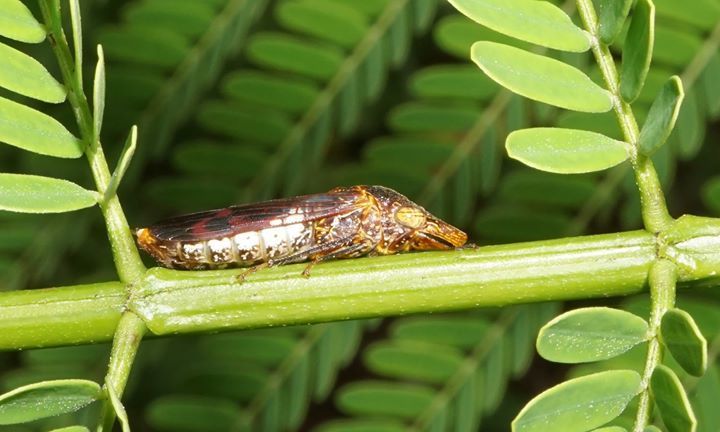
!Is the glassy-winged sharpshooter dangerous?
No. Glassy-winged sharpshooters do not bite or sting people and are not toxic. They may occasionally hop onto people but cause no direct harm. The main human concern is economic: they transmit Xylella fastidiosa, which damages crops.
Pets
Not dangerous to pets. No known direct toxicity or biting risk to cats, dogs or other household animals.
📖Overview
Homalodisca vitripennis, commonly called the glassy-winged sharpshooter (GWSS), is a relatively large leafhopper native to the southeastern United States and northeastern Mexico and now established in parts of California and other regions through accidental human transport. Adults are active during warm months and feed on xylem sap from a wide range of woody and herbaceous plants. While the insect itself is harmless to people, it is a major agricultural pest because it efficiently acquires and transmits the bacterium Xylella fastidiosa, which causes diseases such as Pierce's disease in grapevines and leaf scorch in many ornamental and crop plants.
The species is polyphagous (feeds from many host plants), has multiple generations per year in warm climates, and lays eggs in masses inserted into plant tissue. Natural enemies, including egg parasitoid wasps, predators and entomopathogenic fungi, can reduce populations but are often insufficient where the insect is invasive. Management focuses on monitoring, cultural controls, biological control agents, and targeted insecticide use when necessary to protect high-value crops.
🔍How to identify a glassy-winged sharpshooter
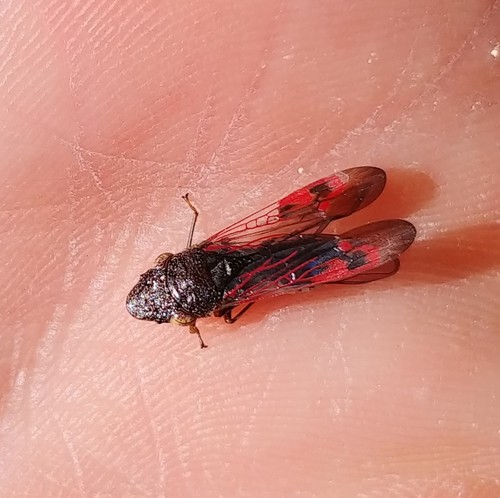
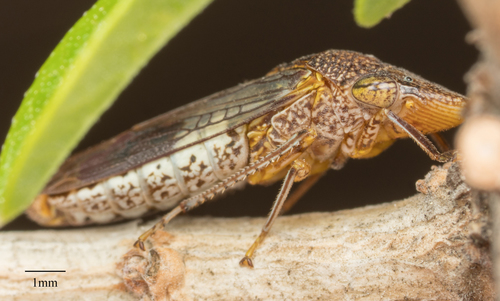
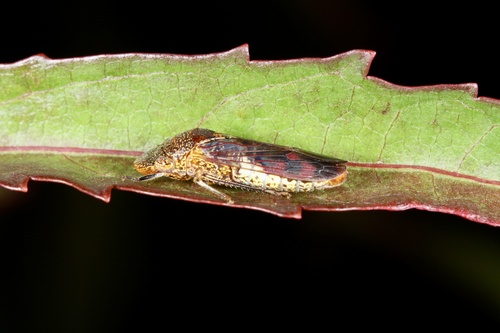
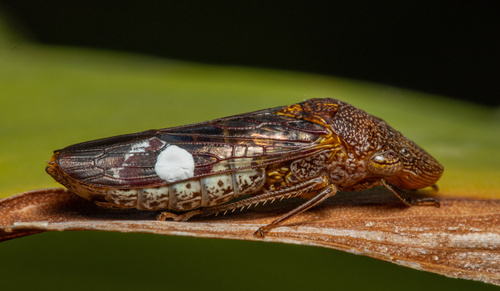
Adults are stout, about 12-14 mm long, with a broad head and translucent forewings with reddish veins that give a glassy look. The body is dark brown to nearly black, with ivory to yellowish spots on the head and thorax. The wings extend beyond the abdomen when at rest. Nymphs are wingless when young, pale grey to olive, and become larger through instars; older nymphs develop wing pads. Eggs are laid in rows inside plant tissue, and females often cover the egg site with white chalky particles (brochosomes) carried on their forewings.
- Large leafhopper 12-20 mm long with broad translucent forewings that extend beyond the abdomen
- Overall brown to olive body with subtle blue-green sheen and darker head/pronotum markings
- When disturbed, adults jump strongly and fly; nymphs are wingless and smaller with pale to greenish coloration
- Egg masses are inserted into plant tissue in overlapping rows
Lookalikes
Green sharpshooter Draeculacephala spp.
Green sharpshooters are usually smaller, uniformly brighter green, and have different wing venation; GWSS is larger with broader, more translucent wings and a characteristic body shape.
Blue-green sharpshooter Graphocephala atropunctata
Much smaller (about 6-7 mm) and bright blue-green to green; also a vector of Xylella in California, but lacks the dark, spotted body and large glassy wings of GWSS.
Smoke-tree sharpshooter Homalodisca liturata
Close relative native to the southwestern USA; very similar in size and shape but with more extensive pale wavy markings on the head and thorax.
↻Life cycle
Egg
Eggs are laid in masses inserted into plant tissue, often in rows beneath the leaf surface. Eggs hatch in about 1-3 weeks depending on temperature.
Nymph
Several nymphal instars are wingless and feed actively on xylem sap. Nymphs develop over several weeks, growing rapidly in warm conditions.
Adult
Adults have fully formed wings, disperse by flying and hopping, and transmit Xylella fastidiosa between plants while feeding.
🍃Diet and predators
Young eat
Xylem sap from a wide variety of host plants
Adults eat
Xylem sap from many woody and herbaceous plants; adults may move between hosts frequently
Predators of the young
Predatory insects, spiders, birds and egg parasitoid wasps (e.g., Gonatocerus spp.)
Predators of adults
Birds, predatory insects, spiders and entomopathogenic fungi
🌱Effect on plants and gardens
Feeds on xylem sap from many plants (grapevines, citrus, oleander, palms, oaks and many ornamentals). Direct feeding can cause minor stress, but the major impact is transmitting Xylella fastidiosa, which causes severe diseases like Pierce's disease in grapes and leaf scorch in ornamentals and shade trees.
How to get rid of glassy-winged sharpshooters
Integrated approaches work best: monitor with yellow sticky traps and visual inspection; remove or manage preferred host plants near vineyards and orchards (e.g., weedy growth and ornamentals like oleander); conserve or introduce natural enemies (egg parasitoid wasps such as Gonatocerus spp.); use targeted insecticides or systemic treatments when economic thresholds are reached; and implement quarantine and sanitation to limit spread. Follow local agricultural guidelines for chemical and biological controls.
📍Where and when to find it
Adults on leaves and stems of host plants (oleander, citrus, grapevines, oaks, ornamentals). Look for nymphs on the underside of leaves and egg masses inserted into stems or leaf petioles.
Best time
Warm months (spring to fall); adults are active during daylight hours.
Observation tips
Use a yellow sticky trap to monitor adults. Photograph broad views showing the whole insect and wing venation; note the host plant for identification and management decisions.
✨Fun facts
- Despite the name 'glassy-winged', the wings are translucent and show visible veins, giving a glass-like look.
- GWSS was accidentally introduced to California and became a major concern because it spread Xylella fastidiosa to vineyards.
- Scientists use egg parasitoid wasps (Gonatocerus species) as classical biological control agents against GWSS.
?Frequently asked questions
Are glassy-winged sharpshooters dangerous to humans?
No. They do not bite or sting people and are not poisonous. Their importance is as plant disease vectors, not a direct threat to human health.
Do glassy-winged sharpshooters bite?
No. They feed on plant sap and do not attempt to bite humans.
Why is a glassy-winged sharpshooter in my yard or houseplants?
They are attracted to many ornamental and native plants where they feed. Warm-season activity and nearby host plants (oleander, citrus, grape, oaks) increase the chance you'll see them on garden plants or potted specimens.
How can I get rid of glassy-winged sharpshooters?
Use integrated management: inspect and remove heavily infested plants, reduce nearby weed and ornamental hosts, monitor with sticky traps, encourage natural enemies, and apply targeted insecticides only when necessary following local agricultural advice.
Do glassy-winged sharpshooters damage grapevines?
Yes. They are efficient vectors of Xylella fastidiosa, which causes Pierce's disease in grapevines and can kill vines or severely reduce yields.
Can I control them biologically?
Yes. Egg parasitoid wasps (Gonatocerus spp.) and other natural enemies have been used successfully in integrated programs to reduce populations.
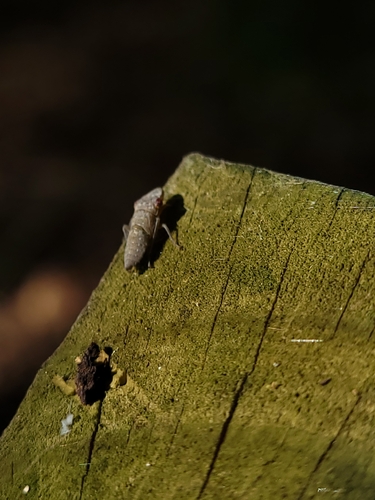
📷Photos of the glassy-winged sharpshooter
More true bugs, cicadas & aphids
Bites cause itching
Non-venomous nuisance
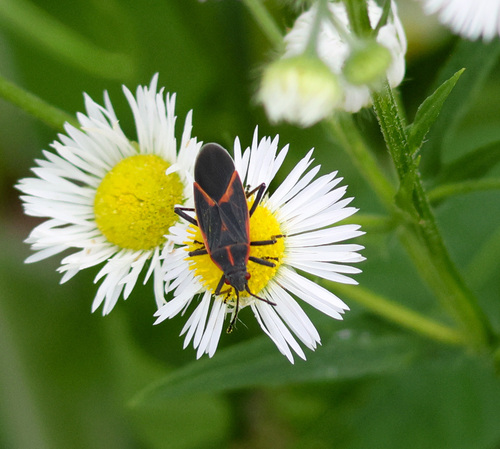
Non-toxic
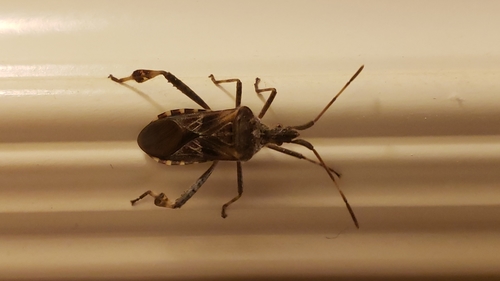
Smelly secretion
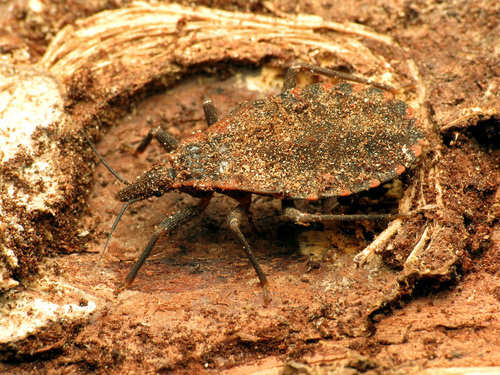
Potential disease vector
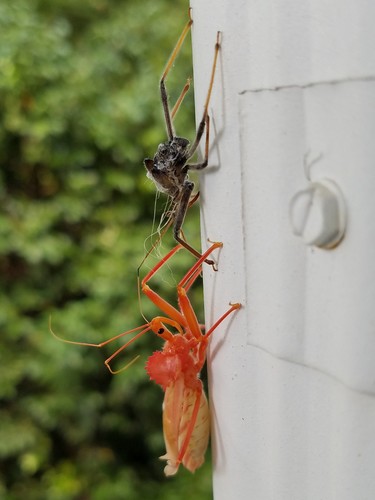
Painful bite
This guide was written with AI assistance and fact-checked, last updated 2026-10-10. Identification from photos is never certain: don't handle insects you can't identify, and get medical advice for bites, stings or allergic reactions. More about the glassy-winged sharpshooter: iNaturalist, Wikipedia.