
Large milkweed bug
Oncopeltus fasciatus · Milkweed bugs
A conspicuous orange-and-black seed-eating bug that feeds on milkweed seeds and is common on milkweed plants across much of the Americas.
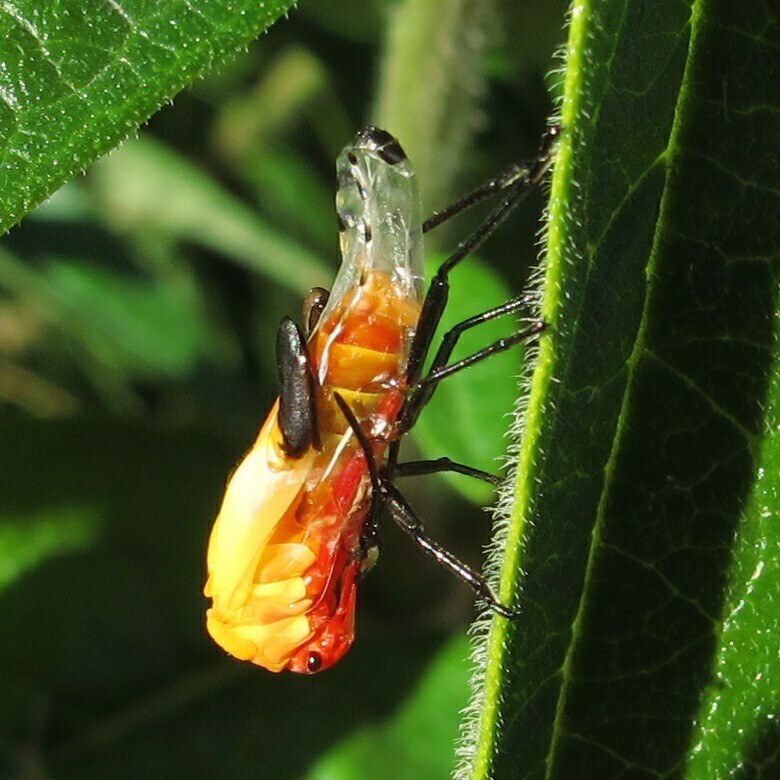
!Is the large milkweed bug dangerous?
No. Large milkweed bugs are not venomous and do not present a medical threat. They do not normally bite people, though they can give a mild pinch with their rostrum if handled. Some people notice a faint unpleasant smell or mild skin irritation if crushed; wash the area with soap and water if this happens.
Pets
Not known to be toxic to pets. Pets that mouth or eat many bugs could have mild digestive upset; seek veterinary advice if a pet appears ill after eating insects.
📖Overview
Oncopeltus fasciatus is a medium-sized true bug (family Lygaeidae) that specializes on the seeds of milkweed (Asclepias spp.). It is most often seen on flowering and seed-producing milkweed plants where adults and nymphs aggregate to feed. The species is hemimetabolous (incomplete metamorphosis): eggs hatch into nymphs that resemble small, wingless adults and go through several molts before reaching adulthood.
These bugs are generally not considered medically dangerous to people or pets. They can be numerous on individual milkweed plants and may reduce seed set locally, but they rarely cause serious damage to wild milkweed populations or to cultivated plants grown for ornament or habitat. Large milkweed bugs are important components of milkweed-associated communities and are often used in ecological and developmental biology research because they are easy to rear and observe.
🔍How to identify a large milkweed bug
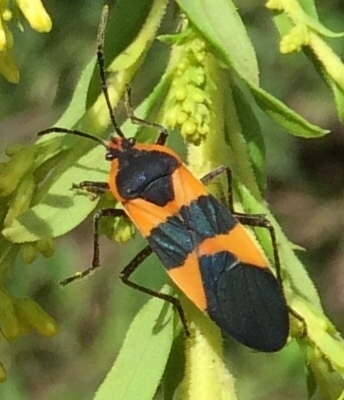
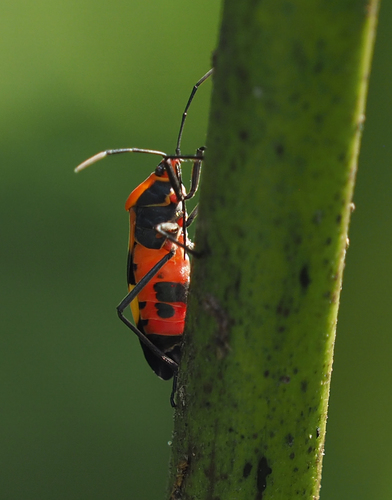
Adults are elongate-oval, about 12-18 mm long, with a bold color pattern: bright orange to red areas marked with black across the body and wings. The dorsal surface shows a black band across the center of the wings and large black markings on the pronotum and head. The wings are held flat over the abdomen, showing the orange-red membrane with black veins. Nymphs are wingless and similarly patterned in orange and black; younger instars are more uniformly orange or red and develop black markings as they grow.
- Bright orange-red body with bold black banding across wings and black markings on head and pronotum
- Adult length 12-18 mm, elongated oval shape with wings covering the abdomen
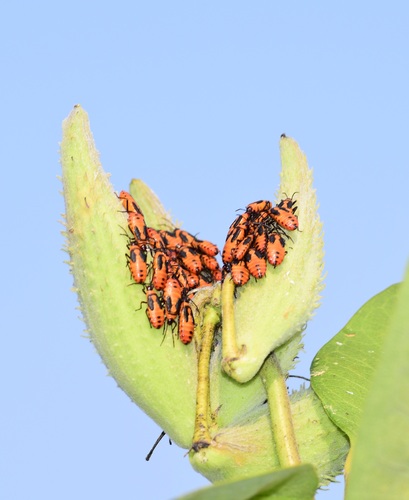
- Aggregates on milkweed seed pods and flowers in conspicuous groups
Lookalikes
Small milkweed bug Lygaeus kalmii
Smaller (about 10-12 mm) with a red-orange X-shaped pattern across a black back and a white-spotted black wing tip, rather than the broad alternating orange and black bands of the large milkweed bug.
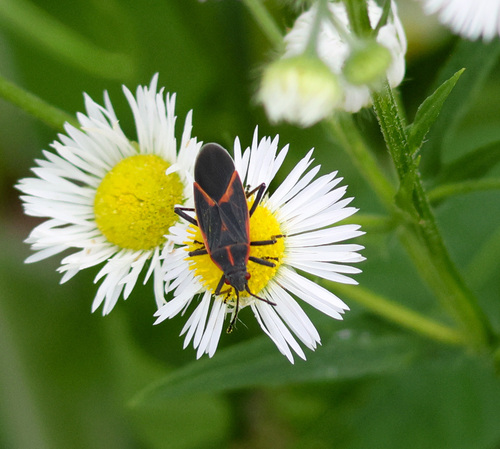
Boxelder bug Boisea trivittata
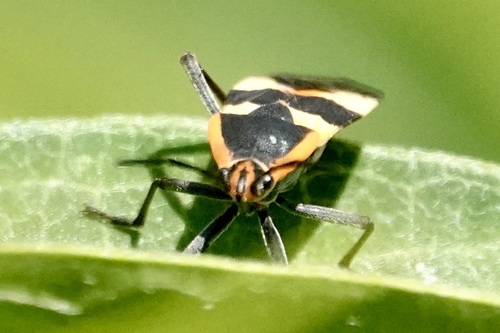
Mostly black with thin red-orange lines on the pronotum and wing edges rather than broad orange bands; found on boxelder and maple trees and often gathers on sunny house walls in autumn.
↻Life cycle
Egg
Females lay clusters of small, elongated eggs in cracks between milkweed seed pods or among seeds. Eggs hatch in about 4-7 days in warm weather.
Nymph
Nymphs pass through five instars; all are wingless. Early instars are bright orange-red, and later instars develop black markings and wing pads as they grow.
Adult
Adults are winged and capable of flight; they aggregate on flowers and seed pods to feed and mate. Adults overwinter in warmer regions or die off with frost in colder areas, with new generations emerging in spring.
🍃Diet and predators
Young eat
Mostly developing milkweed seeds and seed pod tissues; occasionally other nearby seeds and plant fluids
Adults eat
Primarily milkweed seeds and the juices from seed pods; will also feed on other large-seeded plants if milkweed is scarce
Predators of the young
Ants, predatory insects (assassin bugs, lacewing larvae), spiders, and small birds
Predators of adults
Birds, predatory insects and spiders; bright coloration and milkweed-derived toxins provide some protection from generalist predators
🌱Effect on plants and gardens
Feeds primarily on developing seeds of milkweed species; heavy local infestations can reduce seed production but rarely kill mature plants. Occasionally will feed on seeds of other plants if available.
📍Where and when to find it
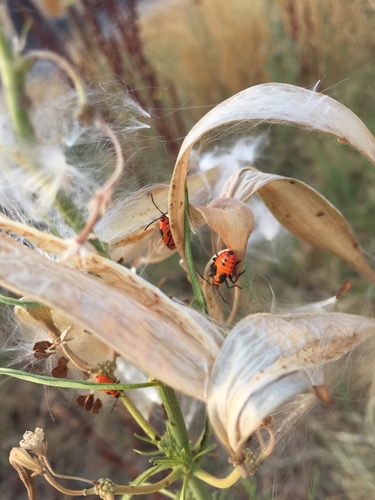
On flowers and seed pods of milkweed (Asclepias spp.). Look for clusters of adults and nymphs on pods and stems.
Best time
Late spring through autumn when milkweed is flowering and setting seed; observe during daylight hours when they are active.
Observation tips
Approach slowly because they may fly off. Photograph groups on seed pods for striking images; use shallow depth of field to show patterning. If rearing, collect unopened pods with eggs or early instar nymphs.
✨Fun facts
- Large milkweed bugs sequester chemicals from milkweed that make them distasteful to many predators, which is why their bright colors act as a warning.
- They are commonly used in laboratory and classroom studies of insect development because they are easy to rear on milkweed seeds.
- Nymphs and adults often form dense aggregations on a single milkweed plant when seeds are available.
?Frequently asked questions
Are large milkweed bugs harmful to people?
No — they are not venomous and don’t pose a health risk. They can give a mild pinch if handled and may emit a faint odor if crushed.
Do large milkweed bugs bite?
They rarely bite people. Their mouthparts are for piercing seeds; a defensive nip can occur but is not venomous.
Why are these bugs on my milkweed?
They feed on developing milkweed seeds and fluids from seed pods, so they congregate where seeds are available.
Will they kill my milkweed plants?
Heavy local feeding can reduce seed production but usually does not kill mature plants. Seed loss is the main impact.
How can I get rid of them?
Remove seed pods before they mature, handpick and drop bugs into soapy water, spray with a strong jet of water, or vacuum them off plants. Use insecticides only as a last resort.
Are they beneficial?
They are not pollinators but are a natural part of milkweed ecosystems and provide food for predators and researchers studying insect ecology.
📷Photos of the large milkweed bug
More true bugs, cicadas & aphids
Bites cause itching
Non-venomous nuisance
Non-toxic
Smelly secretion
Potential disease vector
Painful bite
This guide was written with AI assistance and fact-checked, last updated 2026-10-10. Identification from photos is never certain: don't handle insects you can't identify, and get medical advice for bites, stings or allergic reactions. More about the large milkweed bug: iNaturalist, Wikipedia.