
Green shield bug
Palomena prasina · Shield bugs
A common European shield bug that is green in summer, feeds on plant sap, and emits a defensive odour when disturbed.
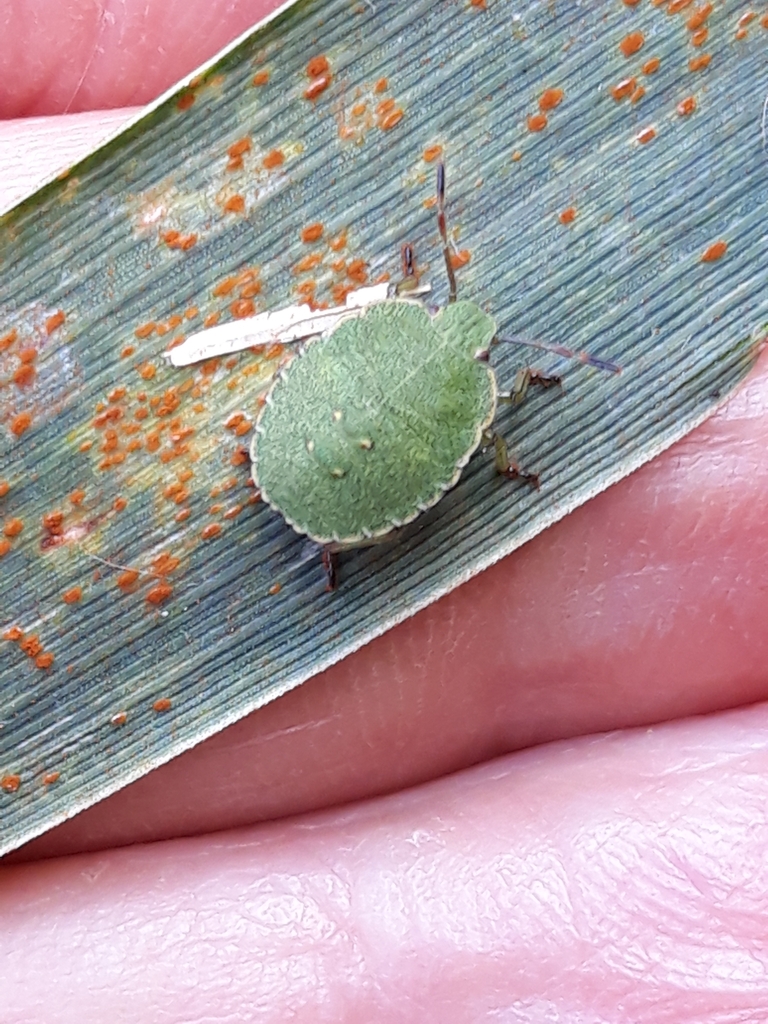
!Is the green shield bug dangerous?
No. Not venomous and not dangerous. May emit a strong, unpleasant smelling defensive secretion if handled. This smell can cling to fingers or fabric; wash with soap and water. Rarely may cause mild skin irritation in very sensitive people.
Pets
Generally harmless to pets; pets may be deterred by the smell. Not known to be poisonous if ingested, but could cause mild stomach upset if eaten in quantity.
📖Overview
Palomena prasina is a medium-sized shield bug common across Europe and parts of western Asia and North Africa. Adults are typically active in summer and autumn; they feed by inserting their needle-like mouthparts into leaves, fruits and seeds to suck plant juices. When disturbed they release a distinctive smelling secretion from glands on the abdomen. In autumn many turn brown before seeking sheltered overwintering sites.
🔍How to identify a green shield bug
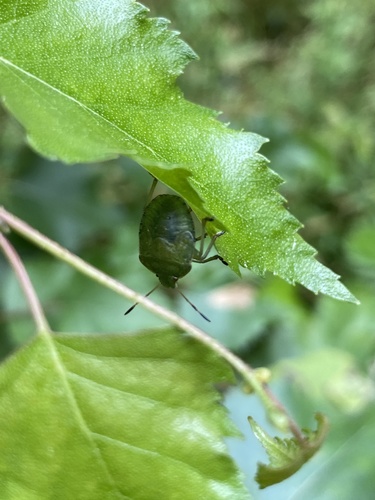
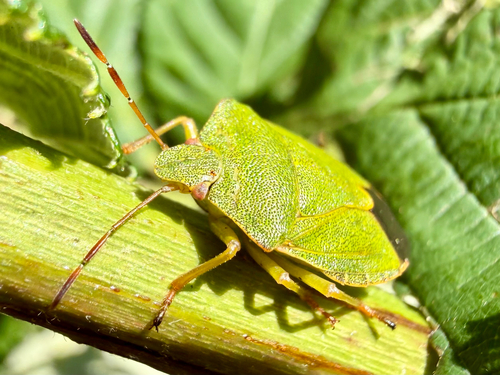
Adults are broadly shield-shaped (typical of shield bugs) with a slightly flattened, rounded body and a small head. In summer the dorsal coloration is bright to mid green; in autumn and late season many adults become brown or mottled. The scutellum (large triangular plate on the back) is prominent and reaches well toward the rear of the abdomen. Antennae are banded with darker segments. Nymphs (immature stages) are wingless and go through several instars, changing colour and pattern as they grow.
- Broad, shield-shaped body 12-14 mm long with a large scutellum covering much of the back
- Bright green dorsally in summer, often turning brown or mottled in autumn
- Antennae with darker banding; legs usually green to brown
- When disturbed, may emit a noticeable foul odour (stink) from abdominal glands
Lookalikes
Southern green shieldbug Nezara viridula
Nezara viridula is slightly larger and more elongate, usually with three small pale spots along the front edge of the scutellum, and has clear rather than brown wing membranes; it is most common in warmer regions.
Rare green shieldbug Palomena viridissima
Almost identical; in P. viridissima the side margins of the pronotum are straight or slightly convex, whereas in P. prasina they are slightly concave. It is much rarer in most of Europe.
↻Life cycle
Egg
Laid in clusters on the underside of leaves in spring; small barrel-shaped eggs that hatch in 1-2 weeks depending on temperature.
Nymph (juvenile)
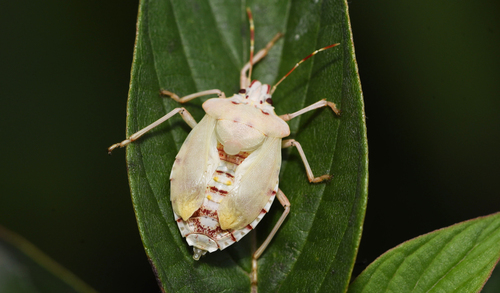
Several nymphal instars, wingless and progressively larger; nymphs feed on the same plants as adults and change colour/pattern as they grow.
Adult (shield bug)
Winged, reproductively mature bugs. Adults are present through summer and often overwinter in sheltered sites to reproduce the following spring.
🍃Diet and predators
Young eat
Plant sap from leaves, shoots, fruits and seeds
Adults eat
Plant sap from a wide range of broadleaved trees, shrubs and herbaceous plants; will feed on fruit and seeds
Predators of the young
Predatory insects (e.g., assassin bugs and some wasps), spiders, birds
Predators of adults
Birds, small mammals and predatory insects; eggs and young nymphs are often parasitized by wasps
🌱Effect on plants and gardens
Feeds on a wide range of broadleaved trees, shrubs and herbaceous plants. It pierces fruits, seeds and developing shoots to feed on sap; in orchards and gardens large numbers can cause cosmetic damage to fruit and reduce yield.
How to get rid of green shield bugs
Remove by hand when numbers are low; use a jar of soapy water to collect them. Reduce overwintering sites by sealing cracks and gaps around buildings and removing piles of garden debris. In orchards and large outbreaks consult local integrated pest management guidance; avoid broad-spectrum insecticides where possible to protect beneficial insects.
📍Where and when to find it
Look on leaves, branches and fruits of broadleaved trees, shrubs and garden plants; eggs on leaf undersides; nymphs on the same host plants.
Best time
Best seen from late spring through early autumn, especially in warm sunny weather and at dusk when they are active.
Observation tips
Approach slowly for photos to avoid startling them; use a macro setting and focus on the scutellum and antennae for identification. In autumn look on walls and window frames where overwintering adults collect.
✨Fun facts
- Many adults change from green to brown in autumn — a seasonal colour change linked to preparation for overwintering.
- Shield bugs are not true beetles; they belong to the order Hemiptera and have piercing-sucking mouthparts.
- The 'shield' name comes from the large triangular scutellum that is very visible on their back.
?Frequently asked questions
Are green shield bugs dangerous to people?
No — they are not venomous or disease vectors. They can release an unpleasant smelling secretion if handled.
Do green shield bugs bite?
They can probe with their mouthparts but do not bite people in the way mosquitoes or biting insects do; they do not seek human blood.
Why are green shield bugs in my house?
In autumn adults often seek sheltered overwintering sites and may enter houses through small gaps, attracted by warm, sheltered spots.
How do I get rid of green shield bugs?
Collect them by hand or with a cup into soapy water, seal entry points to prevent overwintering, and reduce nearby vegetation where large numbers congregate.
Will they damage my fruit trees or garden?
They feed on fruits, seeds and shoots; small numbers cause little harm but large infestations can cause cosmetic damage to fruit and reduce yield.
📷Photos of the green shield bug
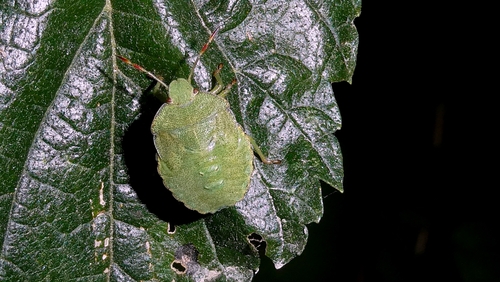
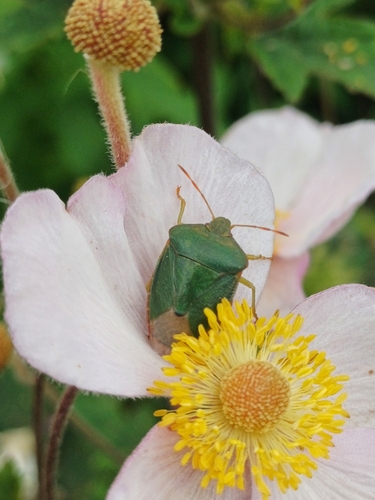
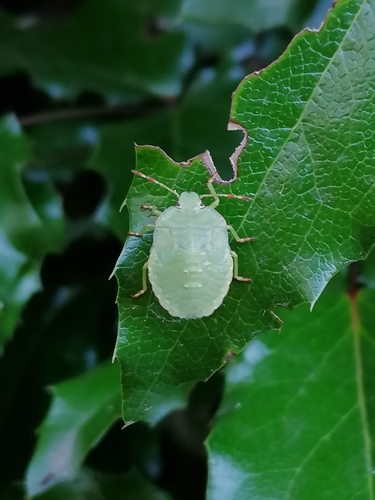
More true bugs, cicadas & aphids
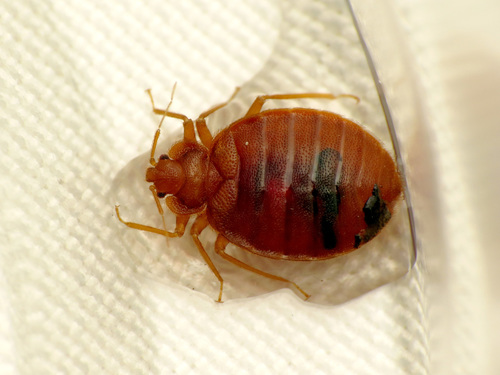
Bites cause itching
Non-venomous nuisance
Non-toxic
Smelly secretion
Potential disease vector
Painful bite
This guide was written with AI assistance and fact-checked, last updated 2026-10-10. Identification from photos is never certain: don't handle insects you can't identify, and get medical advice for bites, stings or allergic reactions. More about the green shield bug: iNaturalist, Wikipedia.