
Two-lined spittlebug
Prosapia bicincta · Spittlebugs (froghoppers)
A small sap-feeding froghopper with two orange-red bands across its dark wings; nymphs make foamy 'spittle' on grasses and adults can damage turf and pastures.
!Is the two-lined spittlebug dangerous?
No. Two-lined spittlebugs are not venomous and do not bite or sting people. They are harmless to touch, though adults jump strongly if disturbed.
Pets
Not toxic to pets. Heavy infestations can damage grass that pets use, but insects themselves are not dangerous if eaten by a dog or cat.
📖Overview
Prosapia bicincta is a common froghopper (spittlebug) of eastern North America. Nymphs produce the characteristic foamy masses called spittle while sucking plant sap; adults are strong jumpers and feed openly on grass blades and stems. They are most noticeable in warm months and can become a minor to moderate pest of lawns, sod, pastures and some forage grasses when populations are high.
🔍How to identify a two-lined spittlebug
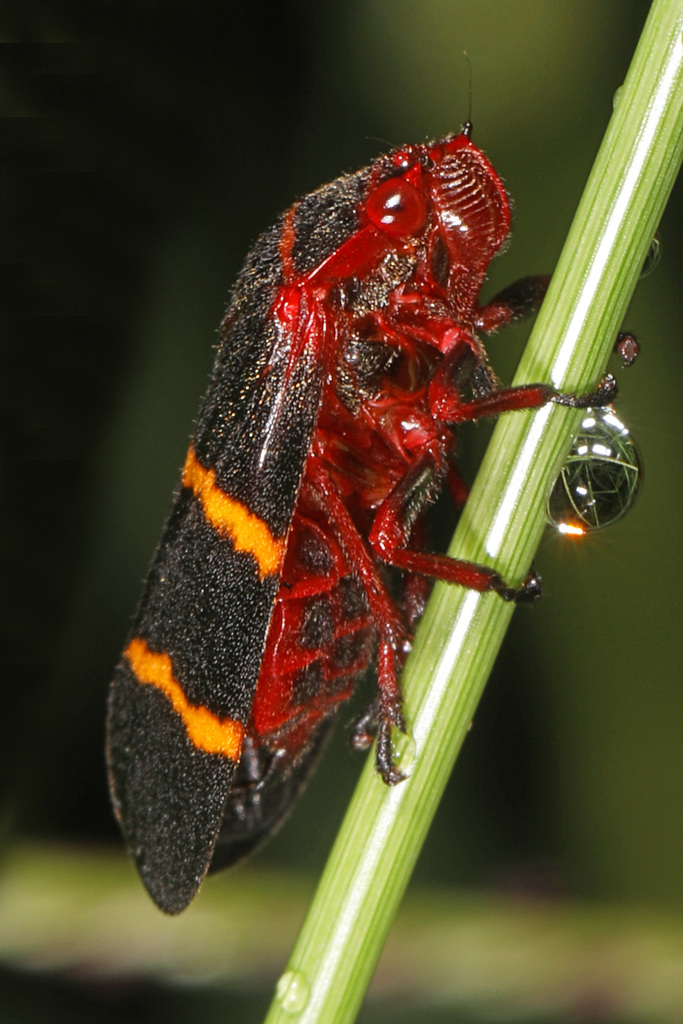
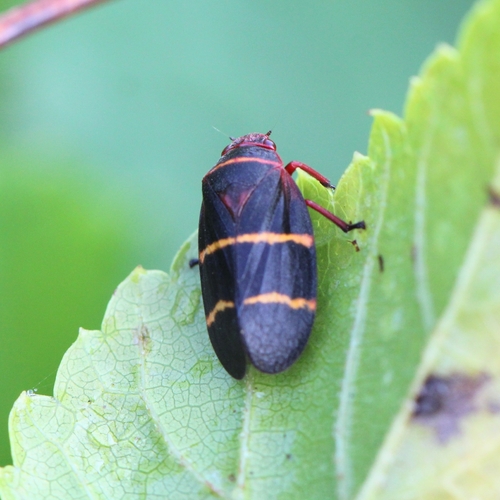
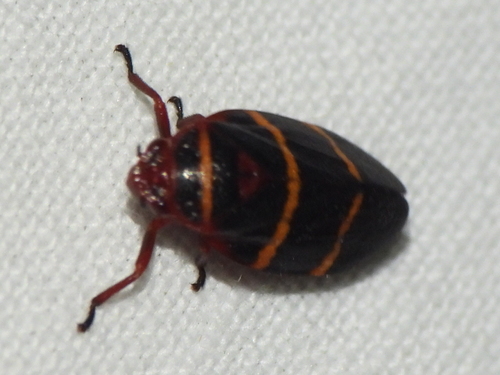
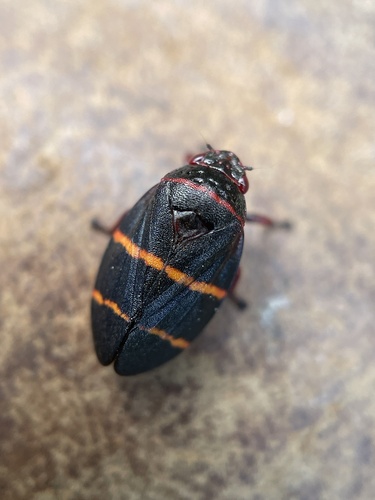
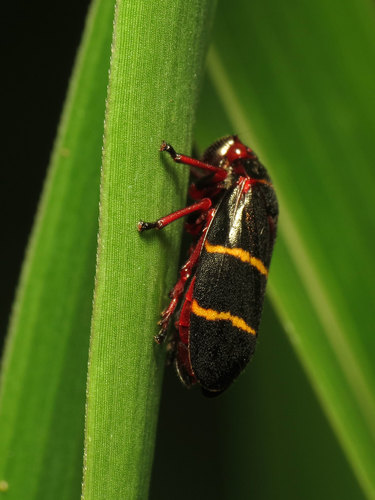
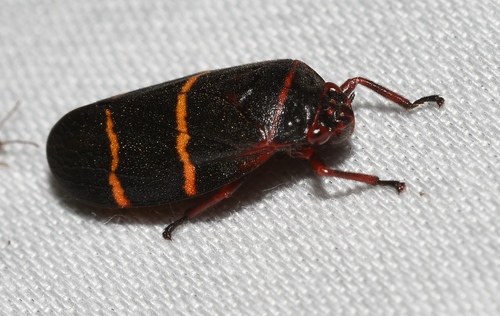
Adults are compact, wedge-shaped insects with a robust body and large hind legs adapted for jumping. They are typically dark brown to black with two distinct orange to red bands running across the forewings (hence the common name), and often a third thin line across the pronotum. The head and pronotum are also dark, and veins on the wings are visible. Nymphs are pale greenish to yellowish and are usually found inside white, frothy spittle masses that conceal them while they feed.
- Two distinct orange-red bands across the wings of a dark brown to black adult
- Adults about 8-11 mm long with wedge-shaped body and strong hind legs for jumping
- Nymphs hidden in white, foamy spittle masses attached to grass stems or leaf sheaths
- Damage appears as patchy yellowing or browning of turf where large numbers are feeding
Lookalikes
Meadow spittlebug Philaenus spumarius
Philaenus spumarius (common in Europe and also introduced in North America) usually lacks the pair of bold red/orange lines and has more variable mottled coloration; its spittle masses may look similar but adult wing pattern differs.
Diamondback spittlebug Lepyronia quadrangularis
Brown with a darker diamond-shaped pattern on the back when the wings are closed, rather than bright orange-red bands on a black body.
↻Life cycle
Egg
Eggs are laid in grass stems or plant debris in late summer and fall and overwinter in the vegetation.
Nymph (spittle-producing)
In spring and early summer eggs hatch to produce wingless nymphs that feed on sap and produce protective frothy spittle masses on grass stems or leaf sheaths.
Adult (froghopper)
Adults emerge in summer, feed openly on grasses, and are capable of strong jumps; they mate and females lay eggs for the next generation.
🍃Diet and predators
Young eat
Sap from grasses and grass stems while concealed in spittle
Adults eat
Sap from grass blades and stems; feed openly on turf and pasture grasses
Predators of the young
Predatory insects (lady beetles, lacewings), spiders, birds; spittle provides partial protection
Predators of adults
Birds, predatory insects, spiders
🌱Effect on plants and gardens
Nymphs feed on sap of grasses, especially turf and forage grasses; adults also feed on ornamental hollies, causing leaf spotting. Heavy feeding by large numbers of adults can cause yellowing, browning and reduced vigor in turf, sod and pastures; damage is usually patchy.
How to get rid of two-lined spittlebugs
Cultural: maintain dense, healthy turf by proper mowing, irrigation and fertilization to reduce visible damage. Mechanical: remove or disturb visible spittle masses to expose nymphs to predators. Biological/chemical: natural enemies (predatory insects, birds) help reduce numbers; insecticides (targeted lawn or pasture products labeled for spittlebugs/froghoppers) can be used if monitoring shows damaging populations — treat when nymphs are abundant inside spittle for best effect. Always follow label directions and consider spot treatments rather than blanket spraying.
📍Where and when to find it
Nymphs: inside white foamy spittle masses on grass stems and leaf sheaths. Adults: on grass blades and stems, or flying/jumping nearby. Look in lawns, meadows, pastures and roadside grasses.
Best time
Late spring through summer on warm, sunny days; daytime is best for seeing adults.
Observation tips
Search lower parts of grass stems for spittle; gently part the foam to reveal a concealed nymph. Photograph adults by approaching slowly to avoid triggering their jump.
✨Fun facts
- Nymphs hide inside a frothy 'spittle' mass they produce by mixing plant sap with air and secretions; the foam helps hide them and keeps them moist.
- Despite the name 'spittlebug', adults are strong jumpers and are often called froghoppers for their jumping ability.
- Damage from adults is most visible on warm sunny days when many adults are feeding and conspicuous on turf.
?Frequently asked questions
Do two-lined spittlebugs bite?
No. They feed on plant sap and do not bite or sting people.
Why is there white foam on my grass?
That foam is 'spittle' produced by spittlebug nymphs; it houses and protects the nymphs while they feed on the grass.
Can two-lined spittlebugs kill my lawn?
They can cause patchy yellowing and browning if large numbers are present, especially in stressed or thin turf, but they rarely kill healthy, well-maintained lawns.
How do I get rid of spittlebugs in my yard?
Promote healthy turf through proper watering, mowing and fertilizing, remove spittle by hand or water spray to expose nymphs, and consider targeted insecticide treatment only if monitoring shows damaging populations and label directions recommend it.
When are two-lined spittlebugs most active?
Adults are most obvious in warm months from late spring through summer; nymphs and their spittle are common in spring to early summer.
📷Photos of the two-lined spittlebug
More true bugs, cicadas & aphids
Bites cause itching
Non-venomous nuisance
Non-toxic
Smelly secretion
Potential disease vector
Painful bite
This guide was written with AI assistance and fact-checked, last updated 2026-10-10. Identification from photos is never certain: don't handle insects you can't identify, and get medical advice for bites, stings or allergic reactions. More about the two-lined spittlebug: iNaturalist, Wikipedia.