
Rabid wolf spider
Rabidosa rabida · Wolf spiders
A large, fast ground-dwelling wolf spider with a bold striped pattern and wandering hunting habits, often found near houses and gardens.
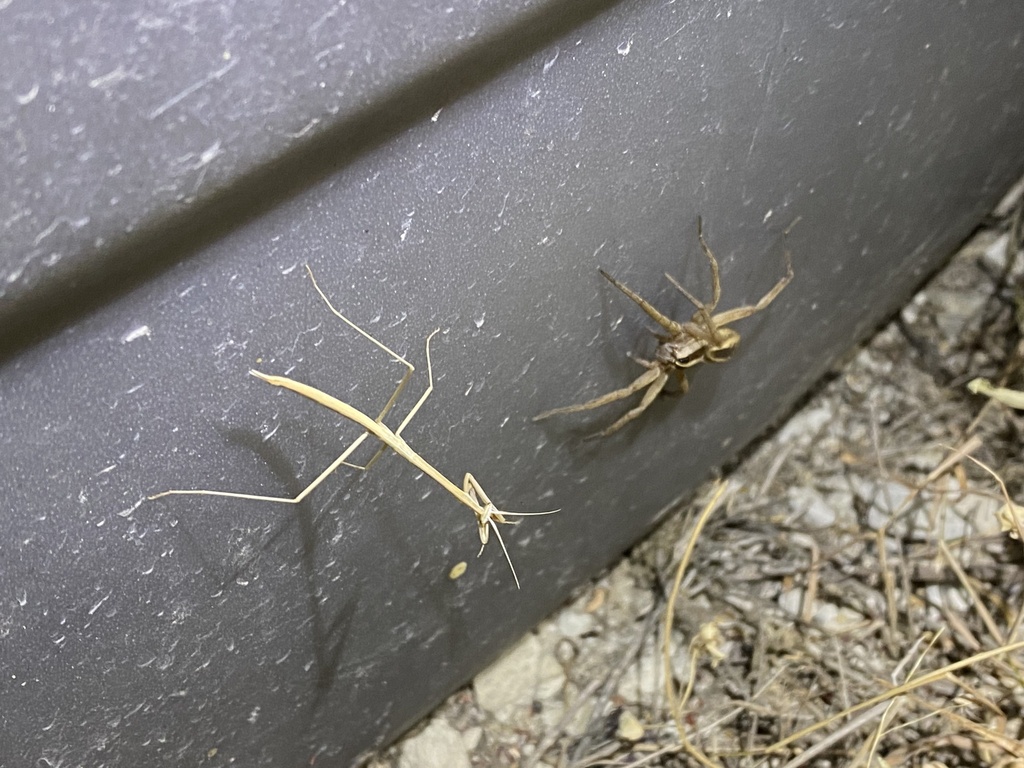
!Is the rabid wolf spider dangerous?
Only mildly. Rabidosa rabida can bite if handled or threatened. Bites are usually painful like a bee sting, may cause local redness, swelling and brief pain. Serious reactions are rare; seek medical care if you experience severe swelling, spreading redness, difficulty breathing, or other signs of an allergic reaction.
Pets
A bite to a small pet could cause local pain and swelling; severe systemic problems are unlikely but monitor pets and consult a veterinarian if signs of distress appear.
📖Overview
Rabidosa rabida is a member of the wolf spider family (Lycosidae). It hunts on foot rather than using a web to catch prey, running down insects and other small arthropods. Adults are most often found on the ground in grassy, leaf-litter or edge habitats and sometimes wander into buildings. Females carry an egg sac attached to their spinnerets and often carry spiderlings on their back after hatching.
This species is widespread in suitable habitats across much of North America. It is an active, visual hunter that is primarily nocturnal but may be seen during the day. While its bite can be painful, Rabidosa rabida is not considered medically dangerous to healthy humans.
🔍How to identify a rabid wolf spider
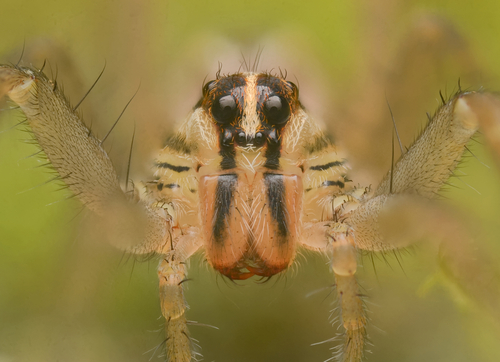
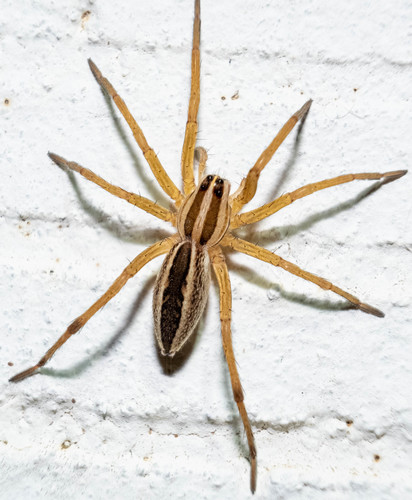
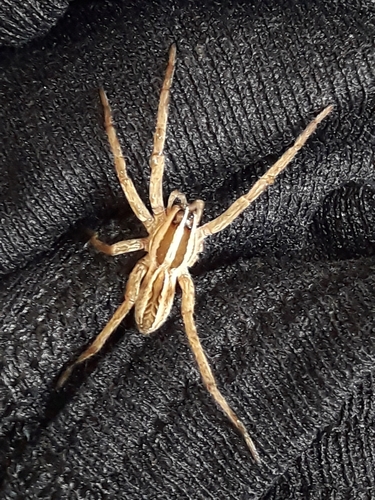
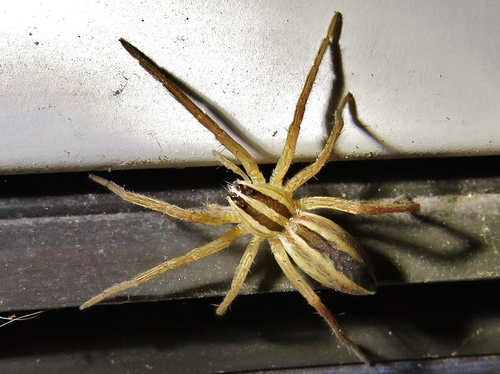
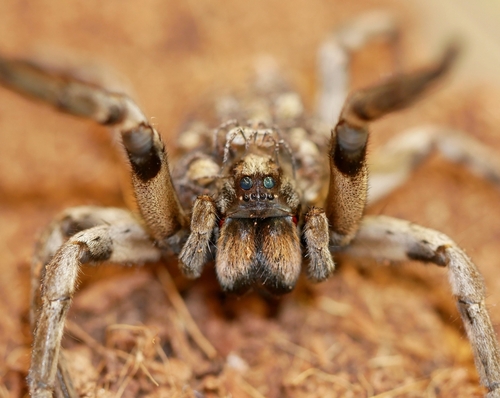
Adult Rabidosa rabida are relatively large wolf spiders, with body lengths typically in the range of 10-20 mm (not including legs). They have a robust, hairy body and long legs adapted for running. The carapace has two broad dark brown stripes separated by a pale median stripe; the abdomen has a dark central band with pale edges. Legs are banded or uniformly colored depending on the individual. Eye arrangement follows the wolf spider pattern: a row of four small eyes on the bottom, two very large forward-facing eyes above them, and two medium-sized eyes on the top rear of the carapace.
- Look for a robust, hairy wolf spider with two dark stripes on the carapace separated by a pale central stripe and a dark band down the abdomen.
- Check eye arrangement: two very large anterior eyes give a shiny, forward-looking appearance typical of wolf spiders.
- Size: noticeably larger than many house spiders, with long powerful legs adapted for running.
- Females may be seen carrying a round silk egg sac attached to the spinnerets; spiderlings may be carried on the mother's back.
Lookalikes
Dotted wolf spider Rabidosa punctulata
Very similar striped pattern and range, but the underside of the abdomen has dark dots and the dorsal abdominal band is less bold; usually slightly smaller.
Pardosa species Pardosa spp.
Pardosa wolf spiders are generally smaller and more slender with different eye and carapace patterning; Rabidosa rabida is bulkier with bold stripes.
↻Life cycle
Egg sac
Female carries a round silk egg sac attached to her spinnerets until the eggs are ready to hatch, protecting and transporting them.
Spiderling (immature)
After hatching, spiderlings may ride on the mother's back for a period before dispersing; juveniles resemble small adults and grow through repeated molts.
Adult
Adults are sexually mature hunters; males roam more in search of mates, females may remain nearer good hunting sites and carry eggs.
🍃Diet and predators
Young eat
Small insects and other tiny arthropods suitable for their size.
Adults eat
Ground-dwelling insects, spiders and other arthropods captured by running them down rather than using a web.
Predators of the young
Small vertebrates, larger spiders, beetles, ants, and parasitoids.
Predators of adults
Birds, small mammals, larger spiders, and wasps that prey on spiders.
🌱Effect on plants and gardens
This species does not feed on plants; it is a predator of insects and arthropods and can help reduce pest populations in gardens.
📍Where and when to find it
Search at ground level in leaf litter, along garden edges, under stones, logs and in low vegetation. Females carrying egg sacs or spiderlings may be found near sheltered, sheltered spots.
Best time
Spring through autumn; more active at night but often visible in early morning or late afternoon.
Observation tips
Use a low-angle, side-on photo to show body pattern and eye arrangement. Approach slowly and avoid handling; a macro lens or smartphone close-up will capture the eye shine and dorsal pattern well.
✨Fun facts
- Female wolf spiders carry their egg sacs and later their spiderlings on their back — a notable example of maternal care among spiders.
- Wolf spiders have excellent vision for spiders: the two large front eyes are useful for hunting and detecting motion.
- They do not build capture webs; instead they actively hunt and pounce on prey like tiny wolves of the ground.
?Frequently asked questions
Do rabid wolf spiders bite?
They can bite if provoked or handled, but bites are rarely serious and typically cause localized pain and swelling.
Are rabid wolf spiders poisonous to humans?
They are venomous like all spiders (use venom to subdue prey) but their venom is not considered dangerous to healthy humans.
Why is a wolf spider in my house?
They wander indoors while hunting or seeking shelter, especially in garages, basements and ground-level rooms near vegetation.
How do I get rid of wolf spiders?
Reduce clutter, seal cracks and gaps, remove debris and leaf litter near foundations, and use sticky traps; insecticide sprays are usually unnecessary for occasional visitors.
Where do rabid wolf spiders live?
On the ground in grassy areas, leaf litter, woodland edges, gardens and sometimes inside buildings across much of North America.
📷Photos of the rabid wolf spider
More spiders
This guide was written with AI assistance and fact-checked, last updated 2026-10-10. Identification from photos is never certain: don't handle insects you can't identify, and get medical advice for bites, stings or allergic reactions. More about the rabid wolf spider: iNaturalist, Wikipedia.