
Arrowhead orbweaver
Verrucosa arenata · Orb-weaver spiders
A small orb-weaver of eastern North America with a distinctive pale, arrowhead-shaped triangular mark on its abdomen; harmless and a useful garden predator.
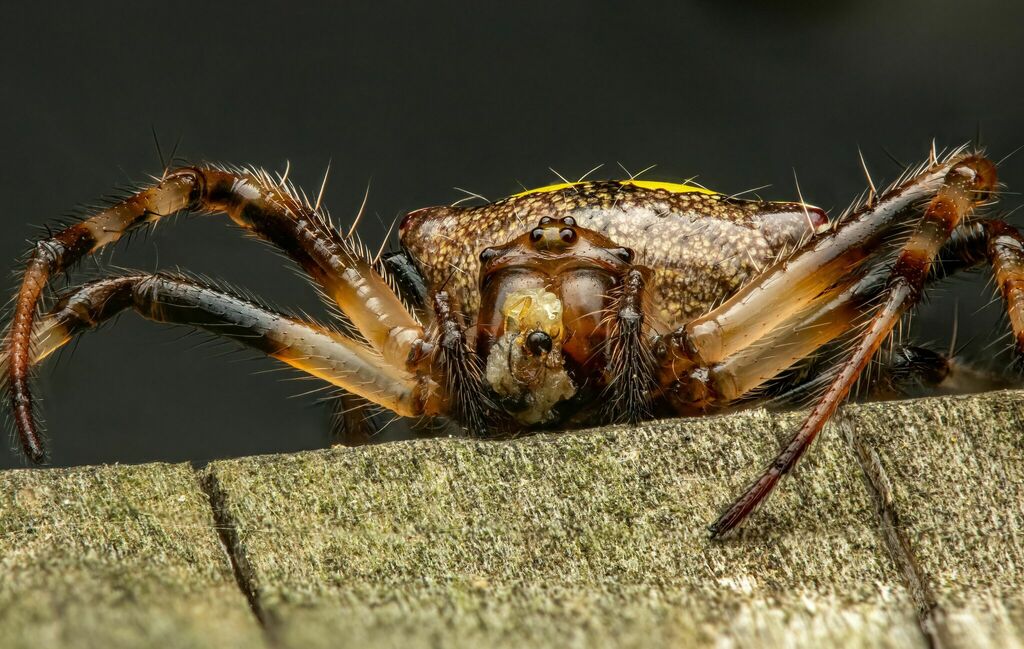
!Is the arrowhead orbweaver dangerous?
No. Arrowhead orbweavers are not dangerous to people. They rarely bite even if handled; any bite would cause only minor, short-lived local pain or redness. Standard first aid (clean the area, apply a cold pack) is sufficient; seek medical attention only if unusual symptoms or an allergic reaction occur.
Pets
Not a threat to pets. Small dogs or cats could receive a mild bite if they handle or play with the spider, but serious effects are unlikely.
📖Overview
Verrucosa arenata (arrowhead orbweaver) is a small orb-weaving spider common in eastern North America. Females are noticeably larger and more brightly patterned than males. They build classic vertical orb webs in low vegetation and around garden edges to catch small flying insects. The species is generally non-aggressive and poses no medical threat to people.
Arrowhead orbweavers are most often seen from mid summer through autumn. Like many orb-weavers they tend to rebuild or repair their webs at night and hide nearby by day. They help control small flying insect populations and are considered beneficial in gardens and natural areas.
🔍How to identify an arrowhead orbweaver
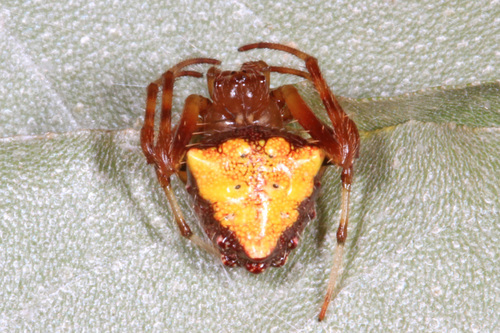
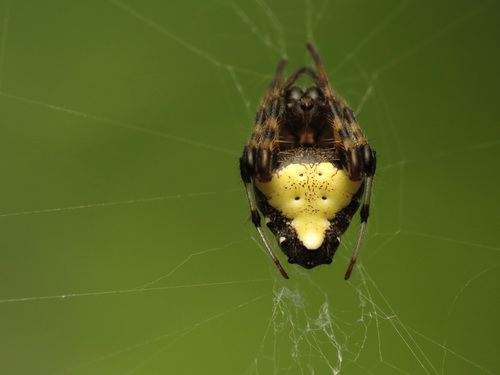
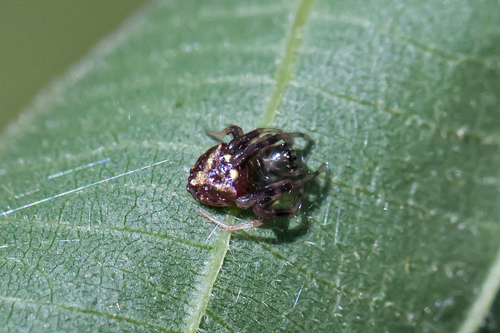
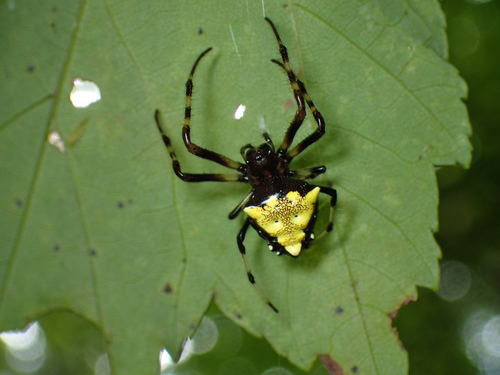
The most distinctive feature is the angular, roughly triangular abdomen, which bears a large pale yellow to white triangle pointing toward the head like an arrowhead. The rest of the abdomen and cephalothorax are brown to reddish-brown. Males are smaller and slimmer with less conspicuous markings. Legs are relatively short and banded in similar tones to the body. The spider usually rests at the hub of its web with its head pointing upward, unlike most orb-weavers.
- Look for an angular, triangular abdomen with a large pale yellow or white arrowhead-shaped triangle on a brown background.
- Rests at the web hub with its head pointing upward; males are smaller and duller.
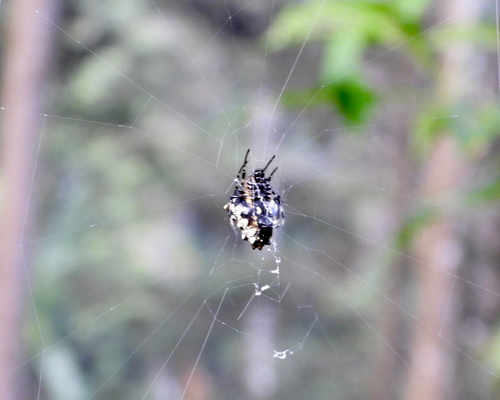
- Found on vertical orb webs in low shrubs, tall grasses or garden vegetation—spot the web first, then the spider near the center or at the web edge.
Lookalikes
Spiny-backed orb-weaver Gasteracantha spp.
Gasteracantha has a hard, flattened, white-and-black abdomen with spines; the arrowhead orbweaver has a softer triangular abdomen with a single pale arrowhead mark and no spines.
Arabesque orbweaver Neoscona arabesca
Neoscona arabesca has a rounded oval abdomen with a wavy pale-and-dark pattern rather than a single bold triangle, and usually hangs head-down in its web.
↻Life cycle
Egg sac
Females lay eggs in silken sacs attached to vegetation or other sheltered spots.
Juvenile (spiderling)
Spiderlings hatch and disperse by 'ballooning' on silk threads; they molt several times while growing and gradually develop adult markings.
Adult spider
Adults build orb webs to catch prey; mating occurs in late summer to autumn and adults typically die after reproduction or before winter.
🍃Diet and predators
Young eat
Small flying insects and other tiny arthropods
Adults eat
Flies, mosquitoes, small moths and other small flying insects caught in their orb webs
Predators of the young
Birds, predatory insects, parasitic wasps and larger spiders
Predators of adults
Birds, wasps, larger spiders and small mammals
🌱Effect on plants and gardens
Does not feed on plants; captures small flying insects (flies, mosquitoes, moths) and so helps reduce pest numbers in gardens
📍Where and when to find it
Look for vertical orb webs in low shrubs, tall grasses, garden plants and along forest edges. Adults are often at the web hub or hiding nearby on vegetation.
Best time
Mid summer through autumn; dusk and night are good times to see them repairing or hunting on webs.
Observation tips
Approach slowly to avoid disturbing the web. Use a flash or side lighting for photos to bring out the pale arrow marking on the abdomen without overexposing colors.
✨Fun facts
- The species gets its common name from the arrowhead-shaped pale triangle on its abdomen.
- Females are often much larger and more brightly colored than males, a common trait in orb-weaver spiders.
- Spiderlings commonly disperse by 'ballooning'—releasing silk threads and drifting on air currents to new locations.
?Frequently asked questions
Do arrowhead orbweavers bite?
Bites are very rare even when handled. Any bite would cause only minor, short-lived local pain or redness.
Are arrowhead orbweavers dangerous to humans?
No. They are considered harmless and are not medically significant.
Why is an arrowhead orbweaver in my house?
They sometimes wander indoors at night while hunting or following prey. More commonly you will find them in garages, porches or near windows rather than deep inside living spaces.
How do I get rid of arrowhead orbweavers?
If you want to remove one, use a cup and a stiff piece of paper to transfer it outside. Avoid smashing it; these spiders are harmless and help control pests. To discourage webs, reduce outdoor lighting at night and clear tall vegetation near doors and windows.
Where do arrowhead orbweavers live?
They live in eastern and central North America in woodland edges, shrubby areas, gardens and places with low vegetation suitable for anchoring orb webs.
📷Photos of the arrowhead orbweaver
More spiders
This guide was written with AI assistance and fact-checked, last updated 2026-10-10. Identification from photos is never certain: don't handle insects you can't identify, and get medical advice for bites, stings or allergic reactions. More about the arrowhead orbweaver: iNaturalist, Wikipedia.