
White-banded crab spider
Misumenoides formosipes · Crab spiders
Small ambush predator often found on flowers; females have a distinctive white band across the abdomen and can change color to match flowers.

!Is the white-banded crab spider dangerous?
Only mildly. Crab spiders are venomous to their insect prey but are not dangerous to people. Bites to humans are rare and usually cause only minor, brief pain, redness or local swelling. Clean the area with soap and water and apply a cold pack if needed. Seek medical care if you have a strong allergic reaction.
Pets
Generally not a threat to cats or dogs. A bite could cause transient local irritation in small pets but serious effects are unlikely.
📖Overview
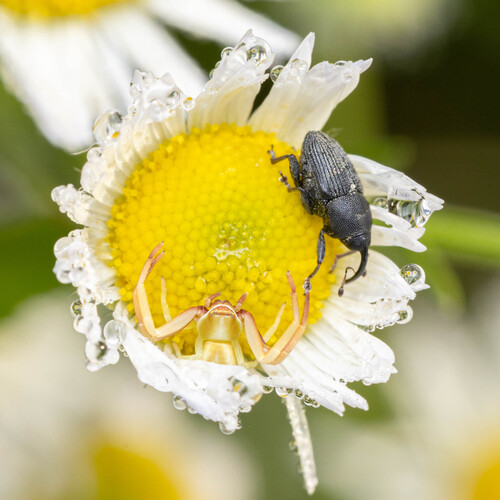
Misumenoides formosipes is a crab spider in the family Thomisidae known for sitting motionless on flowers and catching pollinating insects. Females are larger and more stout than males; they may be white or yellow, sometimes with reddish markings on the abdomen, and have a distinctive white ridge (band) across the face below the eyes that gives the species its name. Males are much smaller and more slender, with darker reddish-brown and green front legs. These spiders do not build capture webs but rely on camouflage and quick strikes to subdue prey.
🔍How to identify a white-banded crab spider
Females are stocky with the first two pairs of legs held out to the sides, giving a crab-like posture. The key feature is a white ridge or band across the face below the eyes. The abdomen is white to yellow, sometimes with faint reddish markings. Males are much smaller and slimmer, with darker, reddish-brown to greenish front legs. The body is smooth without heavy hair.
- Look for a white ridge or band across the face just below the eyes.
- Crab-like stance with front two pairs of legs held wide and flattened body.
- Females may be white, yellow or pale green and can slowly change color to match flowers.
- Males are much smaller and more slender, with darker reddish-brown to greenish front legs.
Lookalikes
Goldenrod crab spider Misumena vatia
Misumena vatia is also white or yellow but lacks the white ridge below the eyes, and females often have red stripes along the sides of the abdomen; check the face to separate them.
Other Misumenoides species Misumenoides spp.
Related species may look similar; identification often requires close inspection of markings or genitalia, or knowledge of local species.
↻Life cycle
Egg sac
Females lay eggs in a silken sac attached to plant stems or leaf undersides; the female may guard the sac until spiderlings emerge.
Spiderlings (juvenile)
Young spiders disperse from the egg sac and undergo several molts. Juveniles resemble adults but are smaller and lack full color patterns.
Adult
Adults are sexually mature, with females larger and able to change color slowly to match flowers; mating occurs in late summer to autumn in temperate regions.
🍃Diet and predators
Young eat
Small flying insects such as tiny flies and aphids
Adults eat
Bees, flies, butterflies, moths and other flower-visiting insects captured by ambush
Predators of the young
Predatory insects (wasps), ants, larger spiders and small birds
Predators of adults
Wasps, birds and larger spiders
🌱Effect on plants and gardens
Not harmful to plants; they ambush insects that visit flowers, including both pest insects and pollinators.
📍Where and when to find it
Adults on open flowers (daisies, goldenrod, milkweed); egg sacs on stems or leaf undersides; juveniles on foliage near flowers.
Best time
Late spring to early autumn, daytime when pollinators are active.
Observation tips
Approach slowly to avoid startling them; use a macro lens or phone close-up mode. Photograph from the side to show the crab-like stance and the white band below the eyes.
✨Fun facts
- Females can change color between white and yellow over a few days to better match the flower they are sitting on.
- They sit openly on flowers and catch much larger prey, including bees and butterflies, by striking quickly.
- Their crab-like front legs allow them to seize prey from the side and walk sideways like a crab.
?Frequently asked questions
Do white-banded crab spiders bite?
They can bite if handled or pressed, but bites are rare and usually cause only minor local pain, redness or swelling.
Are white-banded crab spiders poisonous to humans?
They have venom for subduing prey, but it is not dangerous to humans. Serious reactions are very uncommon.
Why is there a crab spider on my flowers?
They sit on flowers to ambush visiting pollinators and other insects — flowers are hunting grounds rich in prey.
How can I get rid of them in my garden?
They are beneficial predators and usually do not need removal. If necessary, hand-remove spiders into a jar and release them away from high-traffic flowerbeds; avoid pesticides that harm pollinators.
When and where will I find them?
Look on daisy-like flowers, goldenrod, milkweed and blooms in meadows and gardens from spring through autumn, during daytime when insects visit flowers.
📷Photos of the white-banded crab spider


More spiders
This guide was written with AI assistance and fact-checked, last updated 2026-10-10. Identification from photos is never certain: don't handle insects you can't identify, and get medical advice for bites, stings or allergic reactions. More about the white-banded crab spider: iNaturalist, Wikipedia.