
Goldenrod crab spider vs White-banded crab spider
These two are easy to mix up. Here's how to tell a goldenrod crab spider from a white-banded crab spider, and whether either one bites or stings.
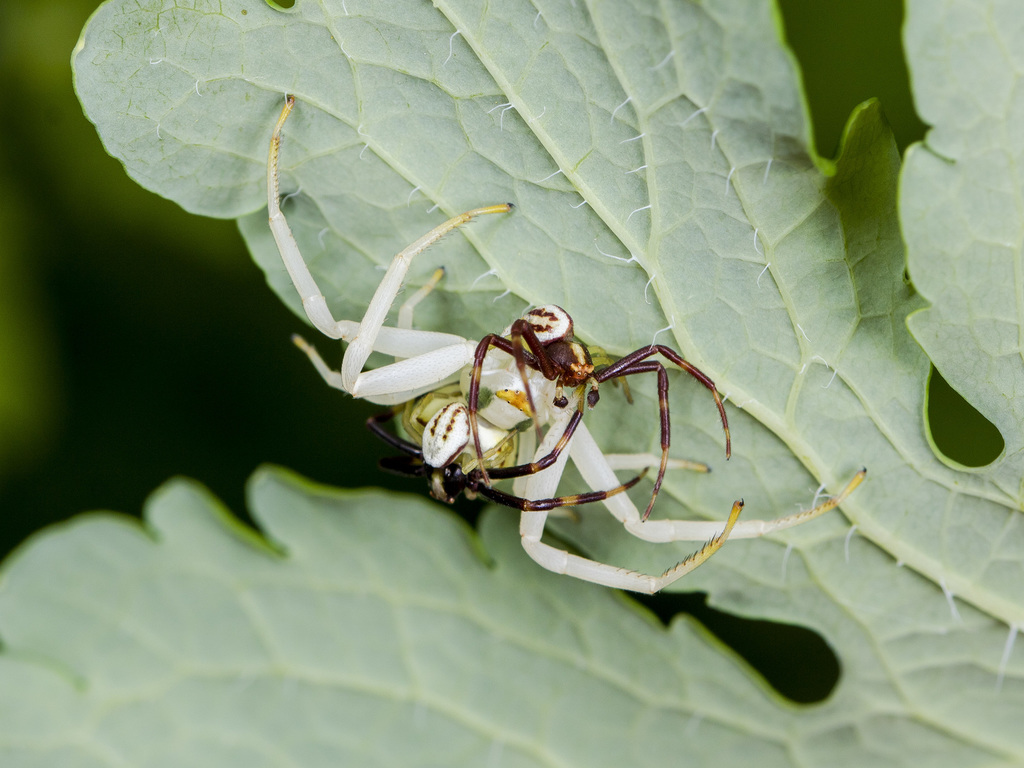
Goldenrod crab spider
Misumena vatia

White-banded crab spider
Misumenoides formosipes
≠The key differences
Very similar in habit and appearance; M. formosipes females often show more distinct dorsal markings and the two species are separated by subtle differences in genital morphology and local distribution. Field separation can be difficult.
Misumena vatia is also white or yellow but lacks the white ridge below the eyes, and females often have red stripes along the sides of the abdomen; check the face to separate them.
⚖︎Side by side
| Goldenrod crab spider | White-banded crab spider | |
|---|---|---|
| To humans | Mild bite | Mild bite |
| Size | Females 6-10 mm body length; males 3-5 mm | Females 6-9 mm body length; males 3-4 mm body length |
| Colours | White, Bright yellow, Pale pink | White, Lemon Yellow, Pale Green, Brown |
| Family | Thomisidae | Thomisidae |
| Habitat | Sunny meadows, gardens and edges with abundant flowering plants, especially goldenrod, daisies, umbels and composite flowers | Meadows, gardens, hedgerows and other areas with abundant flowering plants; commonly found on daisy-like flowers, goldenrod and milkweed. |
| Range | Holarctic: widespread in North America and Europe; also reported in parts of temperate Asia | Eastern North America, from Canada through the United States; range overlaps many temperate eastern habitats. |
| Active | Daytime active; most common in late spring through autumn (depending on region), peaking when target flowers bloom | Spring to autumn (temperate regions); active during daytime when flowers are visited by insects. |
| Pest? | No | No |
🔍How to spot a goldenrod crab spider
- Sits on flowers with front legs spread sideways in a crab-like posture
- Females 6-10 mm body length; very variable color but commonly white or bright yellow matching the flower
- Slow color change between white and yellow over days (compared with instant camouflage of some insects)
- No web used for prey capture; found on open flowers rather than in webs
🔍How to spot a white-banded crab spider
- Look for a white ridge or band across the face just below the eyes.
- Crab-like stance with front two pairs of legs held wide and flattened body.
- Females may be white, yellow or pale green and can slowly change color to match flowers.
- Males are much smaller and more slender, with darker reddish-brown to greenish front legs.
?Frequently asked questions
What is the difference between a goldenrod crab spider and a white-banded crab spider?
Very similar in habit and appearance; M. formosipes females often show more distinct dorsal markings and the two species are separated by subtle differences in genital morphology and local distribution. Field separation can be difficult. Misumena vatia is also white or yellow but lacks the white ridge below the eyes, and females often have red stripes along the sides of the abdomen; check the face to separate them.
Is a goldenrod crab spider or a white-banded crab spider more dangerous?
Goldenrod crab spider: Mild bite. White-banded crab spider: Mild bite. These spiders are not dangerous to people. Crab spiders are venomous to their insect prey but are not dangerous to people.
Identification from photos is never certain: don't handle insects you can't identify, and get medical advice for bites, stings or allergic reactions.