
Promethea moth
Callosamia promethea · Silk moths
A medium-large North American silk moth notable for strong sexual dimorphism and caterpillars that feed on several deciduous trees.
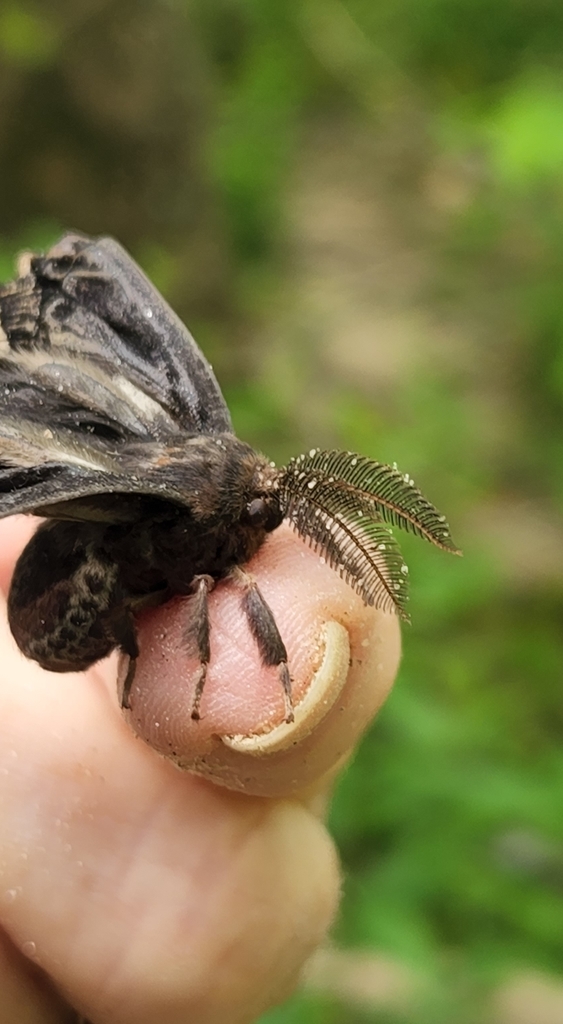
!Is the Promethea moth dangerous?
No. Adults do not bite or sting and are harmless. Caterpillars have small tubercles and short spines but are not known to be venomous; handling may cause minor skin irritation in rare sensitive individuals. Wash skin if contact causes irritation.
Pets
Not toxic to pets. Large caterpillars may be unpalatable but are not known to cause poisoning; discourage dogs or cats from eating many caterpillars to avoid digestive upset.
📖Overview
Callosamia promethea is a North American saturniid moth (silk moth) found across much of the eastern United States and adjacent Canada. Adults are short-lived and do not feed; their main role is reproduction. Larvae are solitary caterpillars that feed on the leaves of several deciduous trees. The species shows clear sexual dimorphism: males and females differ in color and flight behaviour.
Promethea moths occur in woodlands, forest edges, and suburban areas where host trees are present. They are not considered agricultural pests and have no medically significant venom or sting. Populations are generally stable and the species is commonly encountered where host trees grow.
🔍How to identify a Promethea moth
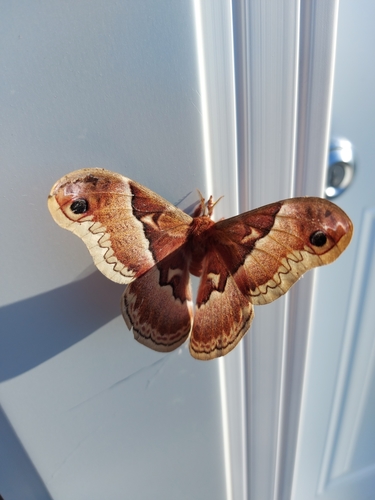
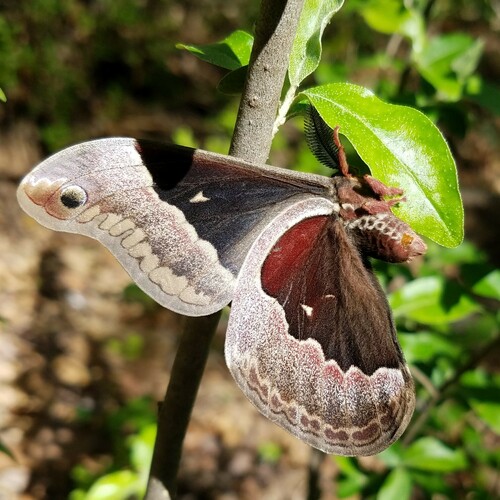
Wingspan typically 7.5-9.5 cm. Females are usually larger and show warm reddish-brown to pinkish wings with broad lighter bands and a small translucent or pale cell spot on each forewing. Males are darker, often deep brown to chocolate with a more elongated wing shape and a small pale spot on the forewing. Both sexes have smooth, rounded wing margins typical of silk moths; hindwings are rounded and may show subtle lighter patches. Body is robust and furry like other saturniids.
- Sexual dimorphism: females are reddish-pink with broad pale bands; males are darker brown and smaller.
- Wingspan 7.5-9.5 cm with rounded hindwings typical of silk moths.
- Small translucent or pale cell spot on each forewing.
- Found on or near host trees (spicebush, sassafras, wild cherry, tulip tree, sweetgum).
Lookalikes
Tulip-tree silk moth Callosamia angulifera
Very similar; tulip-tree silk moth often has more angular forewing margin and different banding; range and exact wing pattern can help separate them.
Polyphemus moth Antheraea polyphemus
Polyphemus is larger with a prominent eyespot on the hindwing; Promethea lacks large eyespots.
Imperial moth Eacles imperialis
Imperial moths are more yellow and have different bold patterning; Promethea is typically reddish or dark brown without large yellow patches.
↻Life cycle
Egg
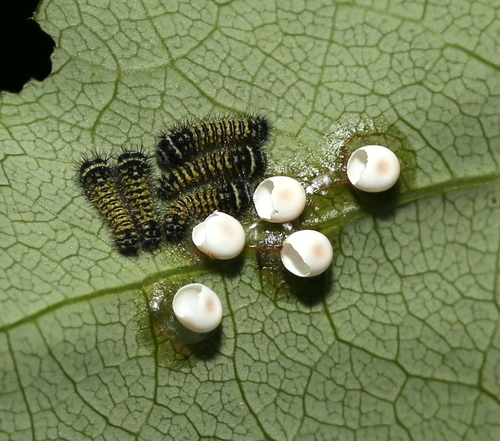
Females lay small, round eggs in groups or rows on the leaves of host plants.
Larva (caterpillar)
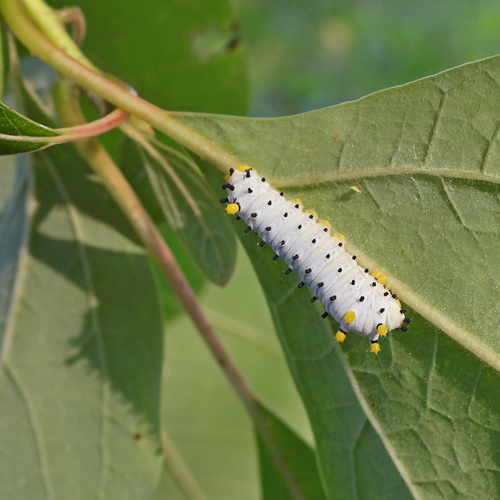
Caterpillars feed side by side in groups when young, then singly when older; mature larvae are bluish-green with rows of small black knobs and four larger red or orange knobs near the front and a yellow knob near the rear.
Pupa (cocoon)
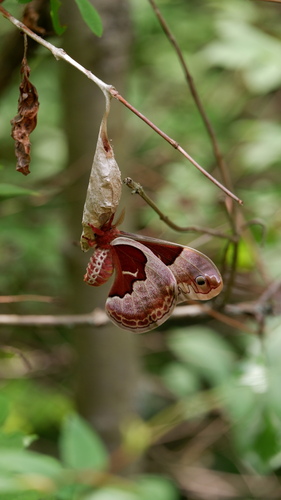
Full-grown caterpillars wrap a leaf around themselves, spin a silken cocoon inside it and attach it to a twig with a silk stalk, so the cocoon hangs on the tree through winter; the pupal stage lasts weeks (summer generation) to months (overwintering).
Adult (moth)
Adults emerge, mate and females lay eggs. Adults do not feed and live only long enough to reproduce.
🍃Diet and predators
Young eat
Leaves of deciduous trees (see plants above)
Adults eat
Do not feed (no functional mouthparts)
Predators of the young
Birds, predatory insects, parasitic wasps and flies
Predators of adults
Bats, birds and nocturnal predators
🌱Effect on plants and gardens
Caterpillars feed on the leaves of various trees and shrubs including spicebush (Lindera), sassafras, wild cherry and other Prunus species, tulip tree (Liriodendron), sweetgum (Liquidambar) and ash (Fraxinus). Defoliation is usually minor and localized.
📍Where and when to find it
Look for caterpillars on the leaves and twigs of host trees. Cocoons hang from twigs wrapped in a dry leaf, and are easiest to spot in winter after leaf fall. Adults are best seen in late afternoon or at dusk near host trees.
Best time
Late spring through midsummer; time of day varies by sex (males often daytime, females dusk/night).
Observation tips
Check the undersides of leaves for eggs and small caterpillars. Photograph adults at dusk near flowering or host trees; use a flashlight carefully so as not to disturb them.
✨Fun facts
- Promethea moths show strong sexual dimorphism: the dark males are thought to mimic the distasteful pipevine swallowtail butterfly when flying by day.
- Males are often active by day searching for females, while females tend to be active at dusk or night.
- Like other silk moths, Promethea adults lack functional mouthparts and do not feed.
?Frequently asked questions
Are Promethea moths dangerous?
No. Adults do not bite or sting and are harmless to people. Caterpillars are not venomous, though very sensitive individuals could have minor skin irritation after handling.
Do Promethea caterpillars bite or sting?
They do not sting. Caterpillars have small tubercles and sometimes short spines but are not known to deliver venom; avoid handling if you have sensitive skin.
Why is a Promethea moth in my house?
Adults are attracted to lights or may enter houses near host trees while seeking mates. Larvae sometimes fall from host trees but do not infest houses.
How do I get rid of Promethea caterpillars on my tree?
For small numbers handpick and relocate the caterpillars to another tree. For larger outbreaks prune affected branches or use targeted biological controls like Bacillus thuringiensis (Bt) following label directions. Chemical insecticides are usually unnecessary.
Where do Promethea moths live?
They live in deciduous woodlands, forest edges and suburban areas across eastern North America where host plants such as spicebush, sassafras, wild cherry and tulip tree grow.
📷Photos of the Promethea moth
More butterflies & moths
This guide was written with AI assistance and fact-checked, last updated 2026-10-10. Identification from photos is never certain: don't handle insects you can't identify, and get medical advice for bites, stings or allergic reactions. More about the Promethea moth: iNaturalist, Wikipedia.