
Giant peacock moth
Saturnia pyri · Silk moths
The largest European moth, a striking nocturnal silk moth with large eye-spots and a short-lived, non-feeding adult stage.
!Is the giant peacock moth dangerous?
Only mildly. Adults are harmless and cannot bite or sting. Caterpillars have short spines or tubercles that can cause mild skin irritation or a rash in sensitive people; avoid handling bare-handed. If irritation occurs, wash the area with soap and water and apply a cold compress; seek medical advice if there is a severe reaction.
Pets
Larval hairs may irritate pet skin or cause mild gastrointestinal upset if swallowed; keep pets away from large caterpillars and remove any caterpillars from areas where pets feed.
📖Overview
Saturnia pyri is a very large silk moth native to southern and central Europe, parts of the Balkans, and the Middle East. Adults are nocturnal, fly in late spring and early summer, and live only a few days — their sole purpose is reproduction. Females release pheromones to attract males, which can fly long distances to find them. Larvae are large, gregarious when young, and feed on a wide variety of deciduous trees and shrubs.
The species is not considered endangered across most of its range and is notable mainly for its size and dramatic eye-spots. Adults do not feed because their mouthparts are reduced; any contact with humans is usually accidental (e.g., being attracted to lights) rather than aggressive or defensive behavior by the moth itself.
🔍How to identify a giant peacock moth
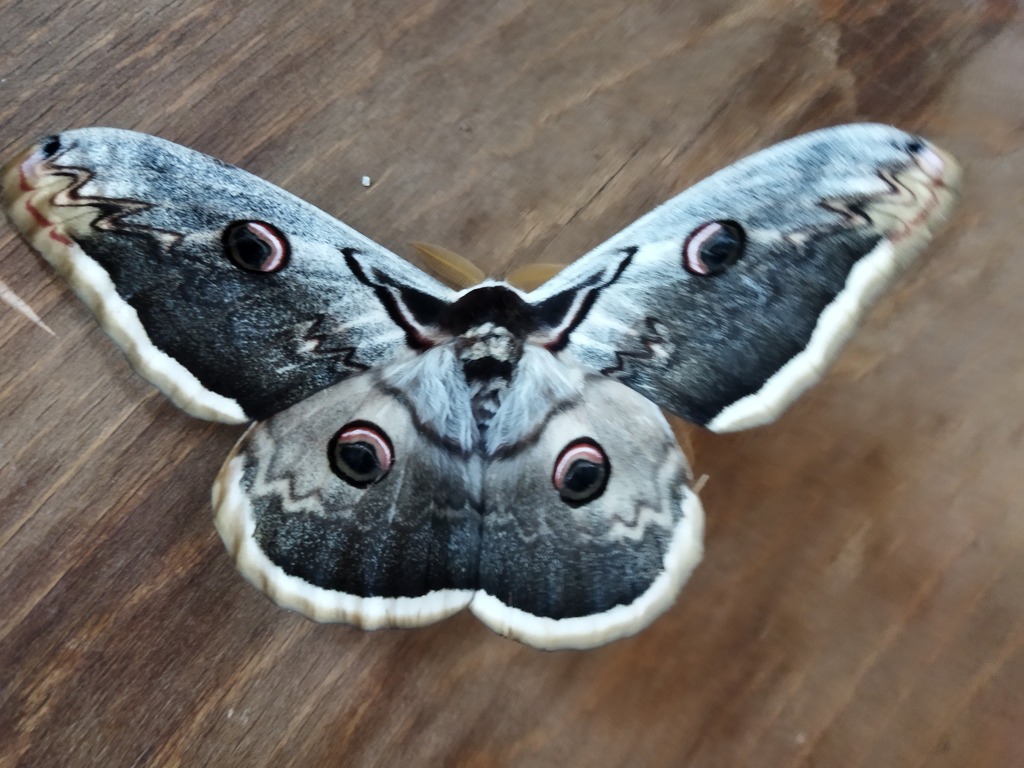
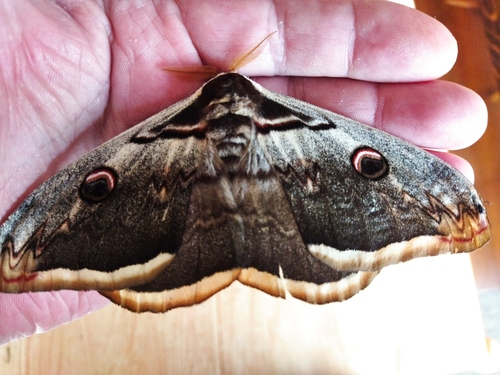
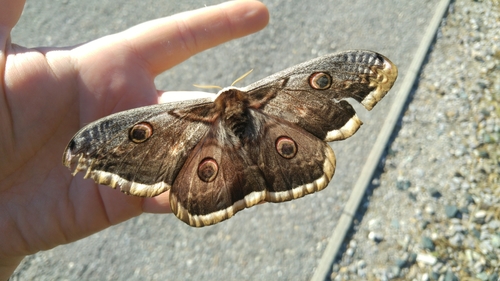
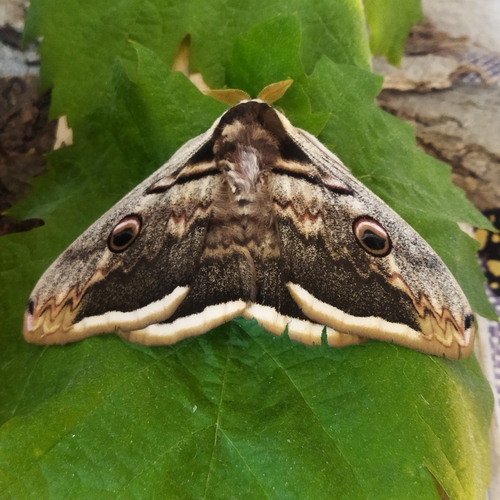
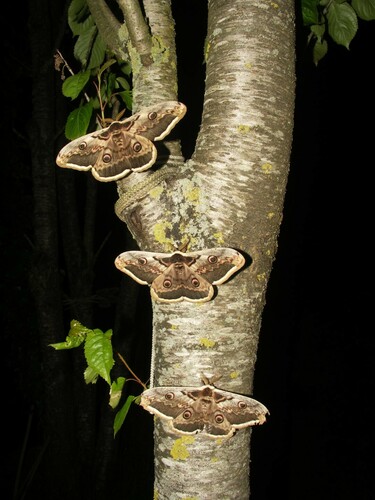
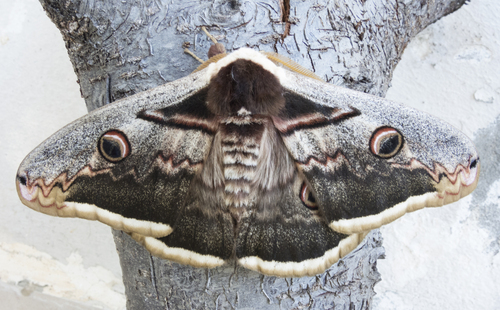
Wings are broad and heavy with rounded margins. Forewings and hindwings are a mottled brown to reddish-brown with a lighter cream or buff submarginal band; each wing bears a large, conspicuous eye-spot composed of concentric rings of black, blue and reddish tones. Body is robust and hairy. Males typically have more feathery (bipectinate) antennae than females, aiding detection of female pheromones. Young caterpillars are black; older caterpillars are plump and bright green with rows of turquoise-blue tubercles bearing stiff bristly hairs that can irritate skin in some people.
- Very large wingspan (commonly 120-160 mm) — largest moth regularly seen in Europe.
- Each wing has a large concentric eye-spot with blue/black center and reddish/brown rings.
- Mottled reddish-brown and cream wing ground colour with rounded wing margins.
- Males have strongly feathered antennae; females' antennae are less comb-like.
Lookalikes
Small emperor moth Saturnia pavonia
Much smaller (wingspan around 60-80 mm) with different patterning; eye-spots are smaller and colours differ.
↻Life cycle
Egg
Laid in batches on leaves or twigs; eggs hatch in about 1-3 weeks depending on temperature.
Larva (caterpillar)
Several instars; gregarious when young, feeding on host foliage and growing rapidly. Mature caterpillars are large and green with blue, bristly tubercles.
Pupa (cocoon)
Larvae spin a tough silken cocoon, often attached to branches or hidden among leaf litter; pupation lasts through winter in many areas.
Adult (moth)
Winged and sexually mature; adults have reduced mouthparts and do not feed. They emerge, mate and females lay eggs within a few days.
🍃Diet and predators
Young eat
Leaves of a wide range of deciduous trees and shrubs (apple, pear, Prunus species, hawthorn, willow, currant, lime, etc.).
Adults eat
Do not feed; adults have reduced mouthparts and survive on energy stored from the larval stage.
Predators of the young
Birds, parasitic wasps and flies, predatory insects and small mammals.
Predators of adults
Bats, nocturnal birds and other predators of flying moths; many adults are short-lived and vulnerable while flying or at rest.
🌱Effect on plants and gardens
Larvae feed on many deciduous trees and shrubs including apple, pear, plum and other Prunus species, hawthorn, willow, currant, lime and others. Heavy local outbreaks can cause noticeable defoliation but the species is not generally a major agricultural pest.
📍Where and when to find it
Look for adults at night around porch or street lights, and around orchards or hedgerows. Look for caterpillars on leaves of apple, pear, plum, hawthorn and willow. Cocoons are often attached to twigs or hidden in leaf litter.
Best time
Late spring to early summer for adults (regional variation). Caterpillars are best found in the weeks before adult flight season. Nighttime is best for photographing adults, using low-impact lighting.
Observation tips
If photographing at night, use a soft light and avoid direct flashes that may damage delicate scales. To see larvae, check host plants during daylight; wear gloves if handling.
✨Fun facts
- Saturnia pyri is the largest moth species found in Europe.
- Adult giant peacock moths do not eat; they rely entirely on energy stored from their caterpillar stage.
- Females release potent pheromones that males can detect from several kilometers under good conditions.
?Frequently asked questions
Are giant peacock moths dangerous?
Only mildly. Adults are harmless to people. Caterpillars can cause mild skin irritation in some individuals due to their bristly tubercles, so avoid handling them bare-handed.
Do giant peacock moths bite or sting?
No. Adults have no functional mouthparts for biting, and they do not sting. Caterpillars do not sting but their bristles can irritate skin.
Why is there a giant peacock moth in my house?
Adults are nocturnal and are often attracted to artificial lights; they may enter houses through open windows or doors at night.
How do I get rid of giant peacock moths or their caterpillars?
For single moths, gently capture and release outdoors. For caterpillars on small trees, hand-pick into a jar and relocate or destroy. Remove cocoons from structures before adults emerge. Large-scale controls are rarely needed; consult local guidance before using pesticides.
Where do giant peacock moths live?
They live where suitable host trees and shrubs grow: orchards, gardens, hedgerows, open woodlands and scrub across southern and central Europe, parts of North Africa and the Middle East.
📷Photos of the giant peacock moth
More butterflies & moths
This guide was written with AI assistance and fact-checked, last updated 2026-10-10. Identification from photos is never certain: don't handle insects you can't identify, and get medical advice for bites, stings or allergic reactions. More about the giant peacock moth: iNaturalist, Wikipedia.