
Emperor moth
Saturnia pavonia · Silk moths
A compact silk moth of Europe and western Asia whose males fly by day in spring; notable for its large eye spots and bristly green-and-black caterpillars.
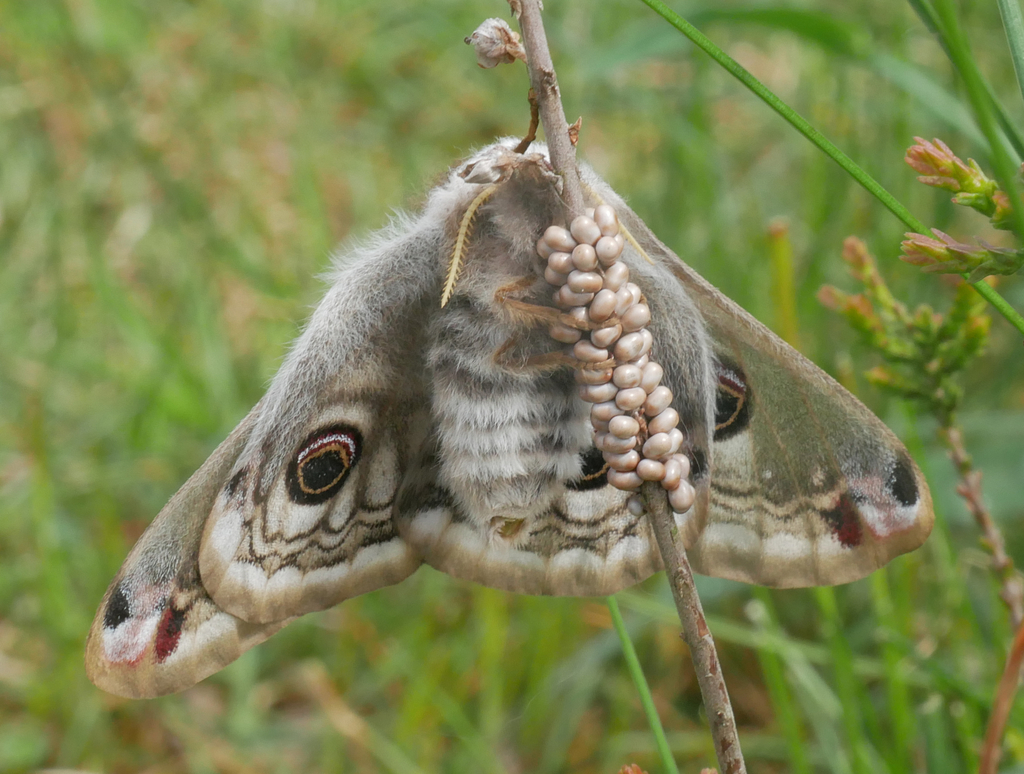
!Is the emperor moth dangerous?
No. Emperor moths are harmless to people. Adults do not bite or sting. Caterpillars may have fine hairs that can cause mild skin irritation in very sensitive individuals, but they are not venomous. Wash exposed skin with soap and water if irritation occurs and avoid rubbing the area.
Pets
Not dangerous to pets. Ingestion of many caterpillars could cause mild stomach upset but serious effects are unlikely. Keep curious pets away from large numbers of caterpillars to avoid vomiting or irritation.
📖Overview
Saturnia pavonia is a smallish member of the silk moth family (Saturniidae) found across much of Europe and into temperate parts of western Asia. Adults emerge in spring. Males fly fast in sunshine by day searching for females using their feathery antennae, while the larger, greyer females fly mainly at night. The larvae are black and gregarious when young, becoming green with black bands and bristly warts as they grow, and feed on a wide range of shrubs and low plants.
This species favours open habitats including heathland, moorland, rough grassland, hedgerows and sunny scrub. It typically has a single generation per year: eggs laid in spring hatch into caterpillars that feed through the summer and then pupate in a tough silk cocoon, in which the pupa overwinters, allowing adults to emerge the following spring.
🔍How to identify an emperor moth
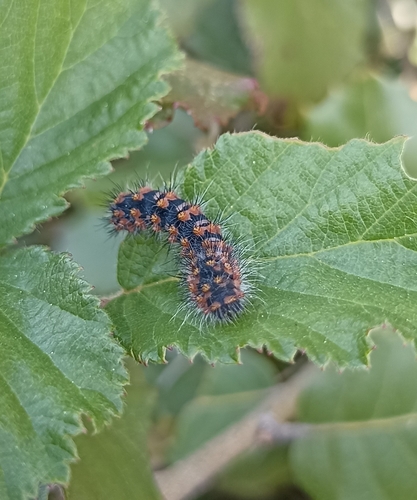
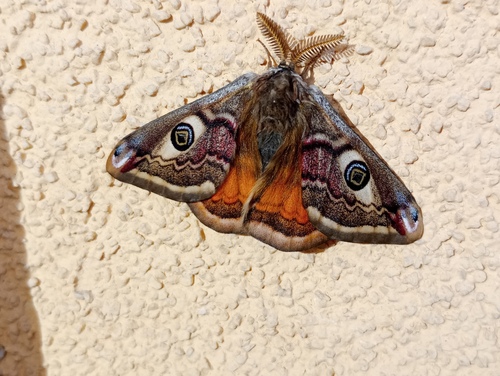
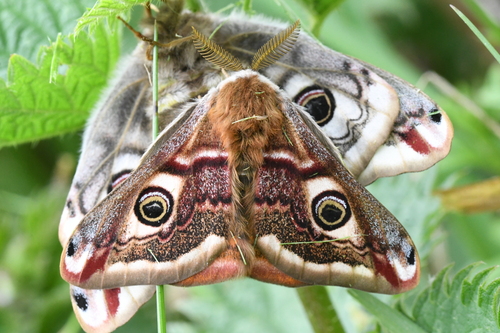
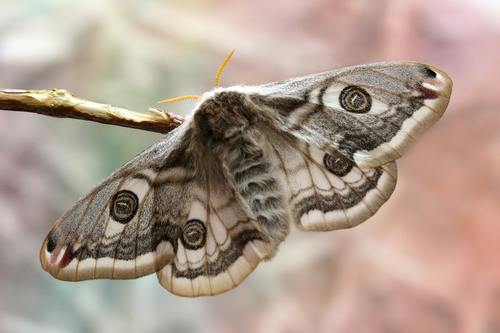
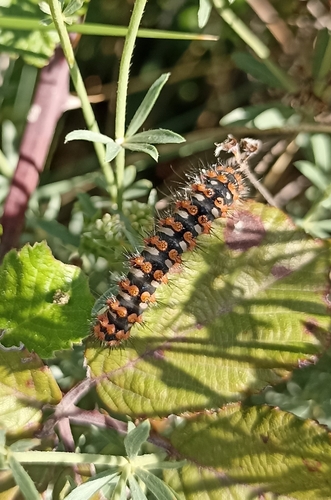
Adults are compact moths with broad wings and a large eye spot on each forewing and hindwing; the eye spots contain rings of black, blue-grey, yellowish and reddish scales. Males are smaller, with grey-brown forewings, bright orange hindwings and very feathery antennae; females are larger and mainly pale grey, with thinner antennae and a heavier abdomen. Young caterpillars are black; older caterpillars are bright green with black bands and yellow or pinkish warts bearing bristles. Pupae are dark brown inside a tough, pear-shaped silk cocoon hidden in low vegetation.
- Look for conspicuous eye spots on each wing: dark central spot with blue and pale rings.
- Males have very feathery antennae, grey-brown forewings and orange hindwings; females are larger and mostly grey.
- Spring flight time (March-May) distinguishes it from many summer saturniids.
- Older caterpillars are bright green with black bands and colourful bristly warts; young ones are black.
Lookalikes
Giant peacock moth Saturnia pyri
Saturnia pyri is much larger (wingspan often over 120 mm), mostly brown-grey, and occurs in southern Europe; Saturnia pavonia is smaller and the males have orange hindwings.
Eyed hawk-moth Smerinthus ocellatus
Has eye spots only on the hindwings, which are hidden at rest, and a long, scalloped hawk-moth wing shape; it flies at night and later in the year.
↻Life cycle
Egg
Females lay small clusters of eggs on host plant shoots in spring. Eggs hatch in about 1-2 weeks depending on temperature.
Larva (caterpillar)
Caterpillars grow through several instars during late spring and summer. Young larvae are black and gregarious; older larvae are green with black bands and solitary.
Pupa (cocoon)
Mature caterpillars spin a tough silken cocoon low in vegetation and pupate. Pupae overwinter (sometimes for more than one winter) and adult moths emerge in spring.
Adult (moth)
Adults emerge in spring, mate, and females lay eggs within a few days. Adults do not feed and live a short time focused on reproduction.
🍃Diet and predators
Young eat
Leaves of shrubs and low woody plants (heather, hawthorn, blackthorn, gorse, bramble, willow, birch and others)
Adults eat
Do not feed (no functional mouthparts); rely on fat reserves built as caterpillars
Predators of the young
Birds, parasitic wasps and flies, small mammals
Predators of adults
Birds, bats and predatory insects; eggs and pupae are also taken by small mammals and invertebrate predators
🌱Effect on plants and gardens
Caterpillars feed on a wide range of shrubs and low plants such as heather, hawthorn, blackthorn, gorse, bramble, willow and birch. Feeding can cause noticeable defoliation locally but rarely causes serious long-term harm to healthy plants.
📍Where and when to find it
Adults: flying in sunny patches, ride edges and hedgerows in spring. Caterpillars: on host plant leaves during late spring and summer. Pupae: in loose cocoons in leaf litter or low vegetation.
Best time
Best observed March to May for adults; caterpillars visible late spring to summer. Males fly on sunny days.
Observation tips
Look at sunny hedgerows and heathland on warm spring days. Photograph wing eye spots from above; handle caterpillars with caution or use a stick to move them.
✨Fun facts
- Unlike most moths, male emperor moths fly fast in bright sunshine, while females fly mainly at night.
- Adults lack functional mouthparts and live only long enough to mate and lay eggs.
- The species shows marked sexual dimorphism: males fly actively using scent-detecting feathery antennae to locate females.
?Frequently asked questions
Are emperor moths dangerous?
No. Adults do not bite or sting. Caterpillars are not venomous; some people may get mild skin irritation from the hairs but serious reactions are rare.
Do emperor moth caterpillars eat garden plants?
Yes, caterpillars feed on many shrubs and can cause visible leaf loss, but they rarely cause lasting damage to healthy plants or crops.
Why is an emperor moth in my house?
Adults may be attracted to light or accidentally enter houses while flying in spring. Pupae in leaf litter near buildings can also lead to nearby emergences.
How can I get rid of emperor moths or caterpillars?
Removal is usually unnecessary. For localized caterpillar outbreaks, hand-pick them off plants or use a physical barrier. Chemical controls are rarely justified. Conserving predators and parasitoids helps natural control.
Where does the emperor moth live?
In open, sunny habitats across much of Europe and parts of western Asia—heathland, moorland, hedgerows, scrub and woodland edges.
📷Photos of the emperor moth
More butterflies & moths
This guide was written with AI assistance and fact-checked, last updated 2026-10-10. Identification from photos is never certain: don't handle insects you can't identify, and get medical advice for bites, stings or allergic reactions. More about the emperor moth: iNaturalist, Wikipedia.