
Squash vine borer
Melittia cucurbitae · Clearwing moths
A wasp-mimicking clearwing moth whose larvae bore into stems of squash, pumpkin and related plants, often killing vines.
!Is the squash vine borer dangerous?
No. Adults are harmless to people; they do not sting or bite. They may look like wasps but pose no danger. No medical first aid is necessary for contact.
Pets
Not toxic to pets. Caterpillars are unlikely to be eaten by pets but are not poisonous; standard caution applies to prevent pets from chewing plants treated with pesticides.
📖Overview
Melittia cucurbitae is a species of clearwing moth whose caterpillars are a major pest of cucurbits (squash, zucchini, pumpkin and related species). Adults resemble day-flying wasps: they fly in daytime, mate and lay eggs on host plants. Eggs hatch to larvae that bore into the plant stem and feed internally, disrupting water and nutrient flow and causing sudden wilting. After feeding the larvae exit and pupate in the soil or plant debris. Outbreaks are most common in warm temperate regions where squash are grown.
🔍How to identify a squash vine borer
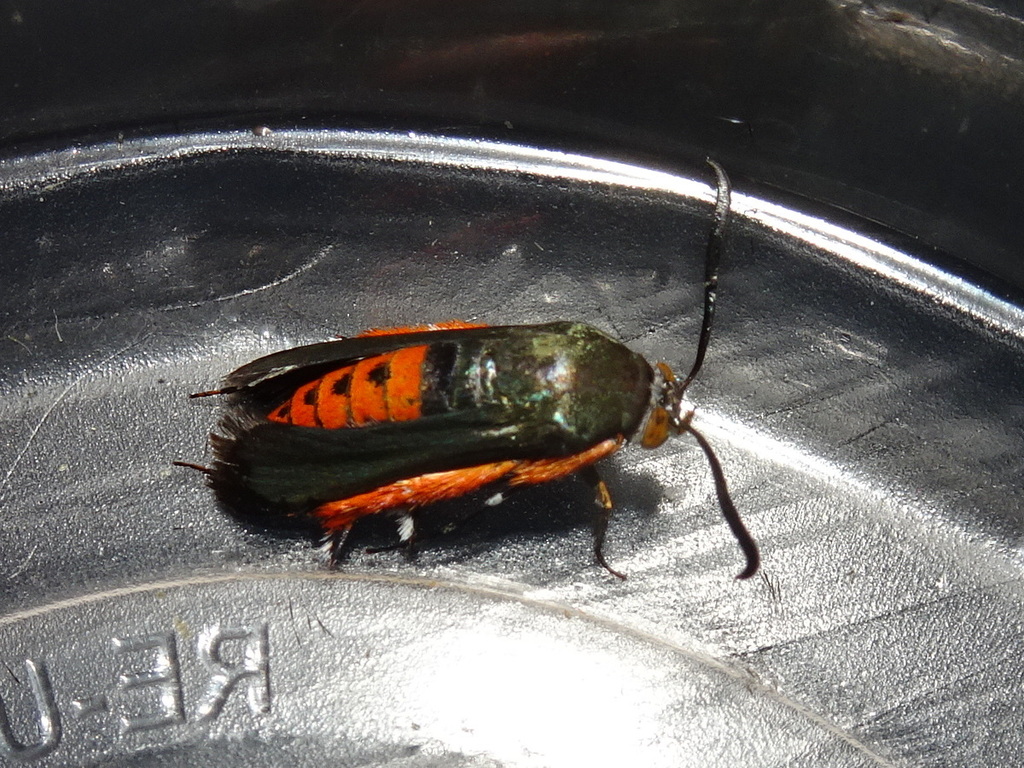
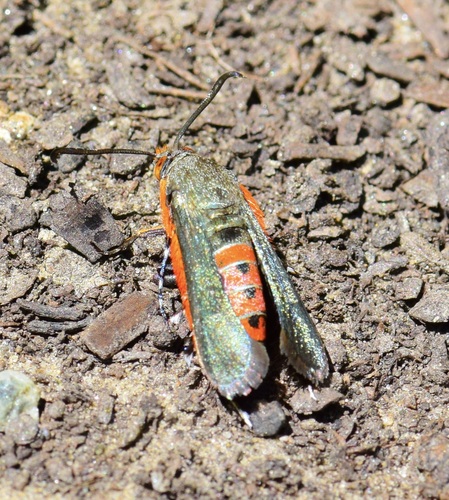
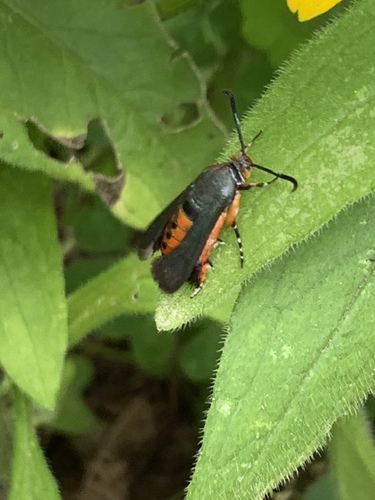
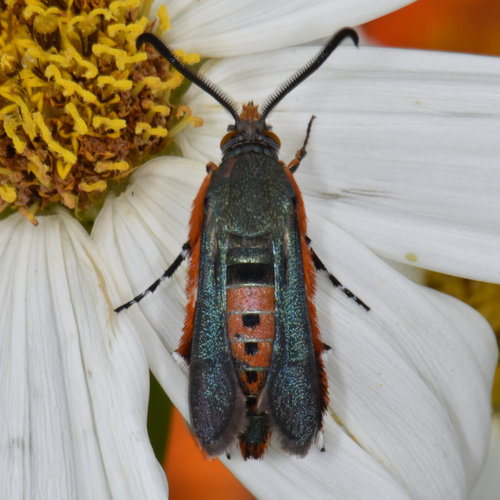
Adult squash vine borers are day-flying moths about 15-25 mm long with narrow wings: the forewings are opaque, metallic olive-black, while the hindwings are mostly clear. The body is wasp-like with a metallic dark-green to black thorax and a bright orange-red abdomen banded with black toward the tip. The hind legs are fringed with long orange and black hairs and the insect typically flies close to host plants in sunlight. Larvae are white to cream-colored caterpillars with a brown head, growing to about 25-30 mm long. Eggs are small, flattened, and laid singly on stems or nearby leaves.
- Day-flying moth that looks like a wasp: metallic olive-black forewings, clear hindwings, bright orange-red abdomen with black spots or bands, and hairy orange-and-black hind legs.
- Look for sawdust-like frass and a small round exit hole or bore hole on squash stems near the base.
- Sudden wilting of a single vine from the tip toward the base, often while other plants remain healthy, is a classic sign of internal borer damage.
- Slice open a suspect stem near the wilted area to reveal a cream-colored caterpillar inside to confirm.
Lookalikes
Peachtree borer Synanthedon exitiosa
Also a clearwing borer but attacks stone fruit trunks and has different host plants and adult markings; squash vine borer targets cucurbits and has a distinctive orange-red abdomen.
Other Melittia species Melittia spp.
Close relatives may look similar but are separated by host plant preference, subtle wing and body pattern differences, and region.
↻Life cycle
Egg
Small flattened eggs are laid singly on stems, petioles or nearby leaves near the base of host plants. Eggs hatch in about 7-10 days depending on temperature.
Larva (borer)
The caterpillar immediately bores into the stem and feeds internally for several weeks, creating frass-filled galleries. Internal feeding causes wilting above the feeding site.
Pupa
Mature larvae exit the stem, drop to the soil or hide in plant debris, then pupate in a silken cocoon in the soil or leaf litter.
Adult (moth)
Day-flying, wasp-mimicking clearwing moth that emerges from pupae to mate and lay eggs; adults live about 1-2 weeks.
🍃Diet and predators
Young eat
Internal tissues of cucurbit stems and sometimes petioles. They feed on pith and vascular tissue.
Adults eat
Adults feed little, but may sip nectar from flowers; their mouthparts are reduced compared with non-clearwing moths.
Predators of the young
Parasitic wasps and flies may attack eggs or exposed larvae; birds, small mammals and generalist predators may prey on larvae when they exit to pupate.
Predators of adults
Predatory insects and birds can catch adults; their wasp-like appearance likely deters some predators.
🌱Effect on plants and gardens
Larvae bore into stems of cucurbits (Cucurbita spp., some Cucumis and related genera), weakening or killing vines and reducing yield.
How to get rid of squash vine borers
Cover young plants with floating row cover until flowering (remove it or hand-pollinate once flowers open). Check stem bases for eggs and remove them. Slit infested stems lengthwise to remove larvae, then bury the damaged section in moist soil so it can root. Remove and destroy infested vines after harvest, cultivate the soil in autumn to disrupt overwintering cocoons, and rotate crops. Resistant squash such as butternut (Cucurbita moschata) is less affected. Bt or registered insecticides applied to stem bases during egg-laying can help; always follow label directions.
📍Where and when to find it
Adults fly in daylight around squash plants and sunny garden edges. Check stems near the base for eggs and frass; slice stems to find larvae. Look in soil and debris at the plant base for pupae.
Best time
Summer months when squash are growing; adults are active during warm, sunny days.
Observation tips
Inspect plants early morning for eggs (small, flat and hard to see). Use close-up photos of stems and underside of leaves to document eggs or frass before removing a suspected vine.
✨Fun facts
- Adults mimic wasps visually and in flight, which helps deter predators despite being harmless.
- Damage often appears overnight — a healthy vine can wilt quickly once vascular tissue is chewed.
- Because larvae live inside stems, they are protected from many pesticides and natural enemies while feeding.
?Frequently asked questions
Do squash vine borers bite or sting?
No. Adults are harmless day-flying moths that only look like wasps; they do not sting or bite people.
Why is my squash suddenly wilting?
Sudden wilting of one vine while others stay healthy is a typical sign that a squash vine borer larva is feeding inside the stem and blocking water flow.
How do I get rid of squash vine borers?
Use an integrated approach: monitor for adults and eggs, protect young plants with floating row cover until flowering, remove and destroy infested vines, carefully slit stems to remove larvae, and crop-rotate. Pheromone traps can help time controls. Chemical controls are most effective against eggs or very young larvae on the stem surface; once larvae are inside stems they are hard to reach.
Can Bt (Bacillus thuringiensis) kill them?
Bt can be effective if applied to eggs or tiny larvae on the stem surface before they bore in. It will not reach larvae once they are feeding inside the stem.
How many generations per year do they have?
Typically one generation per year in northern areas, with potentially two in warmer regions. Exact timing depends on local climate.
📷Photos of the squash vine borer
More butterflies & moths
This guide was written with AI assistance and fact-checked, last updated 2026-10-10. Identification from photos is never certain: don't handle insects you can't identify, and get medical advice for bites, stings or allergic reactions. More about the squash vine borer: iNaturalist, Wikipedia.