
Atlas moth
Attacus atlas · Silk moths
One of the world's largest moths by wingspan and wing surface, native to Southeast Asia and known for its striking triangular wing tips and eye-like markings.
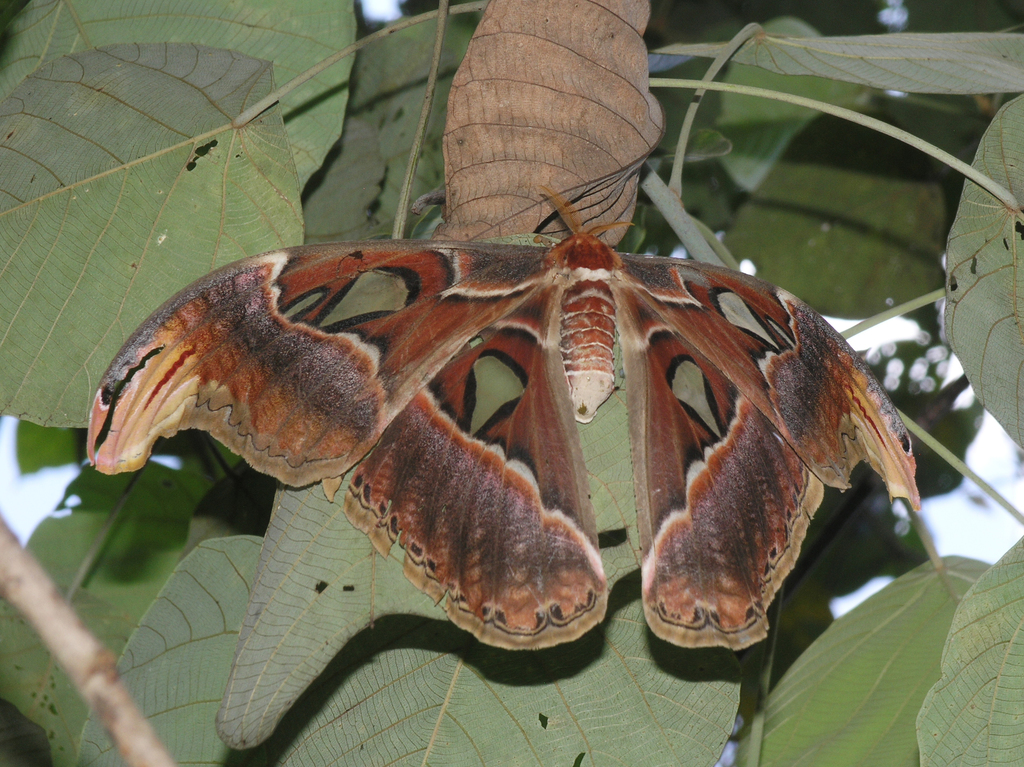
!Is the Atlas moth dangerous?
No. Atlas moths are not harmful or venomous. Adults do not bite or sting. Handling caterpillars may cause mild skin irritation in a few people but they are not known to be toxic; wash hands after handling. No special first aid is usually needed beyond cleaning the area if mild irritation occurs.
Pets
Not poisonous to pets. Caterpillars could, if large numbers are ingested, cause mild gastrointestinal upset in dogs or cats; keep pets from eating large caterpillars or cocoons.
📖Overview
The Atlas moth (Attacus atlas) is a very large silk moth in the family Saturniidae. Adults are remarkable for their huge, broad wings and bold patterns; they are mainly nocturnal and short-lived as adults. Larvae are large green caterpillars that feed on leaves of a variety of trees and shrubs. The species occurs across South and Southeast Asia and some adjacent islands.
🔍How to identify an Atlas moth
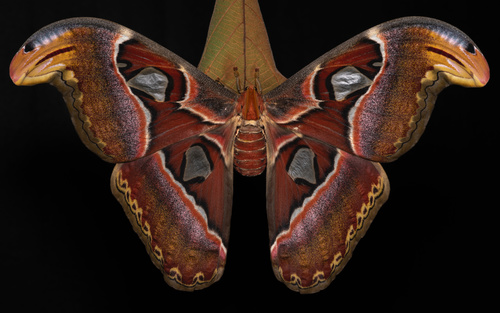
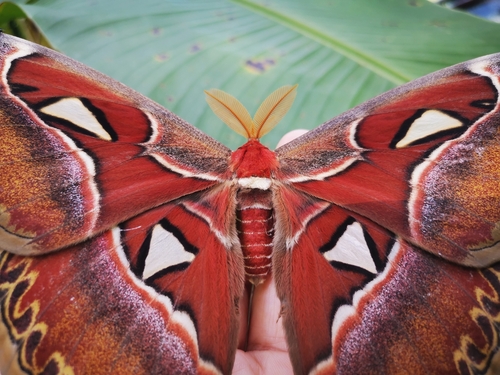
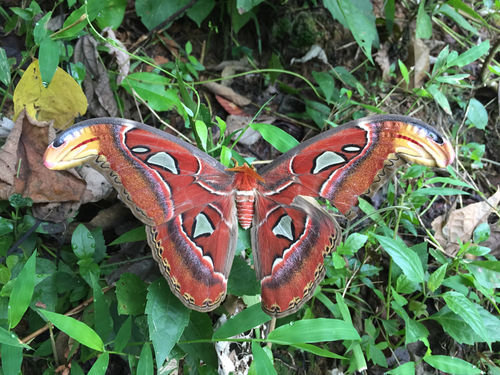
Adults have very large, broad forewings and hindwings with scalloped margins. Wing pattern includes bands of reddish-brown, tan and cream, with translucent 'window' marks and darker borders. The forewing tips are extended and triangular, often said to resemble a snake's head. Wingspan commonly reaches about 20-25 cm, with wing surface covered in fine scales giving a velvety appearance. The body is thick and furry; antennae are feathery (bipectinate) especially in males. Caterpillars are stout, pale to bright green with small tubercles and line markings; pupae are enclosed in dense silken cocoons.
- Very large wingspan (commonly about 20-25 cm) with broad, scalloped wings.
- Forewing tips extended into triangular 'snake-head' shapes.
- Reddish-brown and tan banding with translucent window-like spots on each wing.
- Thick furry body and bipectinate (feathery) antennae in males.
Lookalikes
Hercules moth Coscinocera hercules
Hercules moth (New Guinea/Australia) can have even larger wings and different wing shapes and patterning; geographic range does not overlap in most areas.
Ailanthus silkmoth Samia cynthia
Much smaller (wingspan around 11-14 cm) and olive-brown, with similar pale bands and crescent-shaped windows but without the large hooked, snake-head forewing tips of Attacus atlas.
↻Life cycle
Egg
Small, smooth eggs laid on the underside of host plant leaves; hatch in about 10-14 days depending on temperature.
Larva (caterpillar)
Several instars of large green caterpillars that feed on host foliage and grow rapidly over several weeks.
Pupa (cocoon)
Full-grown caterpillars spin a dense silken cocoon, often attached to branches or sheltered sites, within which they pupate for weeks to months.
Adult (moth)
Large, short-lived adults that emerge to mate; adults typically do not feed and live only long enough to reproduce.
🍃Diet and predators
Young eat
Leaves of various broadleaf trees and shrubs (hosts vary regionally; recorded on citrus, guava, cinnamon and others)
Adults eat
Do not feed; adults rely on fat stores accumulated during the caterpillar stage
Predators of the young
Birds, wasps, predatory insects and parasitoids (flies and wasps) attack eggs and caterpillars
Predators of adults
Bats, birds, and nocturnal predators take adults; large size and wing patterns provide some deterrence
🌱Effect on plants and gardens
Larvae feed on leaves of diverse host trees and shrubs (for example citrus, guava, cinnamon, and other broadleaf species). Heavy localized caterpillar populations can defoliate young trees, but the species is not normally a major agricultural pest.
📍Where and when to find it
Look for eggs and caterpillars on leaves of host trees and shrubs; cocoons are often attached to branches or hidden in foliage. Adults are attracted to lights at night and rest on tree trunks or vegetation during the day.
Best time
Depends on region; in tropical areas adults can appear year-round with seasonal peaks. Nighttime is best for observing adults near lights; daytime for finding pupae and resting adults.
Observation tips
Use a soft light source at night to attract and photograph adults. For caterpillars, inspect host plants and be gentle when handling; photograph dorsal and wing-tip details for identification.
✨Fun facts
- Atlas moths are among the largest moths in the world by wing surface area.
- The extended forewing tips are often said to mimic a snake head, possibly deterring predators.
- Adult Atlas moths do not have functional mouthparts and live only long enough to mate and lay eggs.
?Frequently asked questions
Do Atlas moths bite?
No. Adults do not bite or sting. Caterpillars are not known to bite humans, though handling may cause mild skin irritation in some people.
Are Atlas moths poisonous or dangerous?
No. They are not venomous or poisonous to humans. Exercise normal caution when handling caterpillars if you have sensitive skin.
Why is an Atlas moth in my house?
They are strong fliers and may be attracted to lights at night or enter houses near suitable habitat. If you live near forests or gardens with host trees, adults may wander indoors while searching for mates.
How do I get rid of an Atlas moth in my house?
Gently guide it outside at night using a soft container or sheet; avoid rough handling that can damage the delicate wings. There is no need for pesticides for a single adult moth.
Where do Atlas moths live?
They live in tropical and subtropical forests, secondary growth and gardens across South and Southeast Asia and adjacent islands where host plants are available.
Can I keep an Atlas moth as a pet?
Keeping caterpillars and rearing them to adults is possible with proper permits in some regions. Adults do not feed and need only space to emerge and mate; check local regulations and provide suitable host plant foliage for larvae.
📷Photos of the Atlas moth
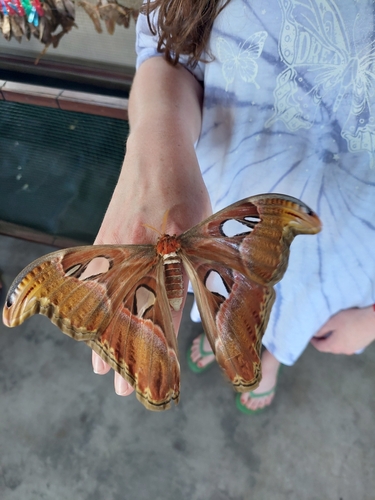
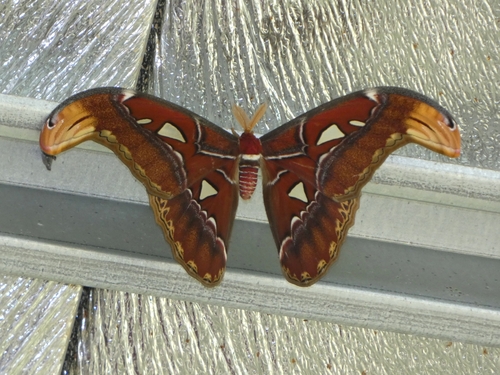
More butterflies & moths
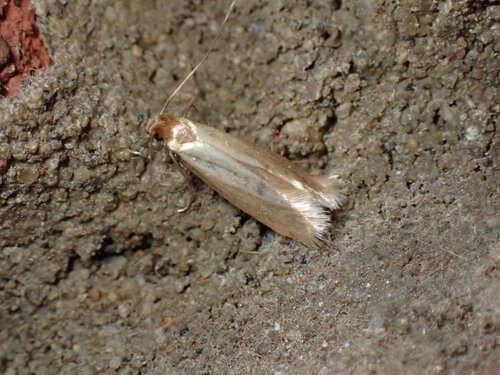
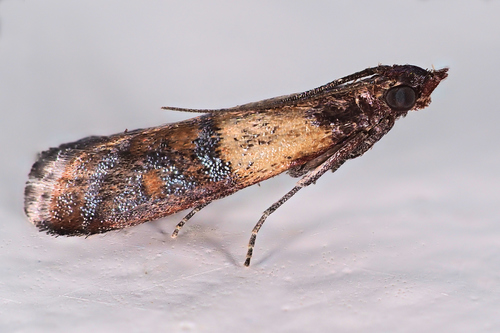
This guide was written with AI assistance and fact-checked, last updated 2026-10-10. Identification from photos is never certain: don't handle insects you can't identify, and get medical advice for bites, stings or allergic reactions. More about the Atlas moth: iNaturalist, Wikipedia.