
Regal moth
Citheronia regalis · Giant silk moths
A large, showy North American silk moth whose spectacular caterpillar is called the hickory horned devil; adults do not feed and are harmless to people.
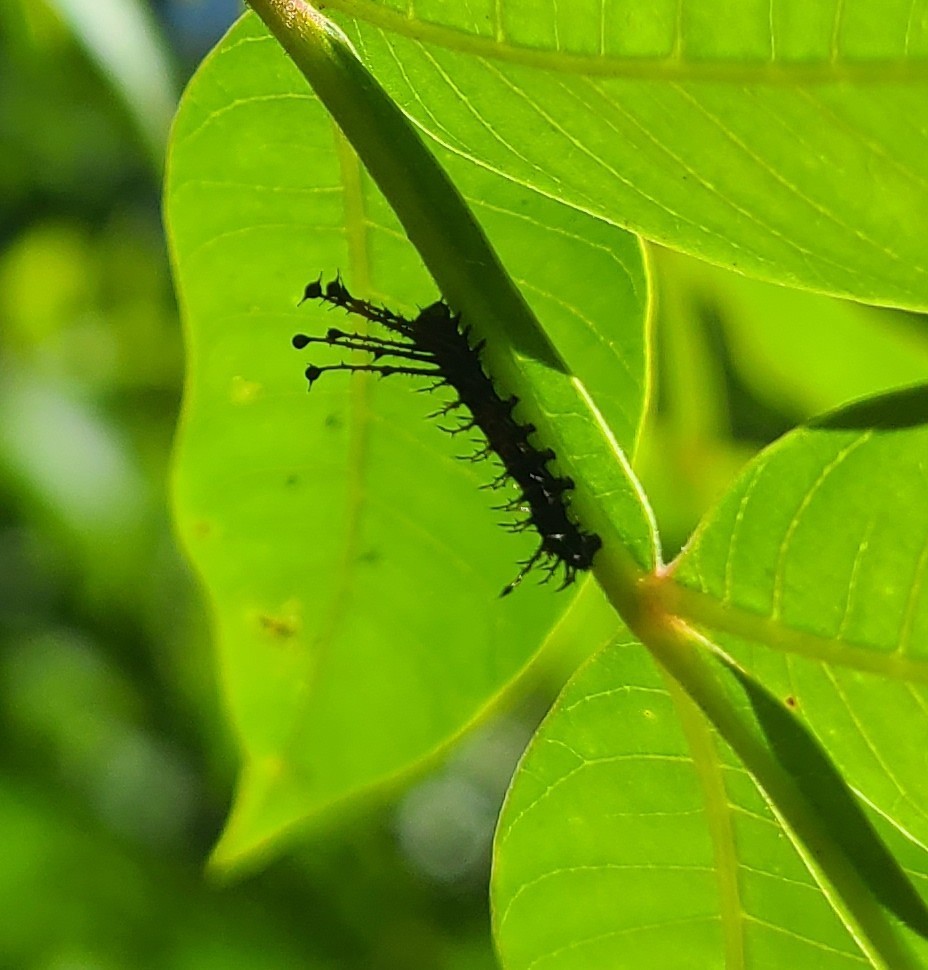
!Is the regal moth dangerous?
No. Adults do not bite or sting and are harmless. Caterpillars look intimidating but are not venomous; they may give a mild pinch if handled roughly. Standard wound care (clean with soap and water) is sufficient for any minor pinch.
Pets
Not known to be toxic to pets. Large caterpillars could cause minor oral irritation if chewed by pets; avoid letting pets eat them.
📖Overview
Citheronia regalis is a large saturniid moth native to eastern North America. Its caterpillar — the hickory horned devil — is one of the biggest and most dramatic-looking caterpillars in the region. Adults are stout-bodied, with grey-olive and orange wings, fly at night, and have very reduced mouthparts so they do not feed. Populations are locally common where host trees occur but are not considered agricultural pests.
🔍How to identify a regal moth
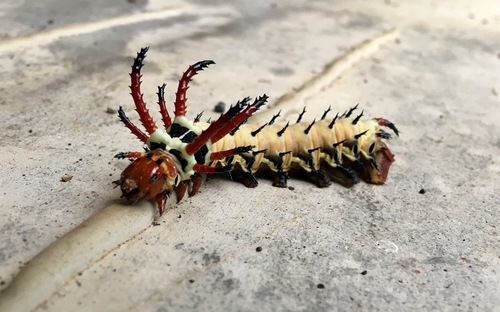
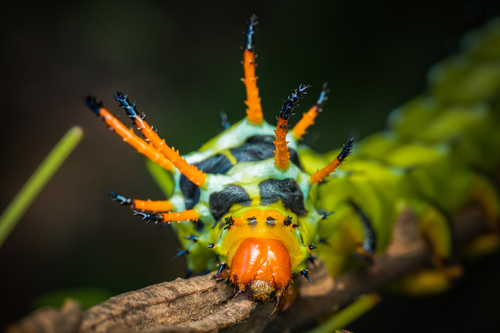
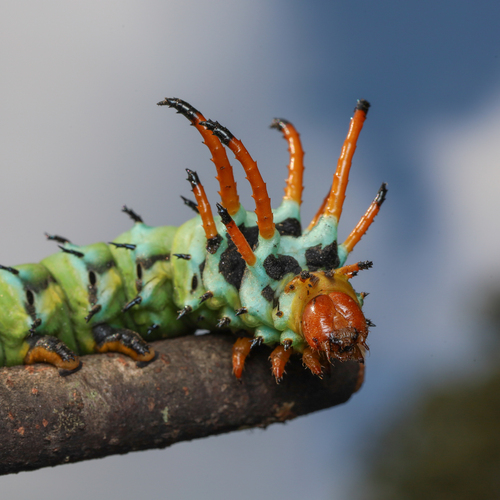
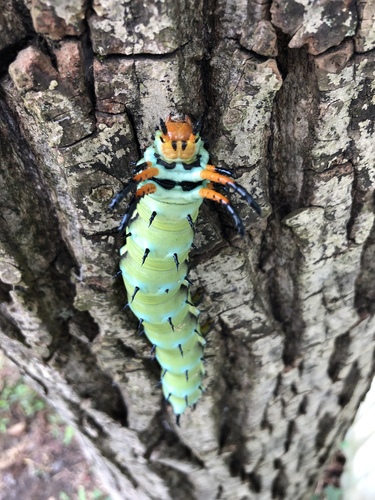
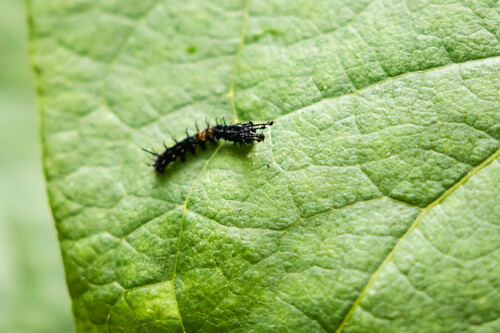
Adults are robust, with broad forewings and rounded hindwings. The forewings are grey to olive-grey with orange-red veins and rows of pale yellow spots; the hindwings are mostly orange-red with yellow patches. The body is thick, furry and orange with narrow yellow bands. The larva (hickory horned devil) is bright blue-green when mature, with long, curved orange-red horns tipped in black on the thoracic segments and smaller spines along the body; young caterpillars are brown and black and resemble bird droppings.
- Large, heavy-bodied moth with grey-olive forewings marked by orange veins and yellow spots, and orange hindwings.
- Very large green caterpillar with long, curved orange horns tipped in black on the thorax (hickory horned devil).
- Larvae burrow into soil to pupate — look for them feeding high in host trees in summer before they disappear.
Lookalikes
Pine devil moth Citheronia sepulcralis
A related species whose adults are mostly dull purplish-brown with little orange; its caterpillars feed on pines and are brown with shorter horns.
Polyphemus moth Antheraea polyphemus
Polyphemus has distinctive eye spots on the hindwings and a more buff-coloured wing background; its caterpillar lacks the large thoracic horns.
↻Life cycle
Egg
Females lay eggs on host plant leaves or twigs; eggs hatch in about 8-14 days depending on temperature.
Larva (hickory horned devil)
Several instars; early instars are brown and black and resemble bird droppings, while later instars are large, bright blue-green with prominent orange horns. Caterpillars feed heavily on host tree leaves through summer.
Pupa (in soil)
Mature larvae leave the tree, burrow into soil and pupate in an underground chamber without a silk cocoon; the pupa overwinters in the soil.
Adult (moth)
Adults emerge in mid-summer, mate, and live a few days while females lay eggs; adults do not feed.
🍃Diet and predators
Young eat
Leaves of hickory, walnut, persimmon, sweetgum, sumac, ash and other deciduous trees and shrubs.
Adults eat
Do not feed (no functional mouthparts).
Predators of the young
Birds, small mammals, parasitic flies and wasps; some predation by ants and ground predators when pupating.
Predators of adults
Bats and nocturnal birds, and predation by rodents or birds when at rest.
🌱Effect on plants and gardens
Larvae feed on leaves of several deciduous trees and shrubs (especially hickory and walnut). They rarely occur at densities high enough to cause serious plant damage.
📍Where and when to find it
Look for larvae feeding on leaves of host trees in summer; adults are nocturnal and may be found at porch lights or resting on tree trunks in mid-summer.
Best time
June to August (varies by latitude); night for adults, daytime for larvae on foliage.
Observation tips
Use a long lens or a phone from a short distance to photograph the striking caterpillar; avoid handling unless necessary. To attract adults, small blacklight setups will draw them at night.
✨Fun facts
- The caterpillar hickory horned devil can reach about 13-14 cm and looks fierce, but it is harmless and becomes the regal moth.
- Adults have no functional mouthparts and live only a few days, relying on energy stored from the caterpillar stage.
- Because they pupate underground, populations can survive cold winters by overwintering as pupae in the soil.
?Frequently asked questions
Are regal moths harmful to people?
No. Adults do not bite or sting and caterpillars are not venomous. Handle caterpillars with care if needed to move them, but they are harmless.
Do hickory horned devil caterpillars bite?
They do not have venomous stings. They can pinch if grabbed but do not bite in the way a mammal would; typical handling causes no lasting harm.
Why is a regal moth in my house?
Adults are attracted to lights at night and may fly through open doors or windows. Larvae are found on host trees and are unlikely to be inside homes except by accidental transport.
How do I get rid of regal moths or their caterpillars?
They are not pests and normally do not need control. If desired, hand-remove caterpillars and relocate them to nearby host trees. Reduce outdoor lighting to lower adult attraction to buildings.
Where do they live and what do their caterpillars eat?
They live in deciduous forests and suburban areas across the eastern US. Caterpillars feed on hickory, walnut, persimmon, sweetgum, sumac, ash and other deciduous hosts.
📷Photos of the regal moth
More butterflies & moths

This guide was written with AI assistance and fact-checked, last updated 2026-10-10. Identification from photos is never certain: don't handle insects you can't identify, and get medical advice for bites, stings or allergic reactions. More about the regal moth: iNaturalist, Wikipedia.