
Pink-spotted hawkmoth
Agrius cingulata · Hawk moths
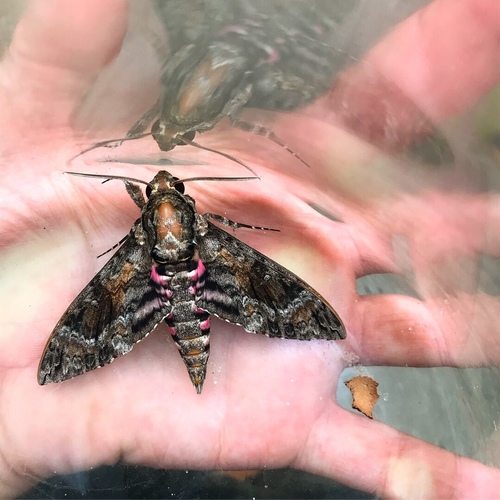
A large, fast-flying nocturnal hawkmoth with distinctive pink spots on the abdomen; larvae feed on sweet potato and morning glory.

!Is the pink-spotted hawkmoth dangerous?
No. Adults do not bite or sting and are not venomous. Caterpillars are not poisonous but may regurgitate or produce irritating fluids if roughly handled; handle with care or avoid touching. No known human disease risk.
Pets
Not toxic to pets. Large caterpillars could cause minor gastrointestinal upset if eaten by dogs or cats, but serious effects are unlikely. Remove any large larvae from pets' reach.
📖Overview
Agrius cingulata is a large sphingid moth native to tropical and subtropical regions of the Americas and a regular migrant into temperate North America. Adults are powerful, fast fliers that visit night-blooming flowers for nectar. Larvae (hornworms) feed mainly on plants in the morning-glory family (Convolvulaceae), including cultivated sweet potato, and can occasionally be agricultural pests. The species is common and adaptable, often attracted to lights and gardens.
🔍How to identify a pink-spotted hawkmoth
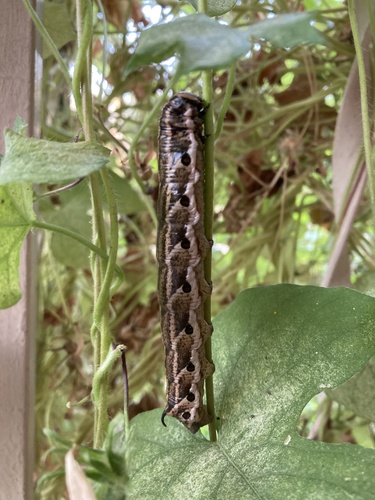
Adults have a stout, streamlined body and narrow, pointed forewings typical of hawkmoths. Forewings are mottled gray-brown with darker and lighter banding; hindwings are paler with subtle banding. The abdomen has a row of conspicuous pink to rose spots along each side, set against a gray-brown background. Wingspan typically ranges 90-120 mm. Caterpillars are robust hornworms (final instars 60-80 mm long), variable in color (green, brown, or almost black) with diagonal lateral white or pale stripes and a curved posterior 'horn'. Pupation occurs in an earthen chamber in the soil.
- Look for a large sphingid moth with a 90-120 mm wingspan and narrow, pointed forewings.
- Check the abdomen for a row of conspicuous pink to rose spots along the sides against a gray-brown background.
- Caterpillars are hornworms with a curved posterior horn and diagonal pale stripes; usually found on morning-glory or sweet potato leaves.
- Active at dusk and nighttime, often visiting tubular, fragrant flowers for nectar.
Lookalikes
Convolvulus hawk-moth Agrius convolvuli
Very similar in shape and habits but found in the Old World (Europe, Africa, Asia, Australia) rather than the Americas; its abdomen has pink and black bands rather than a row of pink side spots.
Carolina sphinx (tobacco hornworm) Manduca sexta
Adults have yellow-orange rather than pink spots along the abdomen; caterpillars are green with diagonal white stripes and a curved red horn and feed on tomato, tobacco and related plants rather than sweet potato.
↻Life cycle
Egg
Small pale eggs are laid singly on host plant leaves and stems; hatch in several days depending on temperature.
Larva (hornworm)
Several instars of a large horned caterpillar that feeds on host foliage for 2-4 weeks, growing rapidly and sometimes causing noticeable defoliation.
Pupa
Caterpillar burrows into the soil and pupates in an earthen chamber; pupal stage lasts from weeks to months depending on climate.
Adult (moth)
Large nocturnal nectar-feeding moth; mates and females lay eggs on suitable host plants to start the next generation.
🍃Diet and predators
Young eat
Leaves of morning glory family (Convolvulaceae), especially Ipomoea species and sweet potato.
Adults eat
Nectar from night-blooming or evening-scented flowers (e.g., petunias, moonflower) using a long proboscis.
Predators of the young
Parasitoid wasps and flies, birds, predatory insects and small mammals.
Predators of adults
Bats, night birds, spiders and mantids; also trapped by artificial lights which can increase mortality risk.
🌱Effect on plants and gardens
Larvae feed on Convolvulaceae such as Ipomoea (morning glory) and cultivated sweet potato (Ipomoea batatas). Heavy local infestations can defoliate vines and reduce yields.
How to get rid of pink-spotted hawkmoths
For garden or small-scale crops: handpick caterpillars and destroy or relocate them; encourage natural enemies (birds, parasitic wasps); use Bacillus thuringiensis (Bt) products labeled for hornworms; apply row covers to protect young plants. For larger infestations consult local agricultural extension for recommended insecticides and integrated pest management practices.
📍Where and when to find it
Adults at night near fragrant, tubular flowers and porch lights; caterpillars on leaves of morning-glory, Ipomoea species and sweet potato vines.
Best time
Best observed at dusk and during warm nights from late spring through early autumn in temperate zones; year-round in the tropics.
Observation tips
Use a flashlight with red filter or low light to photograph without startling moths; check host plants for large hornworms on the undersides of leaves. Night-blooming garden plants like moonflower attract adults.
✨Fun facts
- Pink-spotted hawkmoths are excellent long-distance fliers and sometimes migrate northward beyond their typical tropical range.
- Their long proboscis lets them feed from deep, tubular flowers that many other insects cannot reach, making them important night-time pollinators.
- Larvae that feed on sweet potato are sometimes called hornworms and can be mistaken for the tomato/tobacco hornworm, but host plant and markings differ.
?Frequently asked questions
Do pink-spotted hawkmoths bite or sting?
No. Adults do not bite or sting and are harmless to people. Caterpillars are not venomous; avoid rough handling to prevent regurgitation or mild irritation.
Are pink-spotted hawkmoth caterpillars pests of sweet potatoes?
Yes. Larvae feed on sweet potato and other morning-glory species and can defoliate vines if present in large numbers.
Why is a large moth in my house at night?
Adults are attracted to artificial lights and to night-blooming flowers. They sometimes fly through open doors or windows and become trapped indoors.
How do I get rid of pink-spotted hawkmoths in my garden?
Handpick caterpillars at night or early morning and destroy them; use Bt (Bacillus thuringiensis) for caterpillar control on edible crops; reduce nearby volunteer morning-glory weeds; encourage natural predators. For large-scale problems, consult local extension services.
When can I see them?
Adults are most often seen at dusk and during the night in summer and early autumn in temperate regions; in tropical areas they may be present year-round.
📷Photos of the pink-spotted hawkmoth



More butterflies & moths
This guide was written with AI assistance and fact-checked, last updated 2026-10-10. Identification from photos is never certain: don't handle insects you can't identify, and get medical advice for bites, stings or allergic reactions. More about the pink-spotted hawkmoth: iNaturalist, Wikipedia.