
Long-tailed giant ichneumon wasp
Megarhyssa macrurus · Ichneumon wasps
A very long-ovipositor parasitic wasp that searches dead wood for horntail larvae; harmless to people and beneficial in controlling wood-boring insects.

!Is the long-tailed giant ichneumon wasp dangerous?
No. Megarhyssa macrurus does not have a stinger for human use; the long ovipositor is used to insert eggs into wood and is not a venom-injecting stinger. They are non-aggressive and rarely, if ever, pierce human skin. No medical treatment is normally needed. If an unusual puncture occurs, clean the area, apply antiseptic, and seek medical care if there is persistent pain, swelling or signs of infection.
Pets
Not dangerous to pets. Very unlikely to sting or harm cats or dogs; they are not interested in attacking animals.
📖Overview
Megarhyssa macrurus is a large, slender ichneumonid wasp native to North American forests. Females have an extremely long ovipositor used to drill into dead or dying wood to lay eggs on the larvae of wood-boring horntail wasps. Adults are non-aggressive, feed on nectar, and are most often seen near fallen or standing dead trees where host larvae occur. They are solitary parasitoids: each Megarhyssa larva develops by consuming a single host.
🔍How to identify a long-tailed giant ichneumon wasp
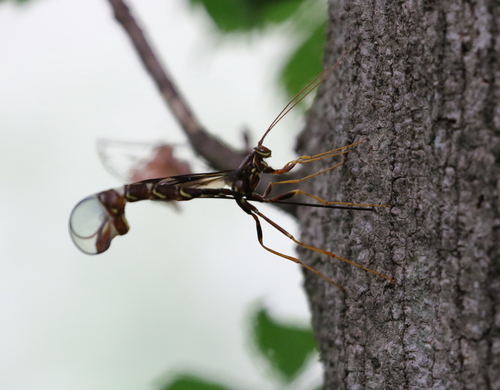
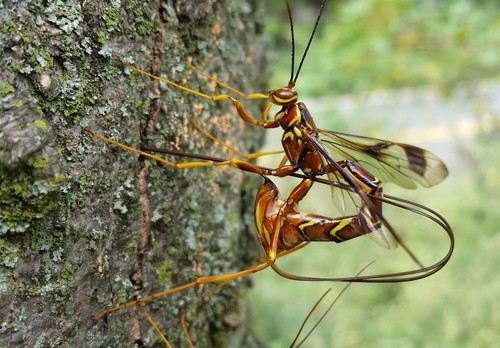
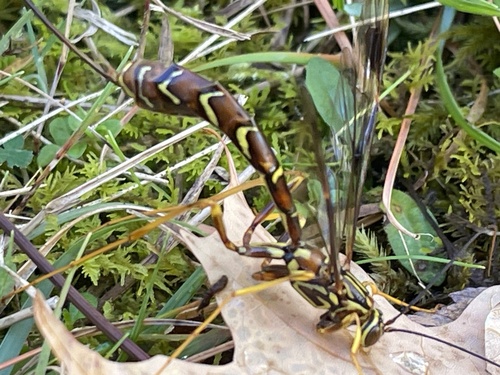
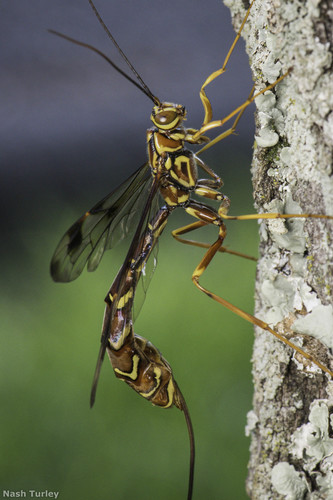
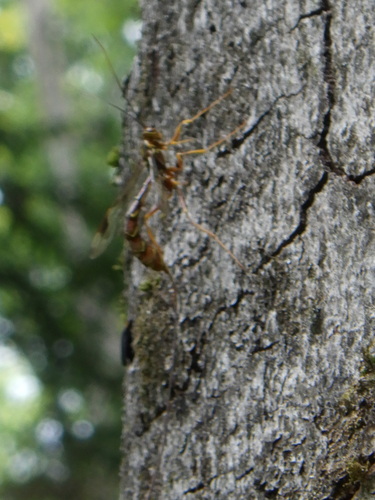
Adults are very long and slender with long legs and a narrow 'waist'. Males lack the long ovipositor and are noticeably shorter. Females carry a thread-like ovipositor that can be about twice the length of the body. Body pattern is a mix of yellow to orange and dark brown or black banding; wings are clear to slightly smoky with visible venation. The overall impression is delicate and stick-like rather than robust.
- Very long, thread-like ovipositor on females that extends well beyond the rear of the body
- Slender, elongated body with contrasting yellow/orange and dark brown or black banding
- Long legs and clear to slightly smoky wings with visible venation
- Large overall length compared with common wasps; males are smaller and lack the long ovipositor
Lookalikes
Black Giant Ichneumon Megarhyssa atrata
M. atrata is darker overall (more black) and usually has less yellow/orange; ovipositor present in females as well but body patterning differs.
Megarhyssa greenei Megarhyssa greenei
Similar long-ovipositor species; differences are subtle and require close comparison of body markings and geographic range.
↻Life cycle
Egg
Female drills an ovipositor through bark into wood and lays eggs on or near a horntail larva, usually within tunnels in dead or dying wood.
Larva (parasitoid)
Megarhyssa larva feeds on the horntail host, feeding externally on it while protected inside the wood, where it overwinters.
Pupa
After consuming the host, the wasp larva pupates inside a chamber within the wood and develops into an adult.
Adult
Adult wasps emerge from the wood, mate, feed on nectar, and females search for hosts to repeat the cycle.
🍃Diet and predators
Young eat
Ectoparasitoid of horntail (Siricidae) larvae, especially the pigeon tremex (Tremex columba), that bore in dead or dying hardwoods; the larva feeds externally on its host
Adults eat
Nectar from flowers, sometimes honeydew
Predators of the young
Probably exposed to wood-associated predators and parasitoids, but specific predators are poorly documented
Predators of adults
Birds, larger predatory insects and spiders may take adults
🌱Effect on plants and gardens
Indirectly beneficial: Megarhyssa larvae parasitize wood-boring horntail larvae that can damage dead or weakened trees. Adults feed on nectar and can visit flowers but are not important pollinators compared with bees.
📍Where and when to find it
Look on or near dead standing trees, fallen logs, and old stumps. Adults visit nearby flowers for nectar; females inspect bark and drill with the ovipositor into wood.
Best time
Late spring through summer, during warm, sunny daylight hours.
Observation tips
Photograph from a distance to avoid disturbing the insect; a macro lens helps capture the long ovipositor and banded body. Look for emergence holes in dead wood as signs of past activity.
✨Fun facts
- The female's ovipositor is not a stinger; it is an egg-laying organ that can be about twice as long as her body.
- Females can detect horntail larvae living deep in wood and drill to reach them using the ovipositor.
- Despite their intimidating look, they are harmless to humans and are beneficial biological control agents.
?Frequently asked questions
Do long-tailed giant ichneumon wasps sting people?
No. The long structure on females is an ovipositor used to lay eggs into wood, not a venomous stinger. They are not aggressive toward people.
Are long-tailed giant ichneumon wasps dangerous?
No. They pose virtually no danger to humans or pets. They do not seek out or attack people.
Why is one in my yard or on my house?
Females are searching for wood-boring horntail larvae inside dead or dying wood. If you have fallen logs, dead limbs, or old fence posts nearby, that attracts them.
How do I get rid of them?
They are beneficial, so the best approach is to leave them alone. If they are unwanted near housing, remove or dispose of infested dead wood and keep firewood stacked away from the house. Avoid spraying broad insecticides because that kills beneficial insects.
Where do they live and when will I see them?
They live where horntail hosts occur: forests and wooded areas with dead or decaying trees. Adults are active in late spring and summer on warm days.
📷Photos of the long-tailed giant ichneumon wasp
More bees, wasps & ants
Bites and formic acid
Painful sting
Stinging insect
Can sting
Can sting
Can sting
This guide was written with AI assistance and fact-checked, last updated 2026-10-10. Identification from photos is never certain: don't handle insects you can't identify, and get medical advice for bites, stings or allergic reactions. More about the long-tailed giant ichneumon wasp: iNaturalist, Wikipedia.