
Pigeon tremex vs Long-tailed giant ichneumon wasp
These two are easy to mix up. Here's how to tell a pigeon tremex from a long-tailed giant ichneumon wasp, and whether either one bites or stings.
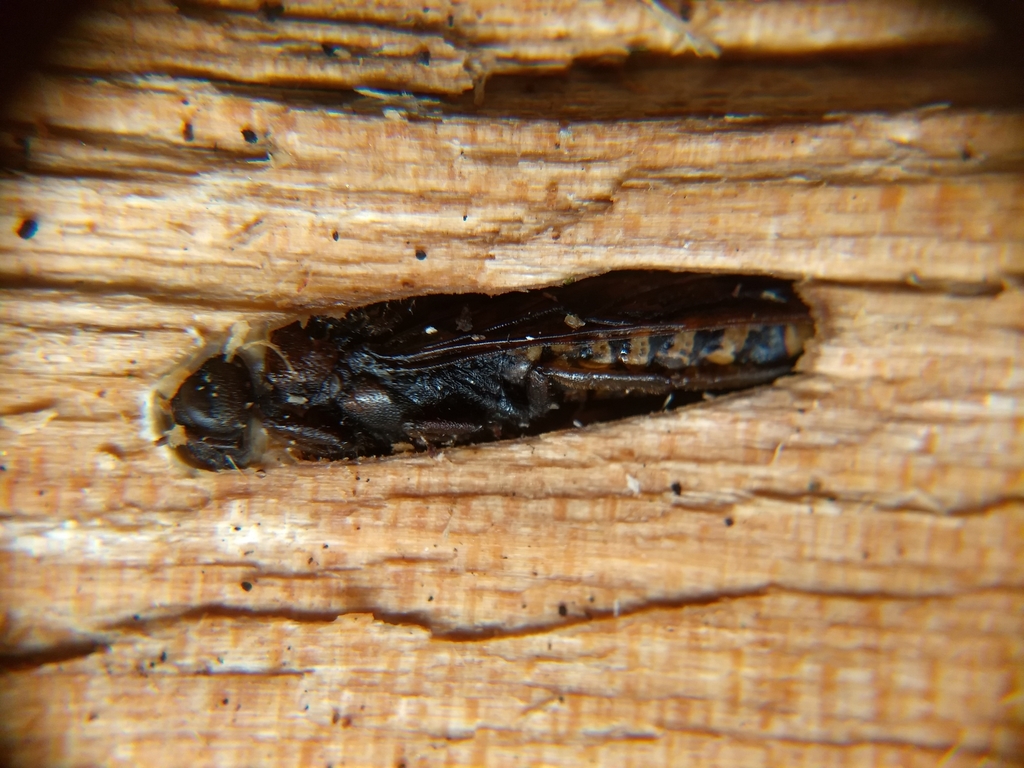
Pigeon tremex
Tremex columba

Long-tailed giant ichneumon wasp
Megarhyssa macrurus
≠The key differences
Slender with an extremely long, thread-like ovipositor (often longer than the body) and a thin, waisted abdomen; it is a parasitoid often seen on the same trees, laying eggs onto pigeon tremex larvae inside the wood.
⚖︎Side by side
| Pigeon tremex | Long-tailed giant ichneumon wasp | |
|---|---|---|
| To humans | Non-toxic | Non-toxic |
| Size | 20-50 mm body length (not counting ovipositor; females larger) | Female body about 3.5-5 cm; ovipositor up to about 10 cm or more beyond the body |
| Colours | Black, Dark brown, Reddish orange | Yellow, Orange-brown, Dark brown, Black |
| Family | Siricidae | Ichneumonidae |
| Habitat | Forests, woodland edges, parks and any site with dead or dying hardwood (logs, stumps, branches). | Deciduous and mixed forests, woodland edges, and areas with dead standing trees or fallen logs where horntail hosts live |
| Range | Native to North America: widespread across the eastern United States and southern Canada, with scattered records farther west. | Eastern and central North America (United States and southern Canada), tied to ranges of wood-boring horntail hosts |
| Active | Adults active in warm months (local summer); most activity during daylight. | Late spring through summer (when adults fly and mate); daytime active, often seen on warm, sunny days |
| Pest? | No | No |
🔍How to spot a pigeon tremex
- Large, stout wasplike insect 20-50 mm long with a cylindrical body and clear or smoky wings.
- Reddish-brown to black body, usually with yellow bands on the abdomen.
- Females have a long, slender ovipositor projecting from the tip of the abdomen (not a sting).
- Exit holes in wood are round and about 6-10 mm across; frass may be seen as powdery wood debris.
🔍How to spot a long-tailed giant ichneumon wasp
- Very long, thread-like ovipositor on females that extends well beyond the rear of the body
- Slender, elongated body with contrasting yellow/orange and dark brown or black banding
- Long legs and clear to slightly smoky wings with visible venation
- Large overall length compared with common wasps; males are smaller and lack the long ovipositor
?Frequently asked questions
What is the difference between a pigeon tremex and a long-tailed giant ichneumon wasp?
Slender with an extremely long, thread-like ovipositor (often longer than the body) and a thin, waisted abdomen; it is a parasitoid often seen on the same trees, laying eggs onto pigeon tremex larvae inside the wood.
Is a pigeon tremex or a long-tailed giant ichneumon wasp more dangerous?
Pigeon tremex: Non-toxic. Long-tailed giant ichneumon wasp: Non-toxic. Adults do not have a venomous sting. Megarhyssa macrurus does not have a stinger for human use; the long ovipositor is used to insert eggs into wood and is not a venom-injecting stinger.
Identification from photos is never certain: don't handle insects you can't identify, and get medical advice for bites, stings or allergic reactions.