
American pelecinid wasp vs Long-tailed giant ichneumon wasp
These two are easy to mix up. Here's how to tell an American pelecinid wasp from a long-tailed giant ichneumon wasp, and whether either one bites or stings.
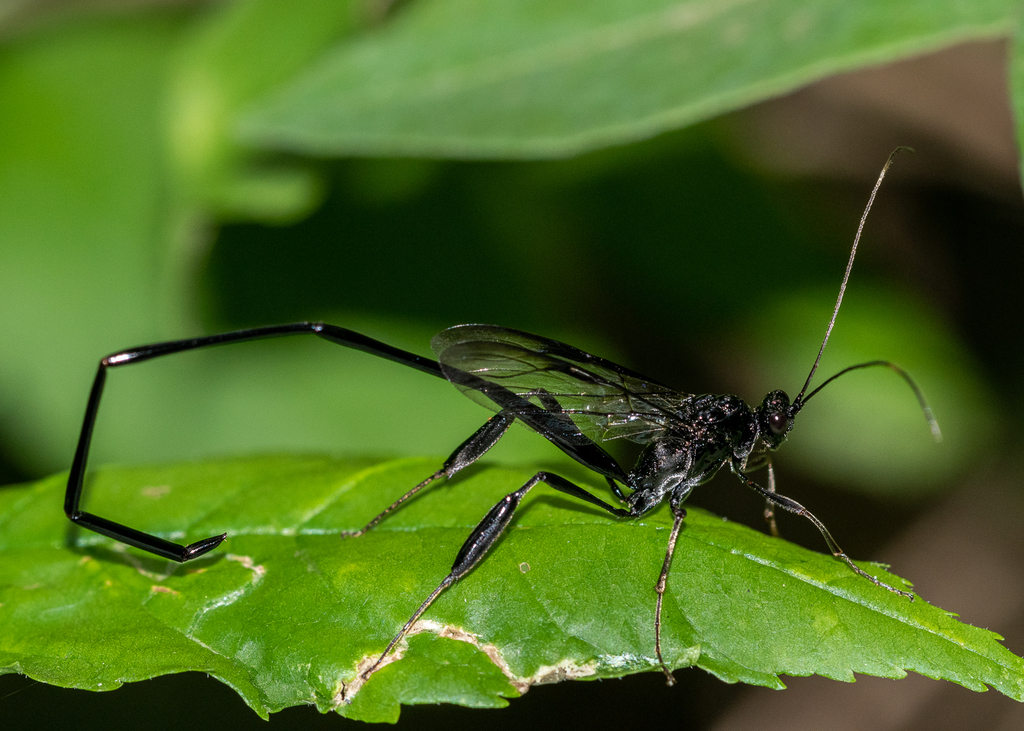
American pelecinid wasp
Pelecinus polyturator

Long-tailed giant ichneumon wasp
Megarhyssa macrurus
≠The key differences
Giant ichneumons have a hair-thin ovipositor that trails far behind a normal-sized abdomen, and are usually brown and yellow; the pelecinid female is all glossy black and the long tail is the abdomen itself.
⚖︎Side by side
| American pelecinid wasp | Long-tailed giant ichneumon wasp | |
|---|---|---|
| To humans | Non-toxic | Non-toxic |
| Size | Females about 50-65 mm including the long abdomen; males much smaller, about 20-25 mm | Female body about 3.5-5 cm; ovipositor up to about 10 cm or more beyond the body |
| Colours | Glossy black, Dark brown (legs), Smoky wing tint | Yellow, Orange-brown, Dark brown, Black |
| Family | Pelecinidae | Ichneumonidae |
| Habitat | Open woodland edges, gardens, fields and areas with sandy or loose soil where scarab larvae occur | Deciduous and mixed forests, woodland edges, and areas with dead standing trees or fallen logs where horntail hosts live |
| Range | Widespread in the Americas, from southern Canada through the eastern and central United States, Mexico and Central America south to Argentina | Eastern and central North America (United States and southern Canada), tied to ranges of wood-boring horntail hosts |
| Active | Warm months; diurnal (active by day). In temperate North America most records are late spring through early fall | Late spring through summer (when adults fly and mate); daytime active, often seen on warm, sunny days |
| Pest? | No | No |
🔍How to spot an American pelecinid wasp
- Females have an extremely long, threadlike abdomen that projects backward like a tail.
- Glossy black body with smooth, slender form and clear to slightly smoky wings.
- Size difference: females far longer than males; males lack the long tail.
- Found on vegetation, near sandy or loose soil where scarab grubs occur.
🔍How to spot a long-tailed giant ichneumon wasp
- Very long, thread-like ovipositor on females that extends well beyond the rear of the body
- Slender, elongated body with contrasting yellow/orange and dark brown or black banding
- Long legs and clear to slightly smoky wings with visible venation
- Large overall length compared with common wasps; males are smaller and lack the long ovipositor
?Frequently asked questions
What is the difference between an American pelecinid wasp and a long-tailed giant ichneumon wasp?
Giant ichneumons have a hair-thin ovipositor that trails far behind a normal-sized abdomen, and are usually brown and yellow; the pelecinid female is all glossy black and the long tail is the abdomen itself.
Is an American pelecinid wasp or a long-tailed giant ichneumon wasp more dangerous?
American pelecinid wasp: Non-toxic. Long-tailed giant ichneumon wasp: Non-toxic. Not considered dangerous. Megarhyssa macrurus does not have a stinger for human use; the long ovipositor is used to insert eggs into wood and is not a venom-injecting stinger.
Identification from photos is never certain: don't handle insects you can't identify, and get medical advice for bites, stings or allergic reactions.