
Red imported fire ant vs European fire ant
These two are easy to mix up. Here's how to tell a red imported fire ant from an European fire ant, and whether either one bites or stings.
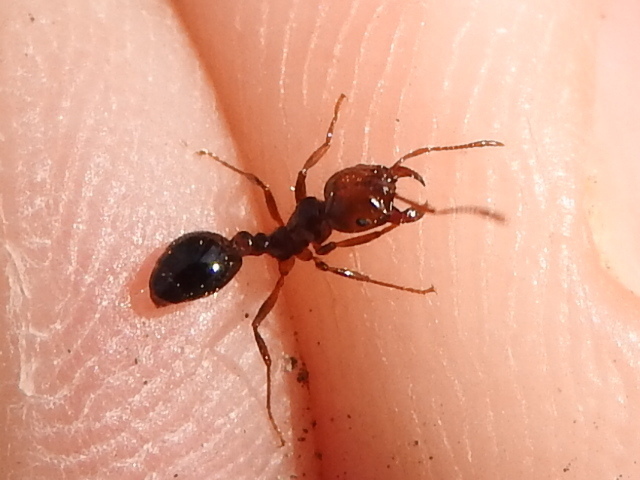
Red imported fire ant
Solenopsis invicta

European fire ant
Myrmica rubra
≠The key differences
Both have a two-segmented waist and a painful sting, but fire ant workers vary greatly in size within one colony, have 10-segmented antennae with a two-segmented club and lack the thoracic spines of Myrmica; they build large dome-shaped mounds in sunny open ground in warmer regions.
⚖︎Side by side
| Red imported fire ant | European fire ant | |
|---|---|---|
| To humans | Painful sting | Painful sting |
| Size | Workers 2.4-6 mm; queens about 7-9 mm | 3-5 mm (workers) |
| Colours | Reddish-brown, Dark brown, Black (gaster in some individuals) | Reddish-brown, Dark brown (gaster), Yellowish-brown (legs and antennae) |
| Family | Formicidae | Formicidae |
| Habitat | Open, sunny habitats: lawns, parks, agricultural fields, roadside verges, disturbed ground, and urban green spaces. Nests in soil mound structures. | Temperate grasslands, meadows, forest edges, gardens, beneath stones, in rotten wood and turf; nests in moist soil and leaf litter. |
| Range | Native to South America; invasive and established across much of the southeastern United States, parts of the western US, Australia, China, Taiwan, parts of the Caribbean and other regions where they were introduced. | Native to Europe and parts of Asia; introduced and established in parts of eastern and northeastern North America and recorded elsewhere as an invader. |
| Active | Active year-round in warm climates; most active spring through fall and during warm parts of the day. | Spring to autumn (most active in warm months), foraging mainly during daylight but sometimes at night in warm weather |
| Pest? | Yes | Yes |
🔍How to spot a red imported fire ant
- Workers reddish-brown to dark red, 2.4-6 mm long; queens larger and darker (about 7-9 mm).
- Two-segmented waist (two nodes) between thorax and abdomen; elbowed antennae with 10 segments ending in a two-segmented club.
- Conspicuous soil mounds without a central entrance hole, often in open, sunny locations.
- Very aggressive: when a mound is disturbed, many workers swarm and sting.
🔍How to spot an European fire ant
- Small workers 3-5 mm, uniform reddish to dark reddish-brown coloration.
- Two-segmented petiole (two distinct nodes) between thorax and gaster.
- Short propodeal spines on the thorax visible under magnification.
- Antennae with 12 segments, gradually thickening toward the tip.
?Frequently asked questions
What is the difference between a red imported fire ant and an European fire ant?
Both have a two-segmented waist and a painful sting, but fire ant workers vary greatly in size within one colony, have 10-segmented antennae with a two-segmented club and lack the thoracic spines of Myrmica; they build large dome-shaped mounds in sunny open ground in warmer regions.
Is a red imported fire ant or an European fire ant more dangerous?
Red imported fire ant: Painful sting. European fire ant: Painful sting. Workers sting repeatedly, injecting alkaloid venom (solenopsin) that causes immediate burning pain, raised wheals and pustules in many people. Workers do not bite strongly but can sting.
Identification from photos is never certain: don't handle insects you can't identify, and get medical advice for bites, stings or allergic reactions.