
Cassin's periodical cicada
Magicicada cassinii · Periodical cicadas
A 17-year periodical cicada of the eastern United States noted for synchronized mass emergences, loud male choruses, and adults that harmlessly feed on plant xylem.

!Is the Cassin's periodical cicada dangerous?
No. Cicadas do not bite or sting humans. They may startle people with their loud chorus. Handle gently if necessary; no special first aid is needed beyond usual wound care if a minor scratch occurs while handling.
Pets
Not toxic to pets. Large numbers can be eaten by birds, dogs, or cats without typical toxicity, though eating large volumes could upset digestion. Supervise pets if large emergences are present.
📖Overview
Magicicada cassinii is one of the periodical cicadas that emerges synchronously in large numbers after long underground development. Most known populations follow a 17-year life cycle and appear in geographically distinct broods. Adults are active above ground for a few weeks to mate, then females lay eggs in small twigs. Nymphs drop to the soil, feed on tree root xylem, and develop underground for many years before emerging en masse. These cicadas do not bite or sting people and are not dangerous, but heavy egg-laying can damage small branches of young trees and shrubs.
🔍How to identify a Cassin's periodical cicada
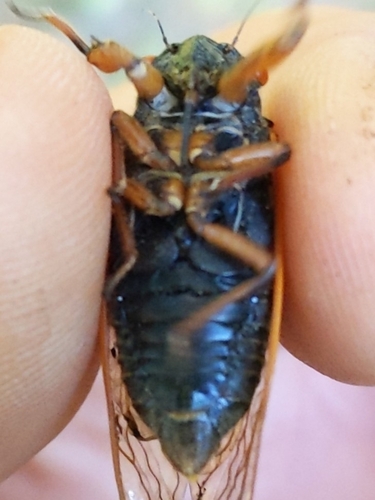
Adults are robust, with a mostly black body, membranous clear wings, and conspicuous red eyes. They have orange wing veins and orange legs. Unlike Magicicada septendecim, the underside of the abdomen is entirely or almost entirely black, without broad orange bands, and there is no orange patch behind the eye; the species is also slightly smaller. The male call, a buzzing song ending in a drawn-out tick-like series, also helps separate M. cassinii from its relatives.
- Look for a black body with red eyes and orange wing veins; the underside of the abdomen is mostly or entirely black.
- Adults about 20-30 mm long with clear, membranous wings extending past the abdomen.
- Emergences in large numbers in a single year (brood) and a loud, continuous male chorus are characteristic of periodical cicadas.
- Distinguish from other Magicicada species by the black underside of the abdomen, slightly smaller size and male song (close examination or audio comparison helps).
Lookalikes
Pharaoh cicada Magicicada septendecim
Larger, with broad orange bands on the underside of the abdomen and an orange patch between the eye and the wing base; its song is a low "phaaa-raoh" call rather than a tick-buzz song.
Little 17-year cicada Magicicada septendecula
Similar in size to M. cassinii, but the underside of the abdomen has orange bands; the song is a rhythmic series of short buzzing phrases.
↻Life cycle
Egg
Laid in slits cut into small twigs by females; eggs hatch in 6-10 weeks, and tiny nymphs drop to the ground.
Nymph (underground)
Nymphs burrow and feed on root xylem for many years (typically 17 years) as they grow through instars underground.
Adult (winged)
Nymphs emerge synchronously, climb vegetation, molt to winged adults, mate, and complete the short above-ground phase before dying.
🍃Diet and predators
Young eat
Xylem fluids from tree and shrub roots
Adults eat
Xylem fluids from twigs and branches
Predators of the young
Burrowing predators, fungal pathogens, and parasitoids (various insects and microbes)
Predators of adults
Birds, small mammals, reptiles, amphibians, and predatory insects; large emergences also attract many opportunistic predators
🌱Effect on plants and gardens
Nymphs feed on xylem fluid from tree roots without usually harming mature trees. Females cut slits in small twigs to lay eggs; heavy egg-laying can cause 'flagging' (dead twig tips) and may damage young or ornamental trees.
How to get rid of Cassin's periodical cicadas
For young or valuable trees, protect branches with fine netting before emergence to prevent egg-laying. Prune and destroy flagged twigs after adults depart to reduce stress on the plant. Chemical controls are rarely necessary; consult a local arborist for high-value trees.
📍Where and when to find it
Look on tree trunks, branches, and shrubs during emergence; freshly molted adults cling to vegetation while their wings expand. Nymphs climb nearby stems after emerging from the soil.
Best time
Emergence typically occurs in late spring to early summer in the brood year, during warm daytime hours and evenings.
Observation tips
To photograph, approach slowly to avoid startling clusters; early morning after molting offers good, less active specimens. Recording male song helps confirm species identity.
✨Fun facts
- Magicicada cassinii is part of a group of cicadas that spend most of their lives underground and emerge in massive synchronized broods every 17 years.
- Mass emergences overwhelm predators by sheer numbers, allowing many cicadas to survive to reproduce — a strategy called predator satiation.
- Despite the dramatic appearance and loud noise, adult periodical cicadas do not feed on leaves and are not harmful to humans.
?Frequently asked questions
Are Cassin's periodical cicadas harmful to people?
No. They do not bite or sting and are not poisonous. They can be noisy but are otherwise harmless.
Will cicadas ruin my trees?
Mature trees usually tolerate cicada emergences. Damage is mostly limited to twig flagging from egg-laying and can harm young or small ornamental trees if egg-laying is heavy.
Why are there so many cicadas all at once?
They synchronize emergence after a long underground development period (usually 17 years for M. cassinii). Mass emergence helps ensure enough individuals survive predation to reproduce.
How do I stop cicadas from laying eggs on my small trees?
Cover small or valuable trees with fine netting before adults emerge, or delay pruning until after emergence and remove damaged twigs. Insecticides are generally unnecessary and not very effective for the brief adult period.
When will Cassin's periodical cicadas appear in my area?
They appear in specific broods year-by-year. Local university extension offices or entomology resources can tell you which brood is expected in your region.
📷Photos of the Cassin's periodical cicada



More true bugs, cicadas & aphids
Bites cause itching
Non-venomous nuisance
Non-toxic
Smelly secretion
Potential disease vector
Painful bite
This guide was written with AI assistance and fact-checked, last updated 2026-10-10. Identification from photos is never certain: don't handle insects you can't identify, and get medical advice for bites, stings or allergic reactions. More about the Cassin's periodical cicada: iNaturalist, Wikipedia.