
Pharaoh cicada vs Cassin's periodical cicada
These two are easy to mix up. Here's how to tell a pharaoh cicada from a Cassin's periodical cicada, and whether either one bites or stings.
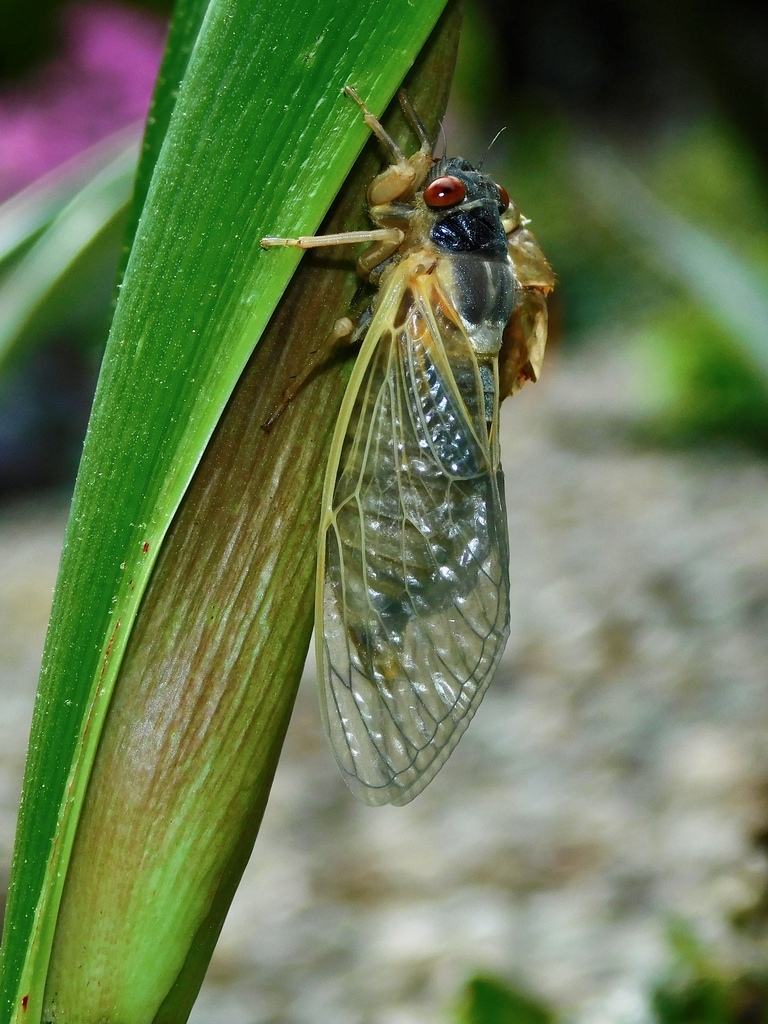
Pharaoh cicada
Magicicada septendecim

Cassin's periodical cicada
Magicicada cassinii
≠The key differences
Larger, with broad orange bands on the underside of the abdomen and an orange patch between the eye and the wing base; its song is a low "phaaa-raoh" call rather than a tick-buzz song.
⚖︎Side by side
| Pharaoh cicada | Cassin's periodical cicada | |
|---|---|---|
| To humans | Non-toxic | Non-toxic |
| Size | Body length 25-35 mm; wingspan about 60-80 mm | 20-30 mm body length (wingspan larger) |
| Colours | Black, Red (eyes), Orange (veins and abdominal markings), Translucent (wings) | Black, Red (eyes), Orange (wing veins and opercula), Clear (wings) |
| Family | Cicadidae | Cicadidae |
| Habitat | Deciduous forests, wooded suburban areas, orchards and tree-lined landscapes where host trees are present for nymph feeding and adult egg-laying. | Deciduous forests, mixed woodlands, suburban and rural areas with trees and shrubs; requires tree roots for nymphal feeding and small twigs for oviposition |
| Range | Eastern and midwestern United States where 17-year broods occur, from the Great Plains east to the Atlantic coast. | Eastern and central United States in regionally distinct broods; exact local occurrence depends on brood distribution |
| Active | Emerges in late spring to early summer (May-July) during the day; the exact year and timing depend on the brood. | Emerges in a single year by brood (spring to early summer); adults active during warm daytime hours and evening |
| Pest? | Yes | Yes |
🔍How to spot a pharaoh cicada
- Emergence years: appears in large, synchronized broods every 17 years (check local brood maps).
- Red eyes and mostly black body with orange vein-highlighted translucent wings.
- Males produce a distinctive low, buzzy 'phar-aoh' call lasting 1-3 seconds, heard in loud daytime choruses.
- Size about 25-35 mm body length with 60-80 mm wingspan; visible tymbals on males.
🔍How to spot a Cassin's periodical cicada
- Look for a black body with red eyes and orange wing veins; the underside of the abdomen is mostly or entirely black.
- Adults about 20-30 mm long with clear, membranous wings extending past the abdomen.
- Emergences in large numbers in a single year (brood) and a loud, continuous male chorus are characteristic of periodical cicadas.
- Distinguish from other Magicicada species by the black underside of the abdomen, slightly smaller size and male song (close examination or audio comparison helps).
?Frequently asked questions
What is the difference between a pharaoh cicada and a Cassin's periodical cicada?
Larger, with broad orange bands on the underside of the abdomen and an orange patch between the eye and the wing base; its song is a low "phaaa-raoh" call rather than a tick-buzz song.
Is a pharaoh cicada or a Cassin's periodical cicada more dangerous?
Pharaoh cicada: Non-toxic. Cassin's periodical cicada: Non-toxic. Pharaoh cicadas are not venomous and do not sting. Cicadas do not bite or sting humans.
Identification from photos is never certain: don't handle insects you can't identify, and get medical advice for bites, stings or allergic reactions.