
Yellow-spotted millipede
Harpaphe haydeniana · Flat-backed millipedes
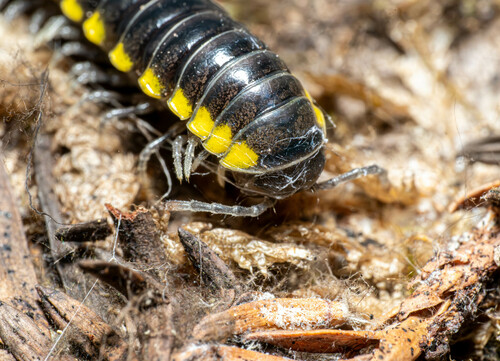
A black, flat-backed millipede with bright yellow dorsal spots common in moist Pacific Northwest forests; a harmless decomposer that can secrete irritating cyanide-containing fluids.
!Is the yellow-spotted millipede dangerous?
Only mildly. Not aggressive and will not bite. When threatened it can exude a defensive fluid that may irritate skin or eyes and has an almond-like odor (products include hydrogen cyanide in trace amounts). Wash skin with soap and water if contacted. If fluid gets in the eyes, rinse thoroughly and seek medical attention if irritation persists. Do not ingest.
Pets
Can be harmful if a pet chews or eats many millipedes: secretions can cause drooling, vomiting, or mouth irritation and, rarely, more serious symptoms. Rinse a pet's mouth and contact a veterinarian if ingestion is suspected.
📖Overview
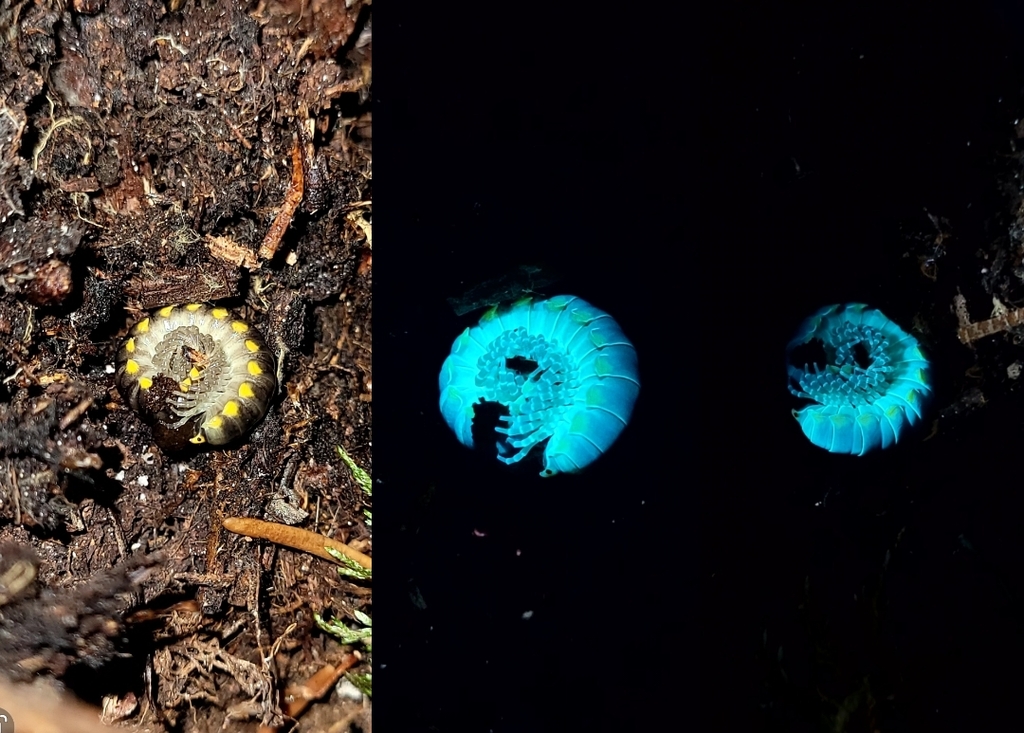
Harpaphe haydeniana is a common detritivore of cool, moist forests along the western coast of North America. It feeds on decaying leaf litter and helps recycle nutrients. When disturbed it curls up and can release defensive chemicals with a characteristic almond-like smell. It is slow-moving, non-aggressive toward people, and is most often encountered under logs, bark and leaf litter.
🔍How to identify a yellow-spotted millipede
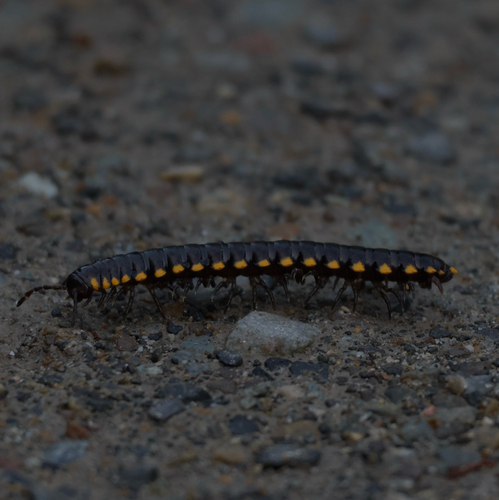
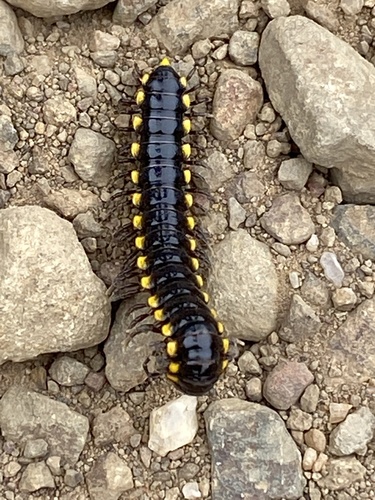
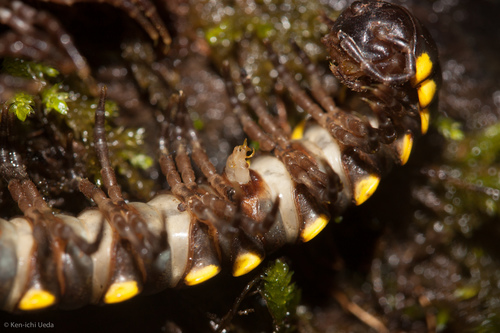
Adults are relatively flattened (typical of 'flat-backed' millipedes) and glossy black with bright yellow spots along the sides of the body, one on each side flange of each segment, and yellowish legs. The body is made of many similar segments, most with two pairs of short legs, giving the appearance of numerous legs on each side. When disturbed they curl up to protect the softer underside.
- Look for a flattened, glossy black segmented body with a row of bright yellow spots along each side.
- Adults are about 4-5 cm long and curl up when disturbed.
- Found under logs, bark and leaf litter in cool, moist forests — often in groups after rain.
Lookalikes
Other flat-backed millipedes Various Xystodesmidae
Harpaphe haydeniana is distinguished by its consistent yellow dorsal spots; related species differ in spot shape, number or color and in geographic range.
↻Life cycle
Egg
Eggs are laid in soil or moist litter; small clutches are deposited in protected, damp places.
Juvenile (nymph)
Young hatch as small nymphs and undergo a series of molts; with each molt they add body segments and legs until reaching the adult form.
Adult
Sexually mature millipedes with the full complement of segments; adults reproduce and continue the detritivore role.
🍃Diet and predators
Young eat
Decaying leaves, wood and other detritus
Adults eat
Decaying leaf litter, decomposing plant material and fungi
Predators of the young
Ground beetles, centipedes and small vertebrates
Predators of adults
Shrews, birds, some amphibians and especially the specialized ground beetle Promecognathus, which can cope with its cyanide; many other predators avoid them because of defensive chemicals
🌱Effect on plants and gardens
Feeds on decaying leaf litter and dead plant material; helps break down organic matter and recycle nutrients in forest ecosystems. Not a plant pest.
📍Where and when to find it
Look under logs, bark, stumps, and thick leaf litter in moist coniferous and mixed forests. After rain they are often found on the forest floor and along trails.
Best time
Best seen in spring and fall and on damp nights or after rain; they are mostly nocturnal or active at dawn and dusk.
Observation tips
Search by turning over damp logs and bark slowly; avoid crushing them. Use a low-angle light for night observations and keep specimens in a moist container if photographing close-up.
✨Fun facts
- When threatened, H. haydeniana curls up to protect its softer underside.
- Its defensive fluid can smell faintly of almonds due to cyanide compounds; the amount is very small but effective at deterring predators.
?Frequently asked questions
Are yellow-spotted millipedes dangerous?
Only mildly. They are not dangerous to humans in normal contact, but they can release an irritating defensive fluid containing small amounts of cyanide-related compounds; wash skin if contacted, keep it away from eyes and do not ingest the animal.
Do yellow-spotted millipedes bite or sting?
No. Millipedes do not bite or sting. Their primary defense is curling up and releasing defensive secretions.
Why are millipedes in my house?
They wander indoors seeking cool, moist shelter—especially during heavy rain or drought when outside conditions change. Basements, bathrooms and damp crawlspaces attract them.
How do I get rid of millipedes?
Reduce moisture and entry points: fix leaky pipes, use dehumidifiers, seal cracks and gaps, remove leaf litter and stacked wood near the foundation. Hand-collect and relocate individual millipedes if desired. Chemical control is rarely necessary and not recommended for general use.
Will millipedes damage my garden?
No. Harpaphe haydeniana feeds on decaying organic matter and is beneficial for soil health; they do not normally eat live plants.
📷Photos of the yellow-spotted millipede
More centipedes & millipedes
This guide was written with AI assistance and fact-checked, last updated 2026-10-10. Identification from photos is never certain: don't handle insects you can't identify, and get medical advice for bites, stings or allergic reactions. More about the yellow-spotted millipede: iNaturalist, Wikipedia.