
White admiral
Limenitis camilla · Admiral butterflies
A medium-sized woodland butterfly with a striking white band across glossy dark wings; caterpillars feed mainly on honeysuckle.
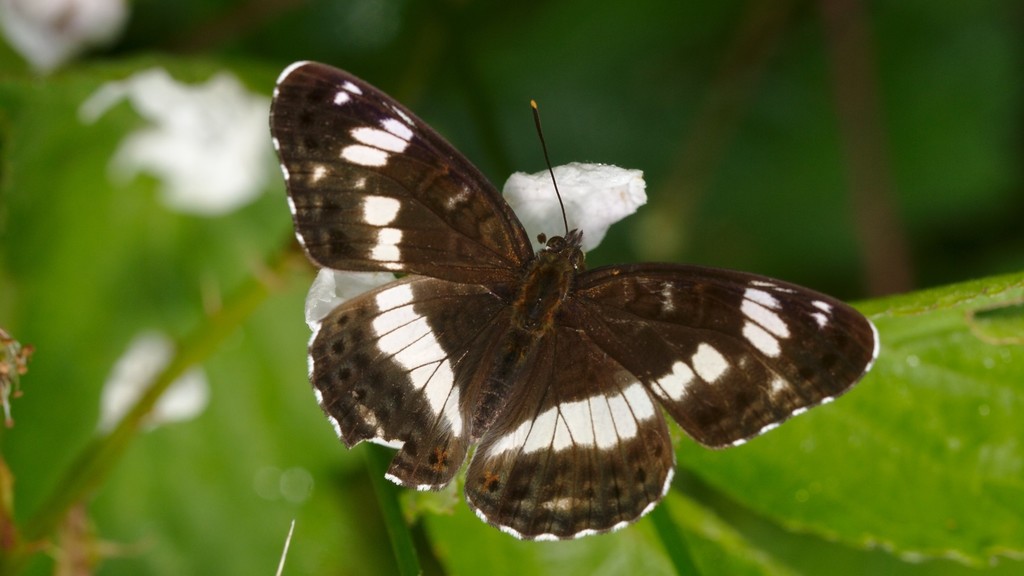
!Is the white admiral dangerous?
No. Harmless to people. Adults and caterpillars do not sting or bite. Handle gently if necessary; avoid crushing delicate wings.
Pets
Non-toxic to pets. Butterflies have no venom and are not a poisoning risk; avoid letting pets eat caterpillars or butterflies as this can harm the insect and may upset the pet.
📖Overview
The white admiral is a nymphalid butterfly of temperate Eurasia that favours shady deciduous woodland and rides. Adults are strong but graceful fliers, often seen patrolling woodland edges and glades. The species is primarily single-brooded in northern parts of its range and lays eggs on honeysuckle plants, whose leaves the caterpillars eat. Populations are sensitive to loss of connected woodland habitat and the decline of understorey honeysuckle.
🔍How to identify a white admiral
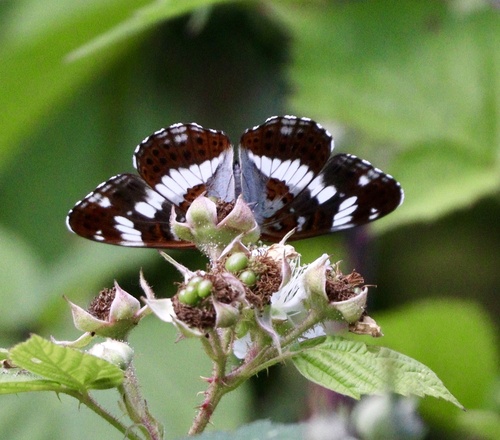
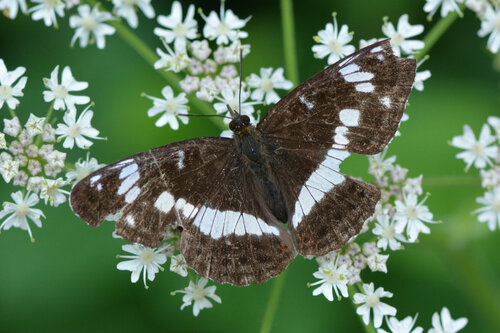
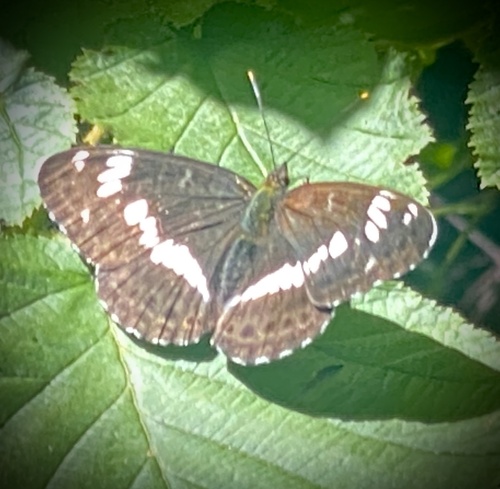
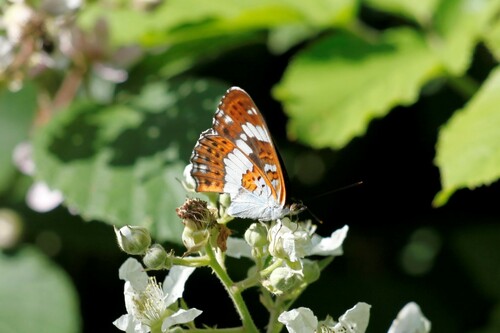
Adults have black to dark brown wings crossed by a broad, sharply defined white band. The forewing has small white spots near the tip. The underside is a striking orange-chestnut with the same white band, rows of small black spots and a pale blue-grey area near the body, a pattern that breaks up its outline at rest. The body is dark and slender; antennae are clubbed as in other butterflies.
- Broad, well-defined white median band across both forewing and hindwing on a dark glossy background
- Small white spots near the forewing tip and no eyespot on the hindwing upperside
- Underside: orange-chestnut with white bands, black spots and a blue-grey base
Lookalikes
Purple emperor Apatura iris
The purple emperor also has a white band but is larger, males show purple-blue iridescence on the upperside, and it has an orange-ringed eyespot on the hindwing; it usually stays high in oak canopies.
Southern white admiral Limenitis reducta
Has a bluish-black upperside with a white spot in the forewing cell and only a single row of black dots along the underside hindwing margin; it replaces the white admiral in southern Europe.
↻Life cycle
Egg
Small, pale eggs are laid singly on the underside of honeysuckle leaves or young shoots.
Larva (caterpillar)
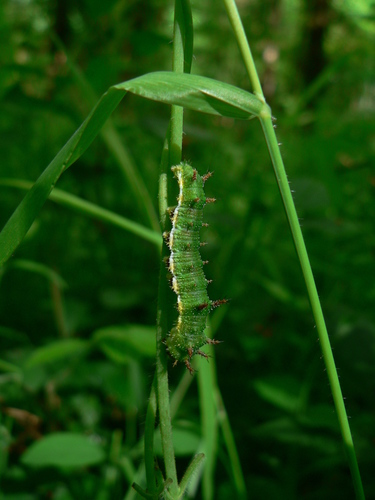
Green caterpillars with reddish-brown branched spines; they feed on honeysuckle leaves, overwinter while small inside a rolled leaf shelter, and grow through several instars.
Pupa (chrysalis)
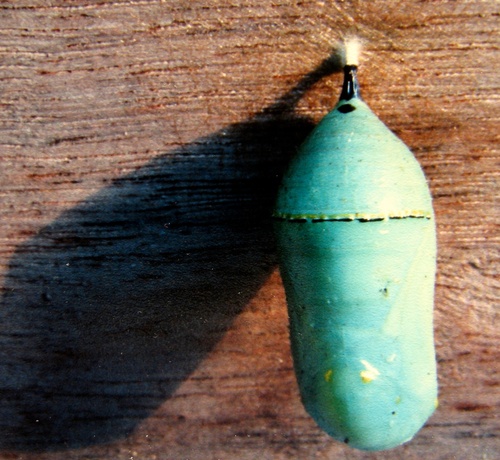
The chrysalis is attached to vegetation; it is cryptic and blends with stems and leaves while metamorphosis occurs.
Adult (butterfly)
Adults emerge and fly during warm daylight hours, visit flowers for nectar, and are active for a few weeks while mating and laying eggs.
🍃Diet and predators
Young eat
Leaves of honeysuckle (Lonicera) species; occasionally other shrubs in the understorey
Adults eat
Nectar from flowers, also tree sap, honeydew and sometimes rotting fruit
Predators of the young
Parasitoid wasps and flies, insectivorous birds, predatory bugs and spiders
Predators of adults
Birds, dragonflies and other aerial insectivores; predation risk reduced by fast flight and cryptic resting posture
🌱Effect on plants and gardens
Larvae feed primarily on honeysuckle species (Lonicera), sometimes other understory shrubs; feeding is usually limited and not a serious garden pest but can affect young shoots in heavy local infestations.
📍Where and when to find it
Adults: woodland rides, glades and sunlit edges; often fly low along shaded paths. Eggs and larvae: on the underside of honeysuckle leaves and young shoots.
Best time
Best seen during warm, sunny days in late spring and summer (June-July in northern Europe), during daylight hours.
Observation tips
Look for slow, patrolling flight along woodland edges and check honeysuckle plants for eggs and caterpillars. Photograph with flash off to capture wing sheen and accurate colours.
✨Fun facts
- The white band gives the species its common name and is highly visible in flight against woodland backgrounds.
- Caterpillars are specialist feeders on honeysuckle, which ties the butterfly closely to understorey plant availability.
- Adults sometimes sip tree sap or honeydew rather than visiting flowers, especially on warm, shady days.
?Frequently asked questions
Do white admiral butterflies sting?
No. White admiral adults and caterpillars do not sting or bite and are harmless to people.
Why is a white admiral in my garden?
If your garden has mature woodland edge, honeysuckle in the understorey, or flowering shrubs, it provides nectar and larval food plants that attract white admirals.
Do white admiral caterpillars eat garden plants?
They feed mainly on honeysuckle leaves. Damage is normally minor and confined to local plants; they are not a major garden pest.
How can I encourage white admirals?
Plant and maintain native honeysuckle in sheltered, semi-shaded spots, keep woodland rides and glades, and avoid removing understorey shrubs to provide larval food and adult nectar sources.
Are white admirals endangered?
Not globally threatened, but they have declined in some regions due to loss and fragmentation of suitable woodland and understorey plants; local trends vary.
📷Photos of the white admiral
More butterflies & moths
This guide was written with AI assistance and fact-checked, last updated 2026-10-10. Identification from photos is never certain: don't handle insects you can't identify, and get medical advice for bites, stings or allergic reactions. More about the white admiral: iNaturalist, Wikipedia.