
Great purple hairstreak
Atlides halesus · Hairstreak butterflies
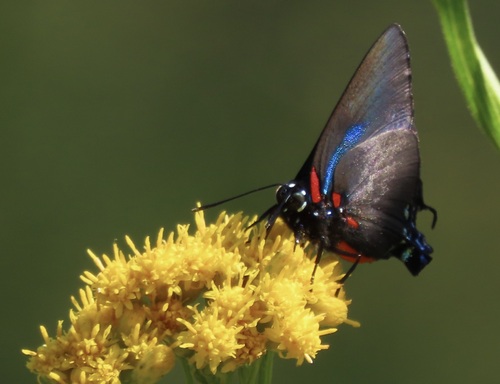
A striking hairstreak with brilliant iridescent blue upperwings, a dark underside with metallic spots and an orange abdomen, whose caterpillars feed on mistletoe.
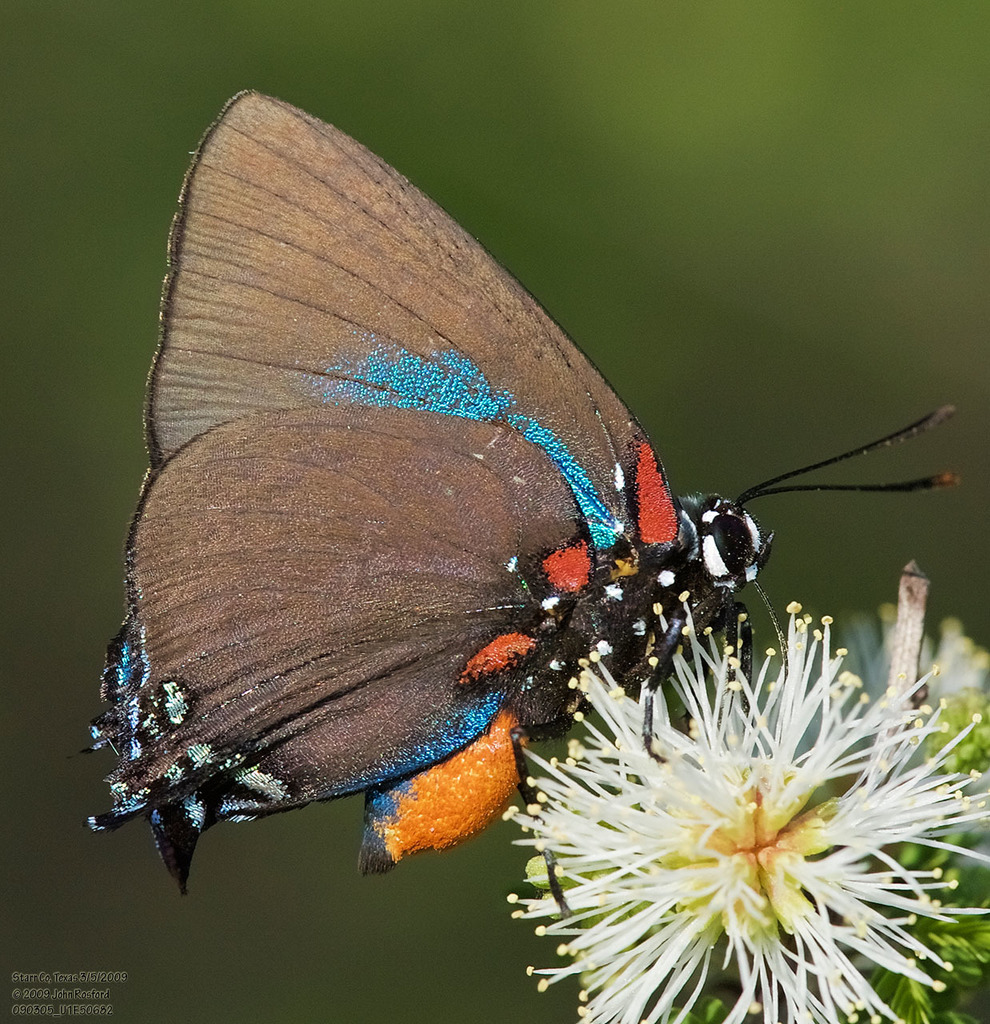
!Is the great purple hairstreak dangerous?
No. Harmless to people. Does not bite or sting. No venom or toxic secretions of concern; handle gently if necessary to avoid damaging the wings.
Pets
Harmless to pets. Large numbers are not toxic if eaten, though eating insects can upset a pet's stomach.
📖Overview
The Great purple hairstreak is a North American hairstreak butterfly noted for its brilliant iridescent blue upperwings (despite its name), dark underside with metallic gold, blue and green spots, red spots near the wing bases and bright orange-red abdomen. Larvae feed mainly on parasitic mistletoes that grow in tree canopies, so adults are often found along woodland edges and near trees with mistletoe. Multiple broods occur in warmer parts of its range. It is not harmful to people and is not considered an agricultural pest.
🔍How to identify a great purple hairstreak
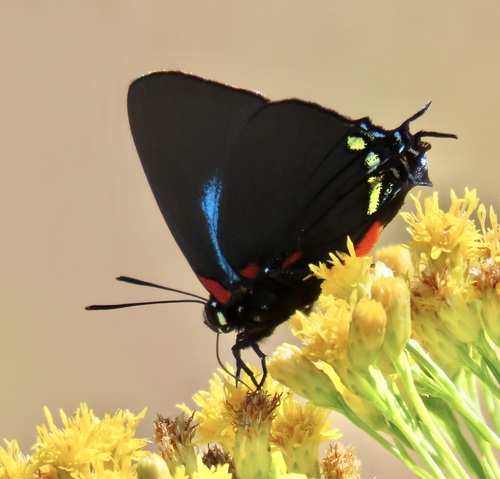
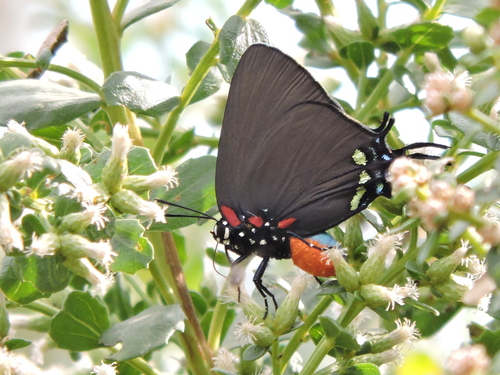
Upperwings have a brilliant iridescent blue (not purple) sheen over a black background, most extensive in males. The underside is dull black with red spots near the wing bases and iridescent gold, blue and green spots near the hindwing tails. The abdomen is blue above and orange-red below. Each hindwing has two tails, one long and one short.
- Brilliant iridescent blue upperwings and an orange-red abdomen.
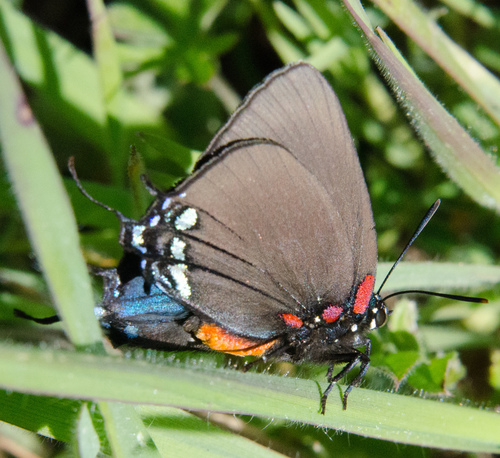
- Underside black with red spots at the wing bases and iridescent gold, blue and green spots near the tails.
- Two tails on each hindwing, one long and one short.
- Association with mistletoe-bearing trees: adults often fly around and perch near mistletoe clumps.
Lookalikes
Gray hairstreak Strymon melinus
Gray hairstreak is gray above and below, with an orange-and-black spot near the tail and a black-and-white line on the underside; it lacks the blue upperside and black underside.
White M hairstreak Parrhasius m-album
Also iridescent blue above, but the underside is brown-gray with a white 'M'-shaped line and a single orange spot near the tail; its caterpillars feed on oaks.
↻Life cycle
Egg
Females lay eggs singly on mistletoe leaves or stems located in tree canopies.
Larva (caterpillar)
Caterpillars are green and covered in short orange or yellow hairs, feeding on mistletoe foliage. They pass through several instars on the mistletoe clump.
Pupa (chrysalis)
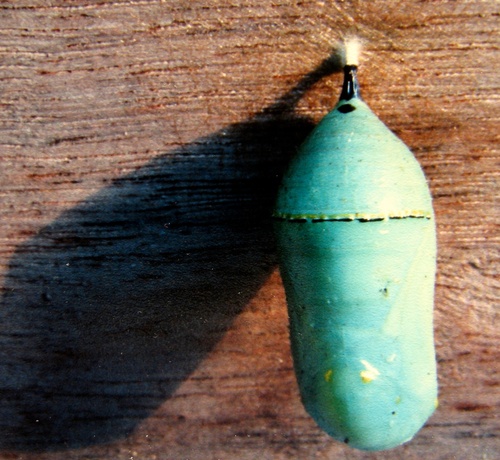
Mature caterpillars usually crawl down the host tree to pupate under loose bark or in leaf litter at its base; the pupa overwinters in cooler areas.
Adult (butterfly)
Adults emerge to feed on nectar, visit tree trunks and branches, court, and disperse; they are day-flying and often perch on sunlit branches.
🍃Diet and predators
Young eat
Leaves of parasitic mistletoe (Phoradendron spp. and related species).
Adults eat
Flower nectar from a wide variety of plants, such as goldenrod, milkweeds, asters and fruit-tree blossoms.
Predators of the young
Parasitoid wasps, ants, predatory insects and birds that can reach mistletoe clumps.
Predators of adults
Birds, spiders and predatory insects; the tails and bright spots near them can deflect attacks toward the hindwing margins.
🌱Effect on plants and gardens
Larvae feed primarily on species of mistletoe (for example Phoradendron spp. in North America). Because mistletoe is a parasitic plant, the butterfly is not considered an agricultural pest and can be seen as part of woodland ecology.
📍Where and when to find it
Look for adults flying and perching on sunlit branches, trunks and near mistletoe clumps high in trees; caterpillars and eggs are on mistletoe leaves and stems within those clumps.
Best time
Spring through fall in much of its range (year-round in the far south); warm sunny afternoons are best for watching adults.
Observation tips
Use binoculars for canopy observations and scan trees bearing mistletoe; adults also come down to nectar at flowers, where the black underside with metallic spots and the orange abdomen confirm the ID.
✨Fun facts
- The caterpillars feed on parasitic mistletoe, so the butterfly is tied to the presence of this unusual host plant.
- The tails and bright spots near them form a 'false head', which can help deflect predator attacks away from the real head.
- The purple sheen is an optical effect from microscopic wing scales and can look different depending on viewing angle and light.
?Frequently asked questions
Are Great purple hairstreaks poisonous or dangerous?
No. They are harmless to people and pets and do not bite or sting.
Do Great purple hairstreak caterpillars eat oak trees?
No. Their caterpillars feed on mistletoe that grows on oaks and other trees, not on the tree leaves themselves.
Why is this butterfly high in the trees and hard to see?
Because its caterpillar host, mistletoe, grows in tree canopies. Adults often stay near those clumps and may perch on branches and trunks out of easy reach.
How can I attract Great purple hairstreaks to my yard?
They require mistletoe as a host for caterpillars, so attracting them usually means having mistletoe-bearing trees nearby. Planting nectar sources and maintaining sunny woodland edges helps adults.
How do I get rid of them if I have many?
They are not pests and usually occur at low densities. If mistletoe growth is undesirable, control of mistletoe in infected trees (pruning or professional tree care) reduces butterfly breeding sites. Do not spray broad insecticides; they harm many beneficial species.
📷Photos of the great purple hairstreak

More butterflies & moths
This guide was written with AI assistance and fact-checked, last updated 2026-10-10. Identification from photos is never certain: don't handle insects you can't identify, and get medical advice for bites, stings or allergic reactions. More about the great purple hairstreak: iNaturalist, Wikipedia.