
Privet hawk-moth
Sphinx ligustri · Hawk moths
A large, fast-flying nocturnal moth whose caterpillars feed on privet and related shrubs; adults are strong nectar feeders and active at dusk and night.
!Is the privet hawk-moth dangerous?
No. Privet hawk-moths and their caterpillars are not venomous. Adults do not sting or bite, and the caterpillars are smooth (not hairy) and harmless to handle. Wash hands after handling any wild insect.
Pets
Not toxic to pets. Large caterpillars might be eaten by curious dogs or cats; they are not known to be poisonous, but eating large quantities of any caterpillar can cause mild stomach upset.
📖Overview
The privet hawk-moth is one of Europe's largest moth species, notable for its powerful, fast flight and sizeable, heavy-bodied adults. Larvae (caterpillars) are often bright green and conspicuous on leaves of privet and other woody plants. Adults visit deep-throated flowers for nectar and are mainly crepuscular and nocturnal, sometimes attracted to light.
This species occurs across much of Europe and temperate Asia, and it is well known to gardeners because its caterpillars feed on common ornamental shrubs. Although a single caterpillar can strip foliage locally, the species is not usually a serious agricultural pest. Adults live for a few weeks, focusing on feeding and reproduction.
🔍How to identify a privet hawk-moth
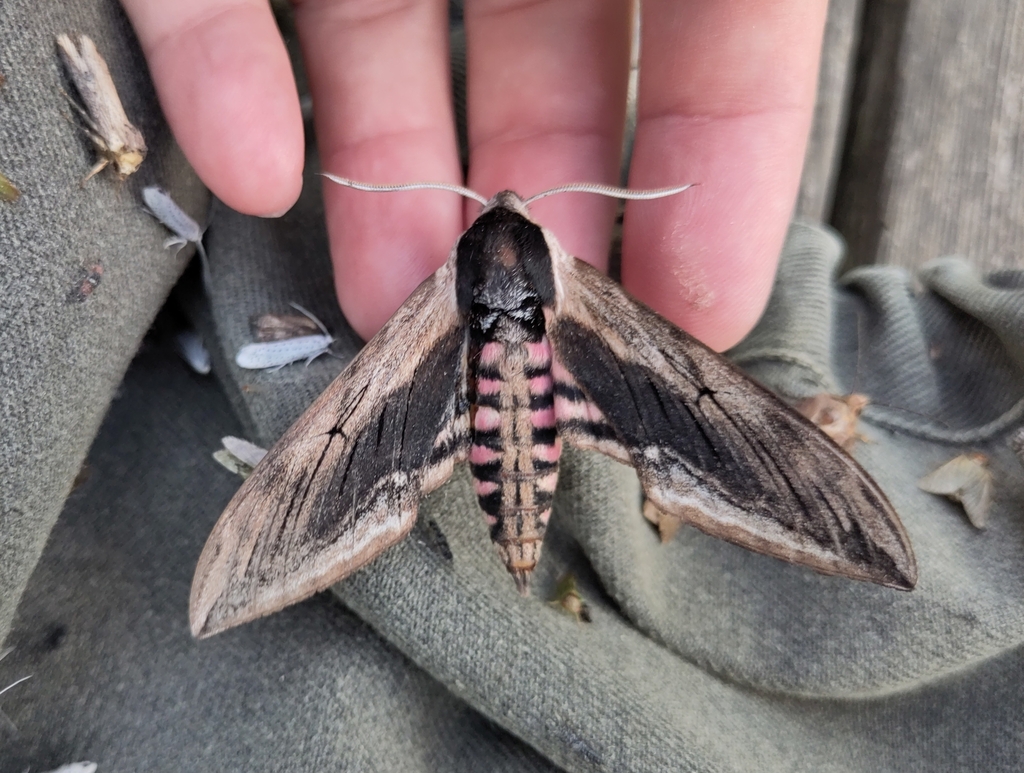
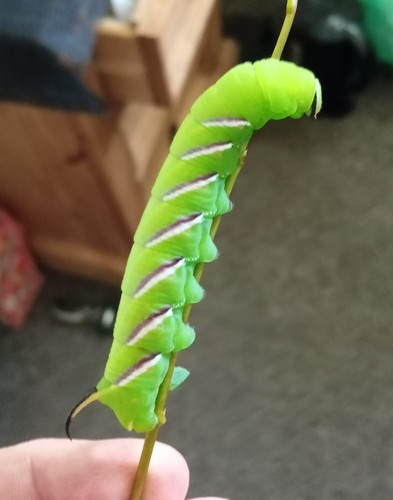
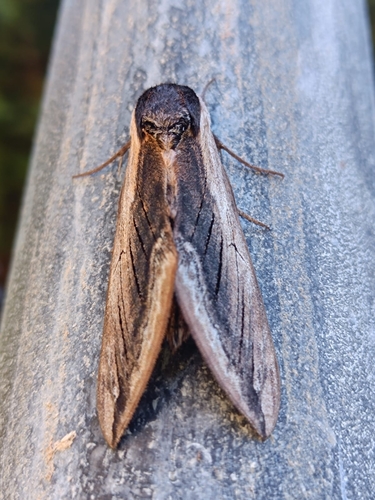
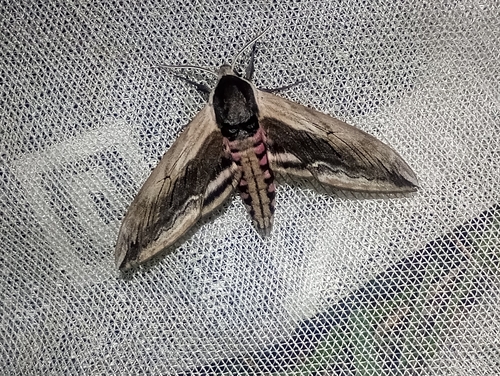
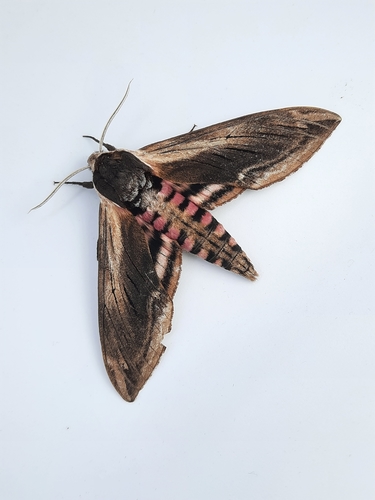
Adult privet hawk-moths are large and robust with a wingspan typically 90-120 mm. Forewings are mottled brown and grey with a cryptic pattern; hindwings are pink with black bands. The abdomen has alternating pink and black bands along the sides. The head and thorax are stout, and the moth has a long proboscis for reaching nectar. Caterpillars are large, smooth-skinned, bright green with diagonal white-and-lilac stripes along the sides and a curved black-and-yellow horn at the tail end.
- Very large moth with wingspan about 90-120 mm; heavy body and rapid flight
- Forewings mottled brown-grey; hindwings pink with black bands and pink-and-black banded abdomen
- Caterpillars bright green with diagonal pale stripes and a curved tail horn
- Adults active at dusk/night and often seen hovering at nectar-rich, deep flowers
Lookalikes
Convolvulus hawk-moth Agrius convolvuli
Similar size and also has a pink-and-black banded abdomen, but its forewings are greyer and its hindwings are grey with dark bands rather than pink.
Pine hawk-moth Sphinx pinastri
Smaller and plain grey with short black streaks on the forewings; lacks the pink on the hindwings and abdomen. Caterpillars feed on pines.
Other hawk-moths Various Sphingidae
Other large hawk-moths may share general shape, but Sphinx ligustri is distinguished by its very large size, pink-tinged abdomen bands and the caterpillar's bright green colour with diagonal striping and pronounced horn.
↻Life cycle
Egg
Small, spherical eggs are laid singly on the underside of host-plant leaves; incubation lasts about 1-2 weeks depending on temperature.
Larva (caterpillar)
Green (sometimes other colours) caterpillars feed voraciously on host foliage, growing through several instars and developing the characteristic tail horn.
Pupa
Mature larvae burrow into the soil to pupate in an underground chamber, where the pupa overwinters (sometimes for two winters) before the adult emerges.
Adult (moth)
Adults emerge, feed on nectar with a long proboscis, mate, and the females lay eggs on suitable host plants; adults are primarily nocturnal.
🍃Diet and predators
Young eat
Leaves of privet, lilac, ash and various woody shrubs
Adults eat
Nectar from deep tubular flowers (they hover like hummingbirds to feed)
Predators of the young
Birds, small mammals, parasitic wasps and flies
Predators of adults
Bats, nocturnal birds, and predatory insects
🌱Effect on plants and gardens
Larvae feed on privet (Ligustrum), lilac (Syringa), ash (Fraxinus), and other shrubs and trees; single caterpillars can eat substantial foliage, but populations rarely cause long-term damage to healthy plants.
📍Where and when to find it
Look for eggs and caterpillars on leaves of privet, lilac, ash and similar shrubs; adults visit nectar flowers at dusk and are attracted to garden lights.
Best time
Late spring to late summer; best observed at dusk and during night for adults, daytime for caterpillars.
Observation tips
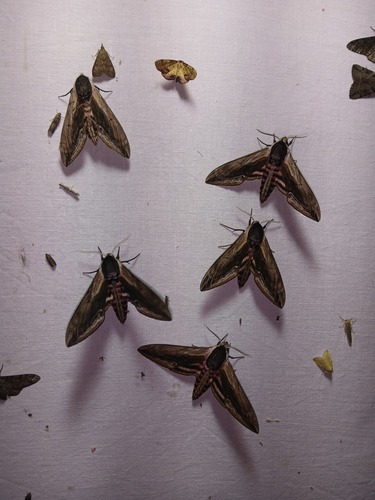
Search host plants for large green caterpillars; photograph adults at dusk near flowering shrubs or use a light sheet to attract flying moths at night (check local regulations and be respectful of wildlife).
✨Fun facts
- One of the largest resident moths in Britain and among the larger moths of Europe.
- Adults can hover in front of flowers and feed like a tiny hummingbird thanks to their long proboscis and strong flight muscles.
- Caterpillars are often easy to spot because of their bright green colour and large size.
?Frequently asked questions
Are privet hawk-moth caterpillars harmful?
They are not poisonous to people, but large caterpillars can strip leaves from shrubs. Most damage is cosmetic and plants usually recover.
Do privet hawk-moths sting or bite?
No. Adults do not sting and cannot deliver a medically significant bite. Handle caterpillars gently to avoid minor skin irritation in sensitive people.
Why is a privet hawk-moth in my garden?
Your garden likely has suitable host plants (privet, lilac, ash etc.) or nectar sources; adults visit flowers at dusk and caterpillars feed on shrub foliage.
How can I get rid of privet hawk-moth caterpillars?
For small numbers handpick and relocate or remove; for heavier infestations encourage natural predators or use Bacillus thuringiensis kurstaki (Btk) following label directions. Chemical insecticides are rarely necessary for ornamental shrubs.
When will I see privet hawk-moths?
In most regions adults appear from late spring through summer; they are most active at dusk and during the night and may be attracted to bright lights.
📷Photos of the privet hawk-moth
More butterflies & moths
This guide was written with AI assistance and fact-checked, last updated 2026-10-10. Identification from photos is never certain: don't handle insects you can't identify, and get medical advice for bites, stings or allergic reactions. More about the privet hawk-moth: iNaturalist, Wikipedia.