
Catalpa sphinx
Ceratomia catalpae · Sphinx moths
A large sphinx moth whose caterpillars (catalpa worms) can quickly defoliate catalpa trees but are harmless to people in most cases.
!Is the catalpa sphinx dangerous?
No. Caterpillars are not venomous, have no stinging hairs and do not bite or sting people. When disturbed they may wriggle and regurgitate green gut fluid, which is harmless; wash your hands after handling them. Adults do not bite or sting.
Pets
Generally non-toxic to pets. Large numbers of caterpillars could cause mild gastrointestinal upset if eaten by dogs or cats; discourage pets from eating large amounts of foliage or caterpillars.
📖Overview
Ceratomia catalpae is a hawk moth (sphinx moth) whose green, often-striped caterpillars are commonly called catalpa worms. The species is well known in eastern North America where catalpa trees (Catalpa spp.) are planted; larvae feed almost exclusively on catalpa leaves and can occur in large numbers. Adults are stout-bodied, nocturnal moths with rapid flight and a typical sphingid shape.
The caterpillar stage is the most visible and economically important life stage because heavy infestations can strip small ornamental catalpa trees. Natural enemies (birds, parasitic wasps and flies) and periodic management usually keep populations in check. Adults do not damage plants and feed little, if at all; they are short-lived and primarily active at dusk and night.
🔍How to identify a catalpa sphinx
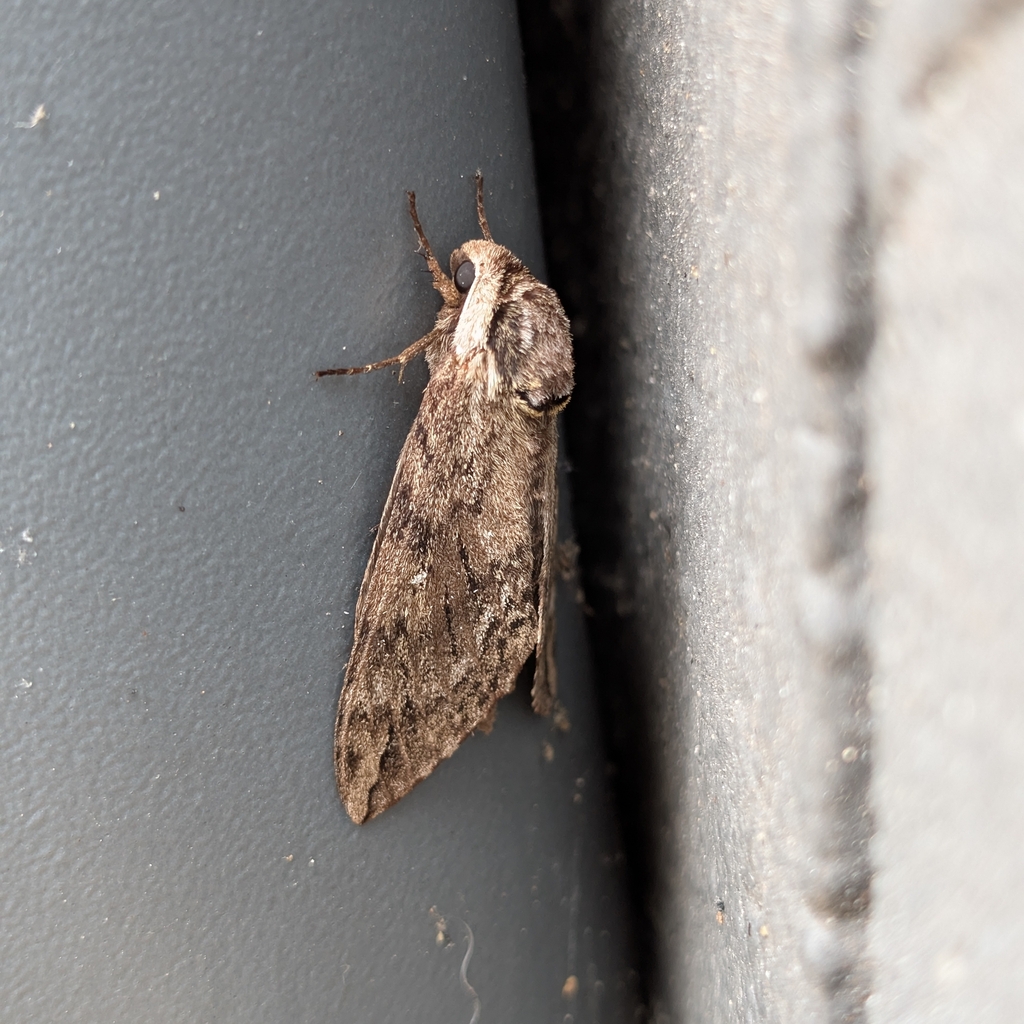
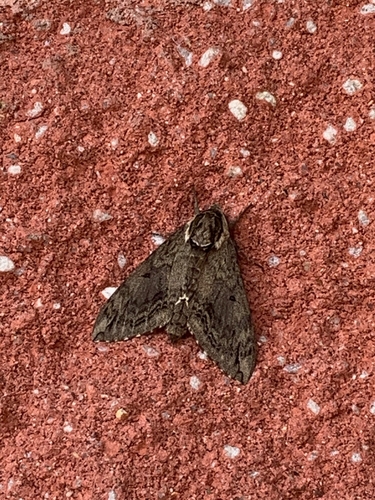
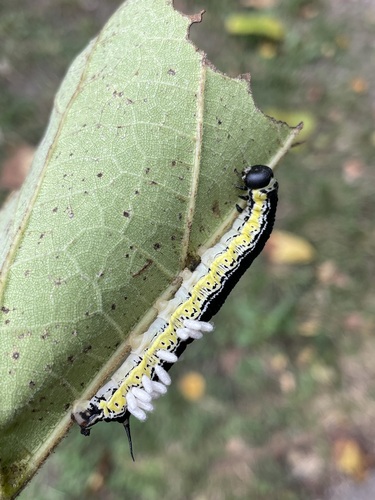
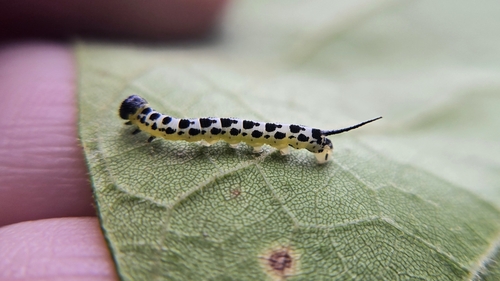
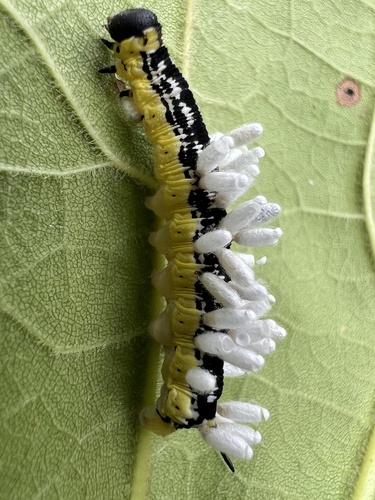
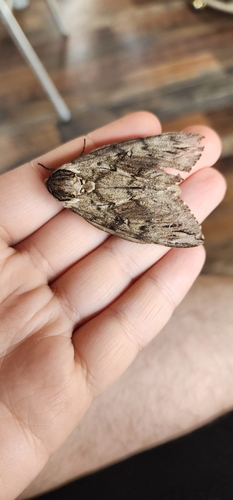
Adult moths have the streamlined, tapered wings and robust body typical of sphinx moths. Forewings are gray-brown with wavy darker lines and paler patches; wingspan typically 6.5-9.5 cm. Caterpillars are smooth and hairless with a black horn at the rear (typical of hornworms). Early instars are pale and nearly white; mature larvae are pale yellow-green with a variable amount of black, ranging from rows of black spots along the sides to a broad black stripe down the back. Eggs are small, rounded, and pale green to yellow; pupae are brown, stout, and formed in the soil or leaf litter.
- Look for smooth yellow-green caterpillars marked with black (a black back stripe or rows of black side spots) and a black rear horn, feeding in groups on catalpa leaves.
- Adult is a sphinx moth with a 6.5-9.5 cm wingspan and gray-brown forewings with wavy dark lines.
- Clusters of chewed leaves or noticeably skeletonized catalpa branches during late spring or summer indicate catalpa worms.
Lookalikes
Waved sphinx Ceratomia undulosa
Waved sphinx feeds on different trees (e.g., ash) and adults have distinct waved lines on the forewing; larvae host plant and subtle pattern differences separate the species.
Tobacco hornworm Manduca sexta
Tobacco hornworm is usually found on solanaceous plants (tomato, tobacco) and has larger diagonal white stripes and a red horn rather than the catalpa worm's coloration and host choice.
↻Life cycle
Egg
Females lay masses of up to several hundred pale green eggs on the undersides of catalpa leaves. Eggs hatch in a few days to a week depending on temperature.
Larva (caterpillar / catalpa worm)
The caterpillar passes through several instars, growing from a few millimetres to several centimetres. Larvae consume large amounts of catalpa foliage and are the conspicuous, damaging stage.
Pupa
Mature caterpillars leave the tree and pupate in the soil or leaf litter, forming a brown, obtect pupa that overwinters or develops to an adult the same season.
Adult (moth)
Adults emerge from pupae, mate, and females lay eggs on catalpa. Adults are nocturnal and are attracted to lights.
🍃Diet and predators
Young eat
Leaves of catalpa species (Catalpa bignonioides, Catalpa speciosa and hybrids).
Adults eat
Adults feed little, if at all, during their short lives.
Predators of the young
Birds, predatory insects, and parasitic wasps and flies (tachinids and braconids) that can kill caterpillars.
Predators of adults
Bats, night-flying birds, and predatory insects.
🌱Effect on plants and gardens
Larvae feed almost exclusively on catalpa (Catalpa spp.) leaves. Heavy infestations can strip young or small trees of their foliage; mature trees typically sprout new leaves and usually recover.
How to get rid of catalpa sphinxes
Usually no treatment is needed: healthy catalpas regrow leaves and parasitic wasps often collapse outbreaks (leave caterpillars carrying white wasp cocoons in place). On small trees, hand-pick caterpillars or shake them off, or spray foliage with Bacillus thuringiensis kurstaki (Btk) while caterpillars are young. Use other insecticides only as labeled.
📍Where and when to find it
Look for larvae on the upper and lower surfaces of catalpa leaves; adults may be attracted to lights near catalpa trees. Pupae are in soil or leaf litter beneath host trees.
Best time
Late spring through summer for caterpillars; adults at dusk and night. Exact months vary by region (usually May-September in much of eastern North America).
Observation tips
Inspect undersides of leaves and branch tips for clusters of caterpillars. Photograph caterpillars against a leaf for size and stripe detail; use a light at dusk to attract adults.
✨Fun facts
- The caterpillars are prized as live bait by anglers and commonly called 'catalpa worms' for that reason.
- While they can defoliate small trees, mature catalpa trees usually tolerate repeated feeding and regrow leaves.
- Large aggregations of caterpillars can appear suddenly because females lay clusters of eggs; outbreaks are often short-lived due to predators and parasites.
?Frequently asked questions
Do catalpa sphinx caterpillars bite?
No. They have no biting mouthparts for people and no stinging hairs; at most a disturbed caterpillar may regurgitate harmless green fluid.
Are catalpa worms poisonous?
No. Catalpa worms are not poisonous or venomous to people and are harmless to handle.
Why is my catalpa tree losing leaves?
Catalpa sphinx caterpillars can eat foliage rapidly and may defoliate branches. Check leaves for green hornworms on the undersides or branch tips.
How do I get rid of catalpa worms?
Hand-pick caterpillars into a bucket of soapy water, shake small branches to dislodge them, or use Bacillus thuringiensis kurstaki (Btk) sprayed to foliage. Encourage birds and parasitic insects. Chemical insecticides are effective but use them cautiously and follow label directions.
Will the moths harm other plants?
No — adults do not damage plants. Larvae are host-specific to catalpa species and do not eat unrelated garden plants.
📷Photos of the catalpa sphinx
More butterflies & moths
This guide was written with AI assistance and fact-checked, last updated 2026-10-10. Identification from photos is never certain: don't handle insects you can't identify, and get medical advice for bites, stings or allergic reactions. More about the catalpa sphinx: iNaturalist, Wikipedia.