
White plume moth
Pterophorus pentadactyla · Plume moths
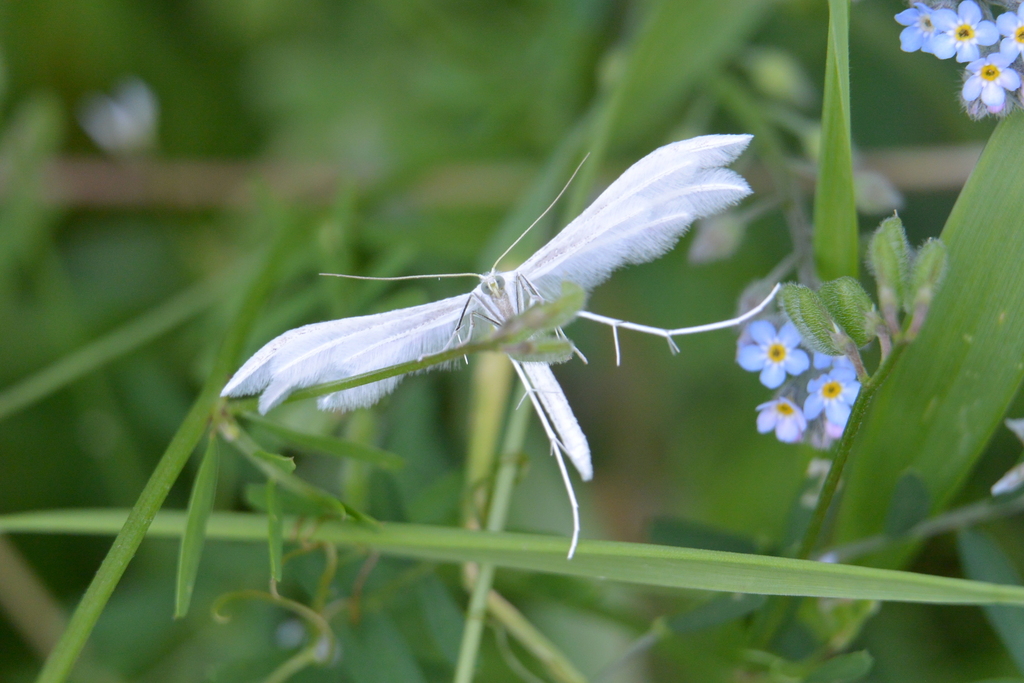
A delicate, pure-white plume moth with deeply divided feathery wings often seen resting in a T-shape near bindweed and hedgerows.
!Is the white plume moth dangerous?
No. Not poisonous or aggressive. Adults do not bite or sting. Tiny scales may cause mild skin or eye irritation in very sensitive people if rubbed into eyes, but this is uncommon.
Pets
Not poisonous to pets. Unlikely to be of interest to dogs or cats except as a short-lived play object.
📖Overview
Pterophorus pentadactyla is a small, elegant moth in the plume moth family (Pterophoridae). Adults are distinctive for their pure-white colour and wings split into feathery plumes. They are most often encountered in gardens, hedgerows and places where their larval foodplants (mainly bindweeds) grow. The species is widespread across Europe, parts of Asia and North Africa and is mainly nocturnal, flying at dusk and during the night, though resting adults are easily disturbed by day.
The caterpillars feed on members of the bindweed family (Convolvulus and Calystegia), where they live and feed on leaves and flowers. The species is not dangerous to people or pets and is not usually a significant agricultural pest; it is commonly regarded as harmless or neutral in gardens.
🔍How to identify a white plume moth
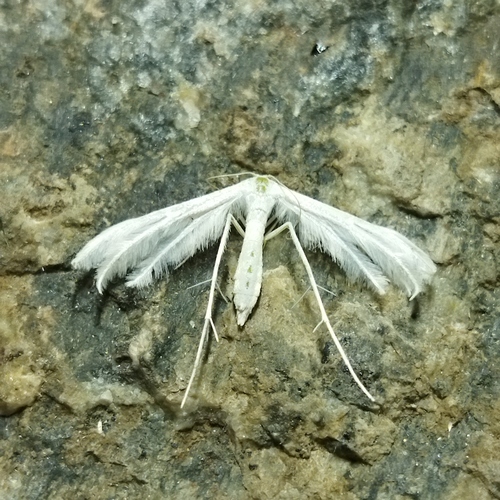
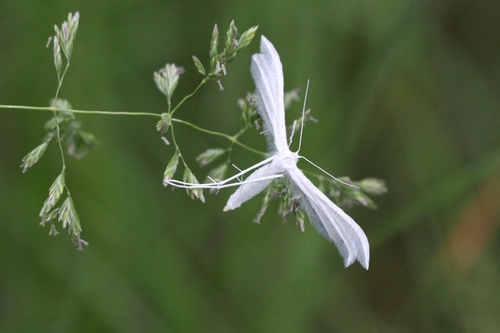
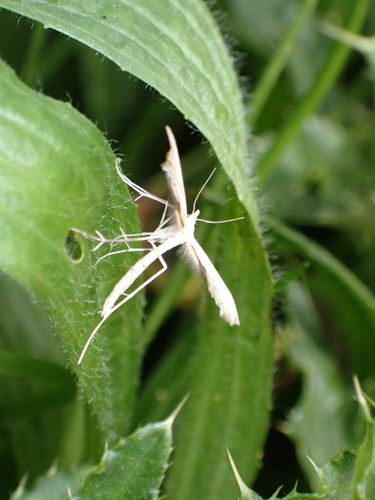
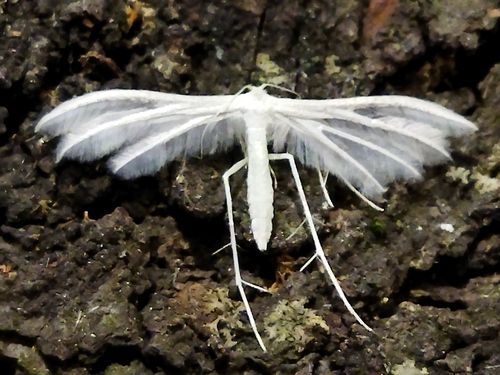
Adult white plume moths are small and slender with a wingspan around 26-34 mm. Each forewing and hindwing is deeply divided into narrow feather-like lobes (giving a 'plume' or 'five-fingered' appearance). When at rest they hold the wings rolled and extend the body so the moth forms a characteristic T-shape. The body, legs and wings are uniformly white; scales give a soft, silky appearance. Caterpillars are typically green and somewhat tapered, matching the leaves they eat; pupae are slender and often attached to stems or leaves.
- Pure white colouration across body and wings (no prominent markings).
- Wings deeply divided into narrow feathery lobes (plume appearance); name pentadactyla refers to five 'fingers'.
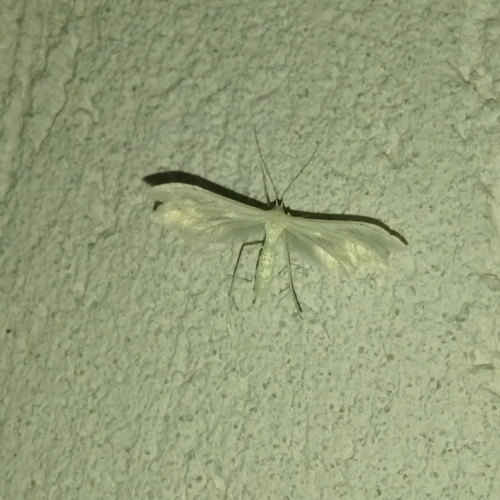
- When at rest holds wings rolled and body extended in a characteristic T-shape.
- Small size with wingspan about 26-34 mm and a silky, powdery scale covering.
Lookalikes
Common plume Emmelina monodactyla
Brownish or buff-coloured and the wing division differs; not pure white and generally more brown/orange tones.
Artichoke plume moth Platyptilia carduidactyla
Usually browner with different patterning and slightly different wing shape; lacks the clean white appearance of Pterophorus pentadactyla.
↻Life cycle
Egg
Tiny eggs are laid on the leaves or flowers of host plants (bindweed and related species).
Larva (caterpillar)
Green caterpillars feed on leaves and flowers of the host plant, often concealed on the undersides of leaves or within curled foliage.
Pupa
Pupation takes place on stems or leaves; the pupa is slender and attached by a silk pad.
Adult (moth)
Delicate white moth with wings divided into feathery plumes; flies at dusk and night to nectar and mate.
🍃Diet and predators
Young eat
Leaves and flowers of bindweed and related Convolvulaceae (Convolvulus, Calystegia)
Adults eat
Nectar from flowers; adults may visit small, light-coloured flowers at dusk and night
Predators of the young
Parasitoid wasps, predatory insects and birds may attack caterpillars
Predators of adults
Bats, nocturnal birds, spiders and insectivorous night-flying predators
🌱Effect on plants and gardens
Larvae feed on bindweeds and related Convolvulaceae (Convolvulus, Calystegia). They can defoliate individual plants but usually do not cause serious crop damage; in gardens they often eat weedy bindweed rather than garden crops.
📍Where and when to find it
Adults: flying at dusk near gardens, hedgerows and flowers or resting on fences, walls and stems. Larvae: on leaves and flowers of bindweed (Convolvulus and Calystegia), often on the undersides of leaves.
Best time
Best observed from late spring to late summer, at dusk or by using a light trap at night.
Observation tips
Look for the characteristic T-shaped resting pose on vertical surfaces; photographing at dusk with a shallow angle helps show the feathery wing divisions.
✨Fun facts
- The species name pentadactyla means 'five-fingered', describing the wing lobes.
- At rest its rolled wings and extended posture make it look like a tiny white cross or T rather than a typical moth.
?Frequently asked questions
Do white plume moths bite or sting?
No. They are harmless to people and do not bite or sting.
Why is a white plume moth in my house?
They are attracted to light and may come indoors at night; they may also fly in through open windows or doors if host plants are nearby.
Are white plume moths pests that will damage my garden?
They feed as caterpillars on bindweed and related plants. Because bindweed is usually a weedy species, plume moths are not typically a garden pest and often feed on plants gardeners consider undesirable.
How can I get rid of white plume moths?
If control is desired, remove their host plants (bindweed) and seal gaps to prevent adults entering buildings. For localized caterpillar outbreaks hand-pick larvae or remove infested plant parts; chemical control is rarely necessary.
When am I most likely to see them?
Adults fly at dusk and during the night from late spring through summer (commonly June to August).
📷Photos of the white plume moth
More butterflies & moths
This guide was written with AI assistance and fact-checked, last updated 2026-10-10. Identification from photos is never certain: don't handle insects you can't identify, and get medical advice for bites, stings or allergic reactions. More about the white plume moth: iNaturalist, Wikipedia.