
Mourning cloak
Nymphalis antiopa · Brush-footed butterflies
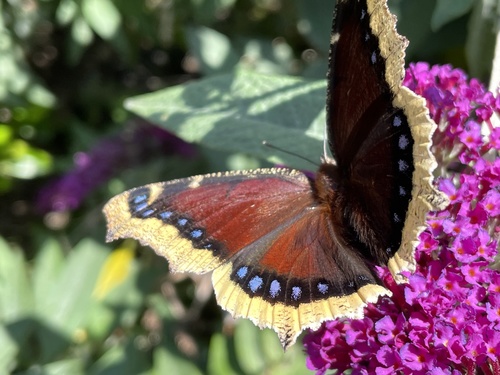
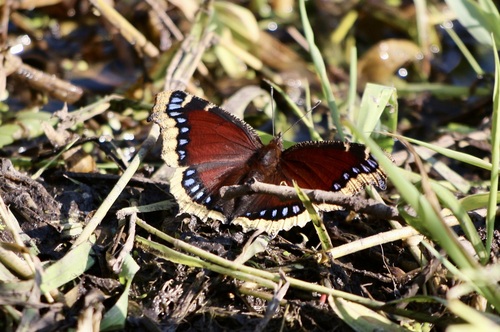
A large, dark-winged brush-footed butterfly with a pale yellow border and iridescent blue spots; adults hibernate and can live many months.
!Is the mourning cloak dangerous?
No. Mourning cloaks are harmless to people; adults do not bite or sting. Handle gently if necessary — like most butterflies they can be injured by rough handling.
Pets
Not toxic to pets. Small animals might catch caterpillars or butterflies, but there is no known poisoning risk.
📖Overview
The mourning cloak is a large, long-lived brush-footed butterfly found across much of the Northern Hemisphere. Adults are notable for their dark maroon to brown wings edged with a broad pale yellow band and a row of blue spots. They overwinter as adults, emerging on warm days in late winter or early spring to mate and feed on tree sap and rotting fruit. Caterpillars feed in groups on leaves of several deciduous trees and shrubs.
🔍How to identify a mourning cloak
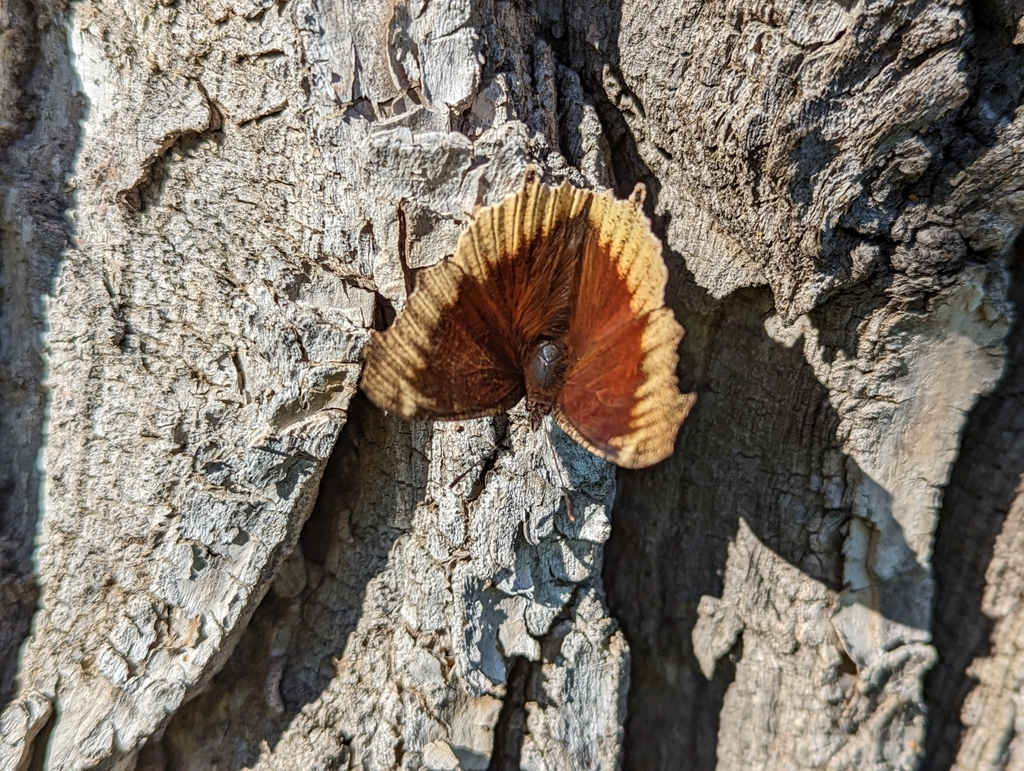
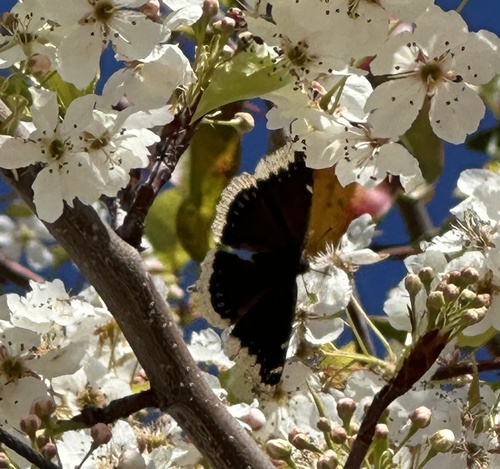
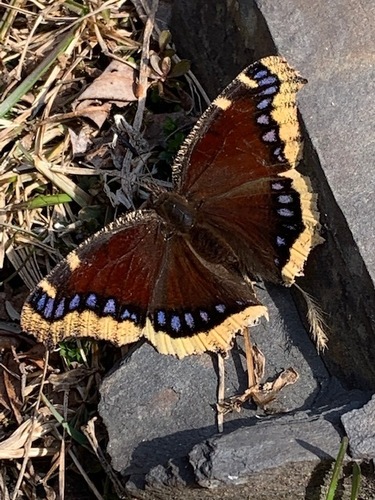
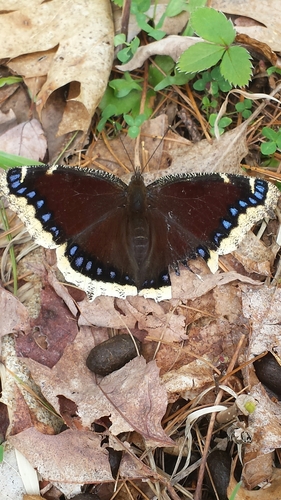
Wings are broad with a rounded outline (no dramatic angle or tails). Upper side is a uniform dark maroon to brownish-black with a wide, pale yellow to cream band along the outer margin and a row of iridescent blue spots immediately inside that band. Underside of wings is cryptically mottled brown and grey, helping them blend on tree bark when resting with wings closed. Body is stout and fuzzy in both caterpillar and adult stages.
- Large wingspan (about 6-8 cm) with uniformly dark maroon-brown upper wings
- Broad pale yellow to cream border along the wing edges with a row of blue spots inside the border
- Underside heavily mottled gray-brown, resembling tree bark when wings are closed
- Rounded wing tips without tails or strong angular projections
Lookalikes
Question Mark Polygonia interrogationis
Question Mark has angular, scalloped wings and a small silver 'question mark' mark on the underside; it lacks the broad pale outer border and uniform dark upper surface of the mourning cloak.
Comma Polygonia c-album
Comma species are smaller, have deeply scalloped wings and a distinctive pale 'C' or comma-shaped mark on the underside; mourning cloak is larger with a smooth rounded outline and a wide pale border.
Tortoiseshells (various) Nymphalis spp. and Aglais spp.
Tortoiseshells often show orange-and-black patterned upper wings rather than mourning cloak's uniform dark maroon; the marginal yellow band and blue spots help distinguish mourning cloak.
↻Life cycle
Egg
Females lay clusters of eggs that encircle twigs of host trees. Eggs hatch in about 1-2 weeks depending on temperature.
Larva (caterpillar)
Black, spiny caterpillars that feed gregariously when young and later disperse; they complete several instars while consuming host foliage.
Pupa (chrysalis)
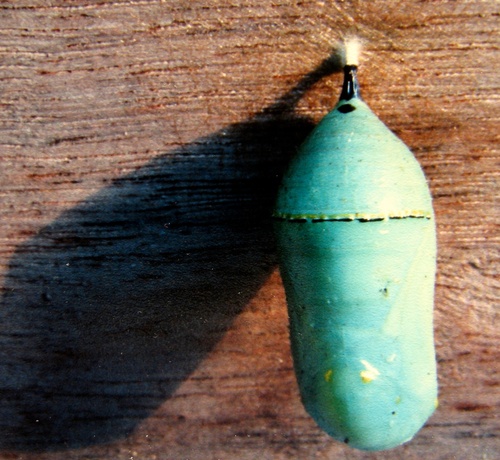
Pupation occurs attached to twigs or other structures; the chrysalis is compact and camouflaged. Pupation lasts about 1-3 weeks in summer; timing varies by region.
Adult (butterfly)
Adults emerge, feed on sap and fermenting fruit, mate and may produce one or more broods per year; many individuals enter diapause and overwinter as adults.
🍃Diet and predators
Young eat
Leaves of willows, poplars, aspens, elms, birches and other deciduous trees
Adults eat
Tree sap, rotting/fermenting fruit, honeydew; they rarely visit fresh flowers but may take nectar occasionally
Predators of the young
Birds, predatory insects such as wasps and ants, parasitic flies and wasps
Predators of adults
Birds, spiders, robber flies, and insectivorous mammals; overwintering adults hide in tree cavities or crevices to avoid predators
🌱Effect on plants and gardens
Larvae feed on leaves of willows (Salix), poplars and aspens (Populus), elms (Ulmus), birches (Betula) and sometimes other deciduous trees. Feeding is rarely severe enough to cause lasting damage except in localized outbreaks.
📍Where and when to find it
Adults: sunny tree trunks, forest edges, parks, gardens with fruit or sap. Overwintered adults in crevices, hollow trees, under loose bark or buildings. Caterpillars: in groups feeding on leaves of willows, poplars, elms and birches.
Best time
Best months vary by region but often from early spring (overwintered adults) through summer into autumn; mid-morning to afternoon on warm sunny days.
Observation tips
Look for adults basking with wings open on tree trunks or fence posts. Fallen fruit, sap runs and tree wounds are hotspots. For photographing, use a telephoto or approach slowly—they tolerate some disturbance when feeding.
✨Fun facts
- Mourning cloaks are among the longest-lived butterflies: adults often overwinter and can live close to a year.
- Adults commonly feed on tree sap and fermenting fruit rather than nectar, so you might spot them on wounds in trees or fallen fruit.
- In Britain the species is called the Camberwell beauty after an unusual 18th-century appearance in London; the common name varies regionally.
?Frequently asked questions
Are mourning cloak butterflies poisonous?
No, mourning cloaks are not poisonous to people. They do not sting or inject venom.
Do mourning cloaks bite or sting?
No. Adults do not bite or sting. Caterpillars are spiny but do not deliver venom; handling caterpillars can cause minor skin irritation in a few people, so avoid touching them with bare hands.
Why is a mourning cloak in my yard?
They are attracted to yards with host trees (willow, poplar, elm, birch) and to tree sap or overripe fruit. You may also see overwintered adults basking on sunny days.
How can I attract mourning cloaks to my garden?
Provide native host trees for caterpillars and leave some fallen fruit or log/branch wounds for adults to feed on. Planting nectar sources helps some butterflies, though mourning cloaks prefer sap and fermenting fruit.
How do I get rid of mourning cloak caterpillars on my trees?
They seldom cause lasting damage; for small outbreaks remove egg clusters or caterpillar groups by hand. For larger problems consult local extension services; use targeted biological controls (Bacillus thuringiensis kurstaki) only when necessary and following label instructions.
📷Photos of the mourning cloak
More butterflies & moths
This guide was written with AI assistance and fact-checked, last updated 2026-10-10. Identification from photos is never certain: don't handle insects you can't identify, and get medical advice for bites, stings or allergic reactions. More about the mourning cloak: iNaturalist, Wikipedia.