
Green-veined white
Pieris napi · Whites and yellows
A common Palearctic white butterfly with distinctive greenish veins on the undersides of the wings; frequent in meadows, hedgerows and gardens.

!Is the green-veined white dangerous?
No. Pieris napi is harmless to humans. Adults do not bite or sting. Handle gently if necessary; caterpillars are not dangerous but may be fragile.
Pets
Not toxic to pets. Neither the butterflies nor the caterpillars pose any known risk to dogs or cats.
📖Overview
Pieris napi is a widespread white butterfly found across Europe, much of temperate Asia and parts of North Africa. It prefers damp meadows, woodland edges, hedgerows and other semi-open habitats where its host plants (mainly wild brassicas and cresses) grow. Adults fly in spring and summer in one to several broods depending on latitude and local climate. The species is generally common and adaptable, often encountered in both countryside and suburban gardens.
Behaviorally it is a typical 'white' butterfly: males patrol or perch to find females, and adults visit a variety of flowers for nectar. Females lay eggs singly on the leaves of host plants. Caterpillars feed on leaves and pupate attached to vegetation. Pieris napi is harmless to people and poses only minor risk to cultivated brassicas in small numbers compared with other Pieris species.
🔍How to identify a green-veined white
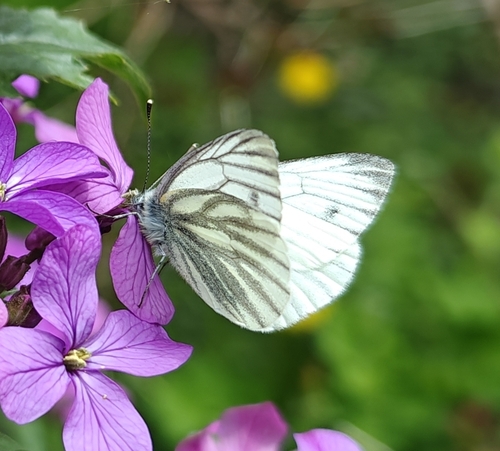
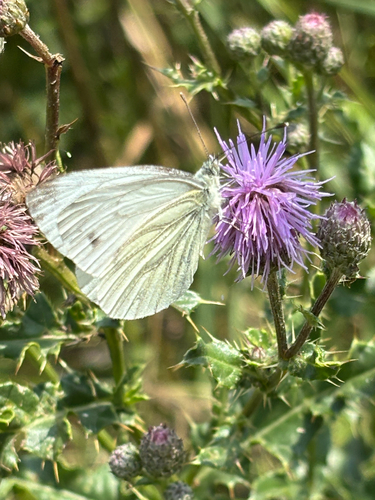
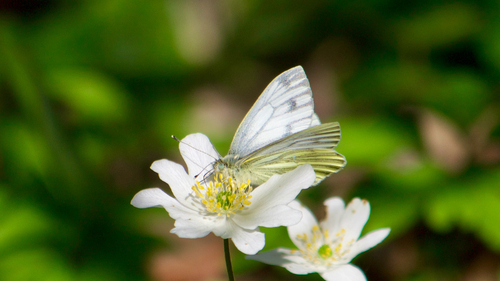
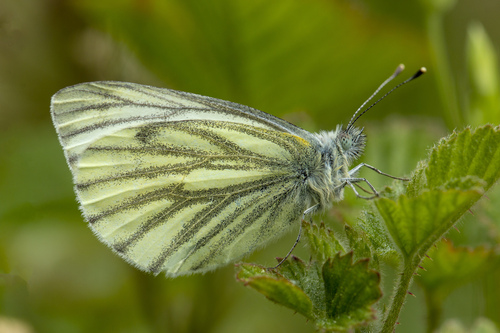
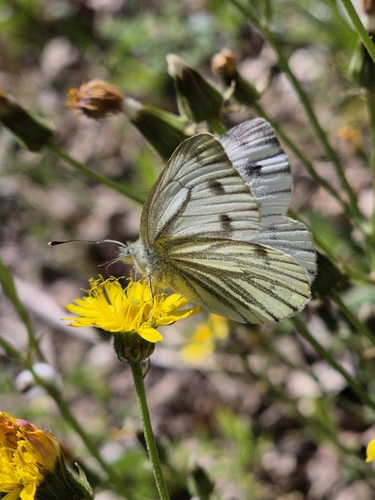
Adults have a white dorsal forewing and hindwing with small dark markings: males often show a single small black spot on the forewing, while females may have more pronounced markings. The underside of the wings is pale greenish with distinct greenish-grey veining, most obvious on the hindwing and giving the species its name. Wingspan typically around 40-50 mm. Caterpillars are green and slightly hairy, with a pale stripe along the sides. Pupae are green or mottled and attached to stems or leaves.
- Underside of hindwing with pale greenish veins visible through the wing — the key field mark
- Adults mostly white above with small dark forewing spots; females often slightly more marked
- Wingspan about 40-50 mm, smaller and more delicately marked than Pieris brassicae (large white)
Lookalikes
Small white Pieris rapae
Pieris rapae usually lacks the clear green venation on the underside and often shows more distinct dark tips and spots on the forewings.
Large white Pieris brassicae
Larger and more heavily marked with bolder dark bands on the forewings and larger black markings on the upperwing surface.
↻Life cycle
Egg
Laid singly on the underside of host plant leaves; eggs are small, ribbed and pale in colour.
Larva (caterpillar)
Green caterpillars feed on leaves of brassicas and cresses, growing through several instars.
Pupa (chrysalis)
Pupates attached to stems, leaves or other vegetation; pupae are green or mottled for camouflage.
Adult (butterfly)
Winged adult feeds on nectar, mates and lays eggs on host plants; flies during warm daylight hours.
🍃Diet and predators
Young eat
Leaves of Brassicaceae and related plants such as cuckooflower (Cardamine), garlic mustard (Alliaria) and other wild brassicas and cresses
Adults eat
Nectar from a wide range of flowers, including thistles, knapweeds, dandelions and other meadow herbs
Predators of the young
Birds, predatory insects, parasitic wasps and flies
Predators of adults
Birds, dragonflies and other insectivorous predators
🌱Effect on plants and gardens
Larvae feed mainly on members of the Brassicaceae and related families (wild mustards, cuckooflower Cardamine species, garlic mustard Alliaria and other cresses). In small numbers they cause minimal damage; they are generally less of a pest to cultivated brassicas than the large white (Pieris brassicae) or small white (Pieris rapae).
📍Where and when to find it
Look for adults visiting flowers in meadows, gardens and hedgerows; eggs and larvae on leaves of wild mustards, cuckooflower and other brassicas; pupae attached to stems and leaves.
Best time
Best seen from spring to late summer on warm, sunny days; mid-morning to mid-afternoon when flowers are open.
Observation tips
Approach slowly and watch for their characteristic fluttering flight. Photograph the underside of the hindwing to show the green venation for confident identification.
✨Fun facts
- The greenish veins on the underside of the wings help camouflage resting butterflies among foliage.
- Pieris napi often prefers damp, flowery meadows and riverbanks rather than very dry habitats.
- It commonly has several broods each year in warmer regions, so you may see adults from spring to autumn.
?Frequently asked questions
Is the green-veined white dangerous?
No. It does not bite or sting and is harmless to people.
Do green-veined white caterpillars eat my vegetables?
They feed on wild and cultivated brassicas and cresses. In small numbers they cause minor damage; heavy infestations can defoliate plants but are less common than with some other Pieris species.
Why is this butterfly in my garden?
Because your garden has nectar sources and suitable host plants (wild brassicas or cress-like plants) for laying eggs and feeding caterpillars.
How can I get rid of green-veined whites from my cabbages?
Use exclusion (netting or horticultural fleece), hand-pick caterpillars, encourage natural enemies, or use Bt as a targeted biological control. Avoid broad insecticides that also kill pollinators.
When can I see green-veined whites?
They are active in warm weather from spring through late summer or autumn; peak times depend on local climate and can include multiple broods.
📷Photos of the green-veined white
More butterflies & moths
This guide was written with AI assistance and fact-checked, last updated 2026-10-10. Identification from photos is never certain: don't handle insects you can't identify, and get medical advice for bites, stings or allergic reactions. More about the green-veined white: iNaturalist, Wikipedia.