
Giant leopard moth
Hypercompe scribonia · Tiger moths
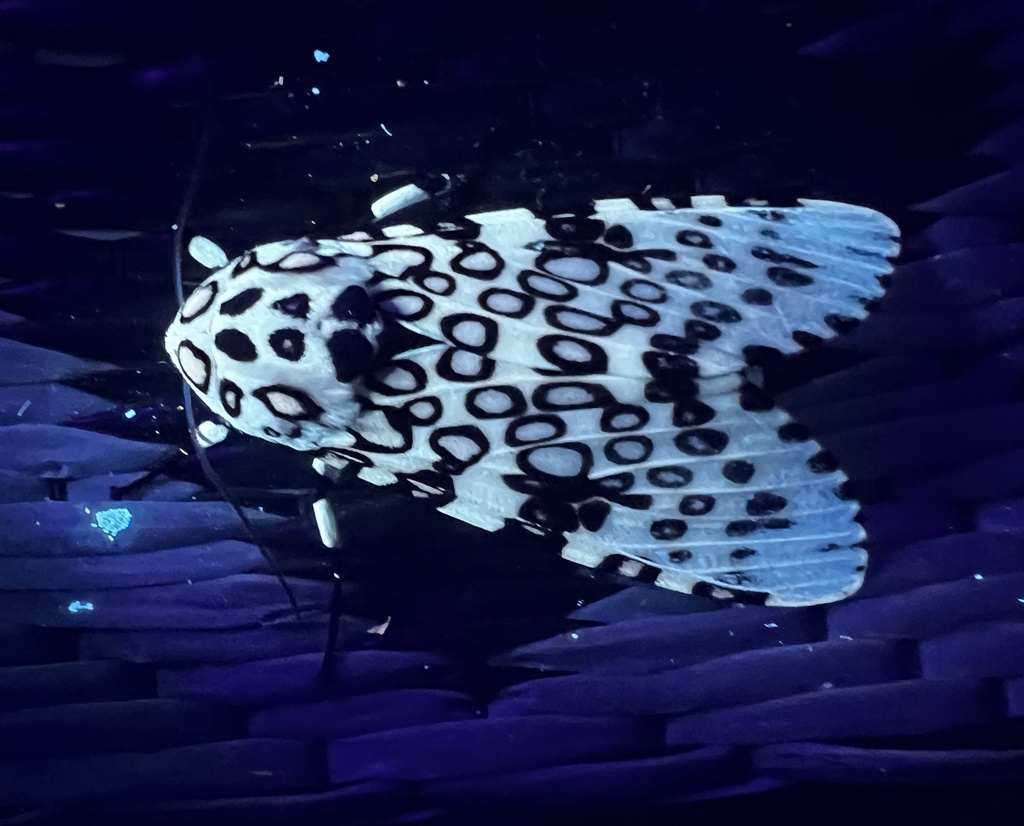
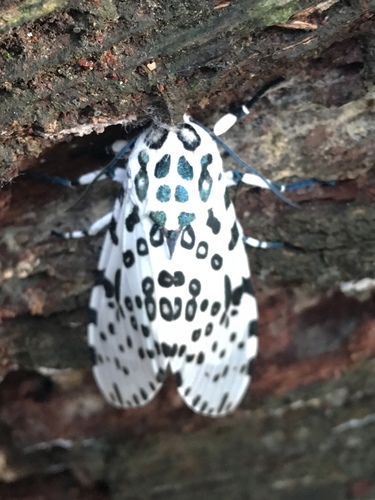
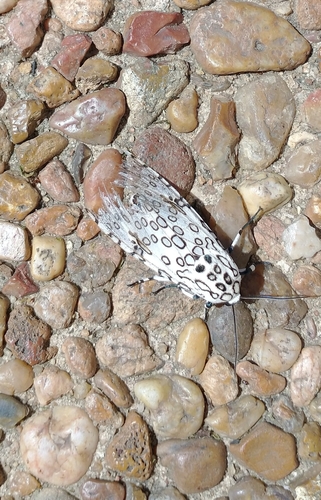
A large, striking North American tiger moth with white wings marked by bold black rings and spots, and an iridescent blue-black and orange abdomen.
!Is the giant leopard moth dangerous?
No. Adults do not bite or sting. The caterpillar's dense hairs can cause mild skin irritation or allergic contact dermatitis in sensitive people if handled; avoid prolonged contact and wash skin if irritation occurs.
Pets
Not known to be toxic to pets. Pets that chew on the hairy caterpillar could get minor mouth or throat irritation from the hairs; monitor and consult a veterinarian if symptoms develop.
📖Overview
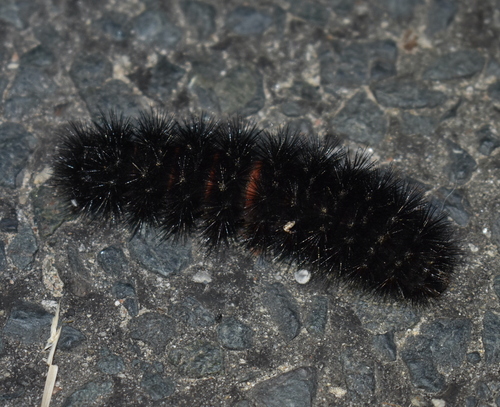
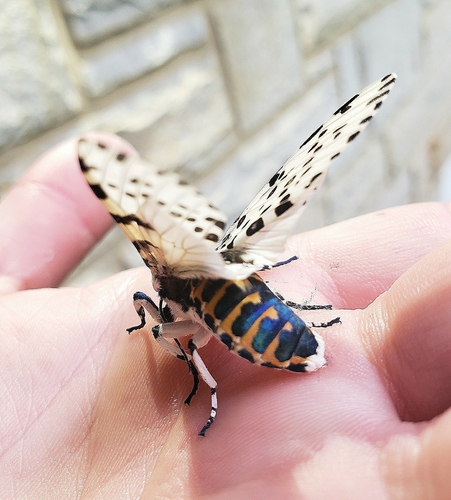
The giant leopard moth is a distinctive large moth of eastern and southern North America. Adults are mostly nocturnal and attracted to lights. The species is notable for the contrast between its white wings peppered with black rings and spots and the iridescent dark blue abdomen with orange markings, which is visible when the wings are spread or when the moth is disturbed. The caterpillar is a fuzzy black 'woolly bear' covered in stiff bristles (setae), with red bands between the segments that show when it curls up.
This species uses a variety of broadleaf plants as larval food and is usually harmless to people and gardens. Adults do not feed heavily and live short lives focused on mating and laying eggs.
🔍How to identify a giant leopard moth
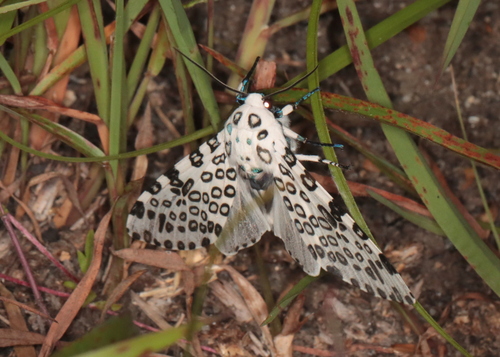
Adult wingspan usually about 60-90 mm. Forewings are white with a pattern of black rings (some hollow, some solid); hindwings are white with fewer markings. When the wings are open or the moth is disturbed, the abdomen shows iridescent dark blue with orange markings. Head and thorax are white with black markings. The caterpillar is densely covered in stiff black bristles and rolls into a ring when disturbed, revealing bright red bands between the segments. Pupae are in loose cocoons incorporating larval hairs.
- Large white moth with bold irregular black rings and spots on the wings.
- Iridescent dark blue abdomen with orange markings, visible when wings are open or when disturbed.
- Larvae are black, bristly 'woolly bears' that curl into a ring when touched, revealing red bands between the segments.
- Wingspan about 60-90 mm — noticeably larger than many common white-and-black moths.
Lookalikes
Salt marsh moth Estigmene acrea
Salt marsh moths have white forewings with only small scattered black dots and an orange-yellow abdomen; their caterpillars are variable, often yellowish to reddish-brown. The giant leopard has bold black rings and a black woolly bear larva.
Virginian tiger moth Spilosoma virginica
Virginian tiger moths are smaller, mostly plain white with only a few tiny black dots, and have a yellow abdomen with black spots instead of the blue-black and orange abdomen of Hypercompe scribonia.
↻Life cycle
Egg
Clusters of small, spherical eggs are laid on host plant leaves or stems and hatch in about 1-2 weeks depending on temperature.
Larva (woolly bear caterpillar)
Larvae are black, bristly 'woolly bears' with red bands between the segments that feed on many herbaceous and woody plants; they grow through several instars and overwinter as caterpillars, resuming feeding in spring.
Pupa (cocoon)
Pupation occurs in a loose cocoon of silk and larval hairs hidden in leaf litter or sheltered spots; adults emerge after a few weeks.
Adult (moth)
Adults are nocturnal, mate, and females lay egg clusters to start the next generation.
🍃Diet and predators
Young eat
Generalist herbivore: recorded on a variety of broadleaf plants and weeds (for example dandelion, plantain, violets and other common garden plants and shrubs).
Adults eat
Adults do not feed heavily; they may sip nectar occasionally but are primarily focused on reproduction.
Predators of the young
Birds, small mammals, parasitic wasps and flies; the caterpillar's hairs provide some protection.
Predators of adults
Bats, night-flying insectivores, and predatory insects; bright abdominal coloration may be a warning or startle display.
🌱Effect on plants and gardens
Larvae feed on a wide range of broadleaf plants (generalist), including common weeds and garden plants; feeding is usually not severe enough to cause significant damage.
📍Where and when to find it
Adults at night near porch lights or by walking along woodland edges; caterpillars on host plants, low vegetation, and leaf litter.
Best time
Spring through fall in most of their range; nocturnal for adults, daytime for caterpillars.
Observation tips
Use a flashlight or light sheet to attract adults at night. Photograph the abdomen to show the blue-black and orange markings; approach caterpillars gently and avoid touching their hairs.
✨Fun facts
- The iridescent blue-black and orange abdomen is hidden at rest and may serve as a warning display to predators.
- Although called a 'giant' leopard moth, its wingspan is moderate compared with the largest moths worldwide but large for North American tiger moths.
- When its black caterpillar curls up in defense, bright red bands appear between its body segments.
?Frequently asked questions
Are giant leopard moths dangerous?
No. Adults do not bite or sting. Caterpillar hairs can cause mild skin irritation in sensitive people, so avoid handling.
Do giant leopard moth caterpillars bite?
No. They do not bite, but their stiff hairs can be irritating if you handle them.
Why is a giant leopard moth in my house?
They are attracted to light and may enter houses at night; adults are nocturnal and occasionally fly indoors near porch or indoor lights.
How do I get rid of giant leopard moths?
For occasional indoor visitors, gently capture and release outside. There is usually no need for control; caterpillars can be removed by hand (wear gloves) if they are feeding on garden plants.
Where do giant leopard moths live?
They are found across eastern and central North America in habitats with host plants: gardens, fields, woodland edges and suburban areas.
📷Photos of the giant leopard moth
More butterflies & moths
This guide was written with AI assistance and fact-checked, last updated 2026-10-10. Identification from photos is never certain: don't handle insects you can't identify, and get medical advice for bites, stings or allergic reactions. More about the giant leopard moth: iNaturalist, Wikipedia.