
Box tree moth
Cydalima perspectalis · Crambid moths
An East Asian moth now invasive in Europe and North America whose caterpillars can rapidly defoliate boxwood (Buxus) shrubs.
!Is the box tree moth dangerous?
No. Box tree moth is not dangerous or venomous to people. Caterpillars may cause mild skin irritation in very sensitive individuals if handled (due to hairs and frass); avoid direct contact and wash skin if exposure occurs.
Pets
Not known to be toxic to pets. Pets could ingest caterpillars or frass and may vomit or show minor digestive upset; contact a veterinarian if a pet becomes unwell after eating large numbers of caterpillars.
📖Overview
Cydalima perspectalis is a moth native to East Asia that has become a serious invasive pest of boxwood (genus Buxus) across Europe and parts of North America. Adults fly in warm months and lay eggs on boxwood leaves; the larvae feed gregariously and can skeletonize and defoliate plants within weeks. In warm climates the species can produce multiple generations per year. Control relies on monitoring, physical removal of larvae and frass, biological insecticides such as Bacillus thuringiensis, and targeted chemical treatments when necessary.
🔍How to identify a box tree moth
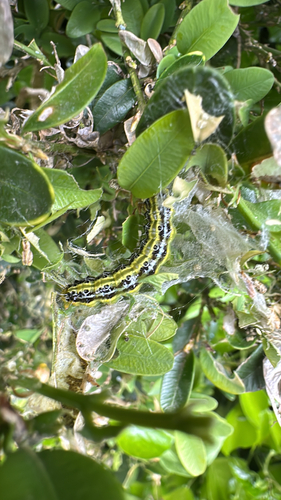
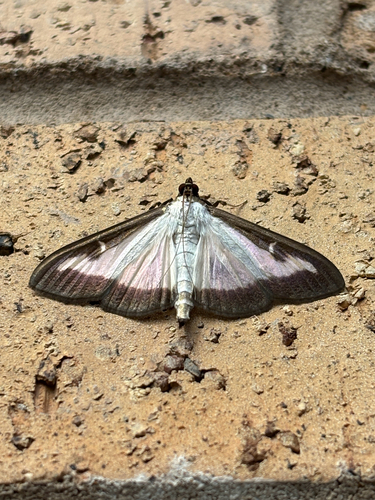
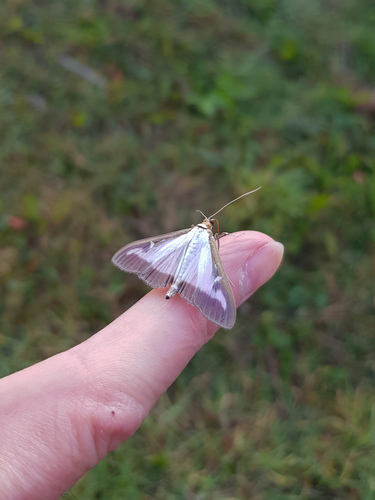
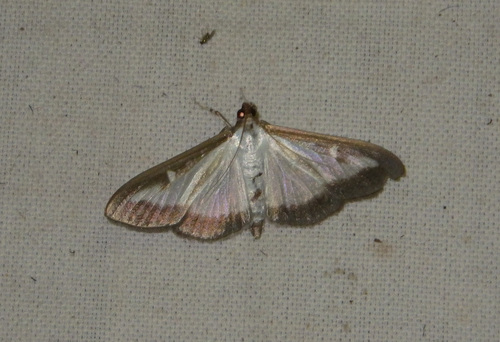
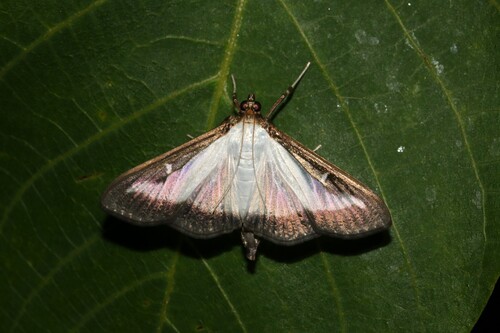
Adult box tree moths have a wingspan around 35-45 mm. Forewings and hindwings are mostly glossy white with a broad dark brown border along the wing edges and a small white crescent-shaped spot within the brown band along the leading edge of each forewing; a less common form is almost entirely brown apart from this white spot. Many specimens show a faint purple iridescence in strong light. Caterpillars are cylindrical, 30-40 mm when mature, usually green to yellowish-green with a shiny black head, dark and white stripes along the body and rows of black spots; late-instar caterpillars can appear darker or brownish and are covered in short hairs and fine tubercles. Pupae are in loose cocoons among leaves or bark crevices.
- Adults: white wings with a broad dark brown border and a small white crescent-shaped spot in the brown band on each forewing (some moths are almost entirely brown)
- Larvae: green to yellow-green caterpillars up to about 40 mm with a black head, dark and white stripes and rows of black spots, often feeding with webbing and frass
- Damage: rapid defoliation of Buxus shrubs with brown frass and silky webbing visible on affected plants
- Flight time and habitat: nocturnal adults near boxwood plantings and crowded hedges
Lookalikes
Small white butterfly (cabbage white) Pieris rapae
Pieris has plain white wings with black tips or spots and lacks the dark marginal band and central discal spot pattern seen on Cydalima perspectalis; Pieris caterpillars feed on brassicas, not boxwood.
Other crambid and pyralid moths Various Crambidae/Pyralidae
Many small white crambid moths exist, but the combination of glossy white wings, broad dark brown border, and boxwood association helps identify Cydalima perspectalis.
↻Life cycle
Egg
Females lay flattened, yellowish eggs in small clusters on the undersides of boxwood leaves and along stems; eggs hatch in about 6-14 days depending on temperature.
Larva (caterpillar)
Larvae feed gregariously, often webbing leaves and producing visible frass. There are several instars over 3-6 weeks; large aggregations can rapidly defoliate shrubs.
Pupa
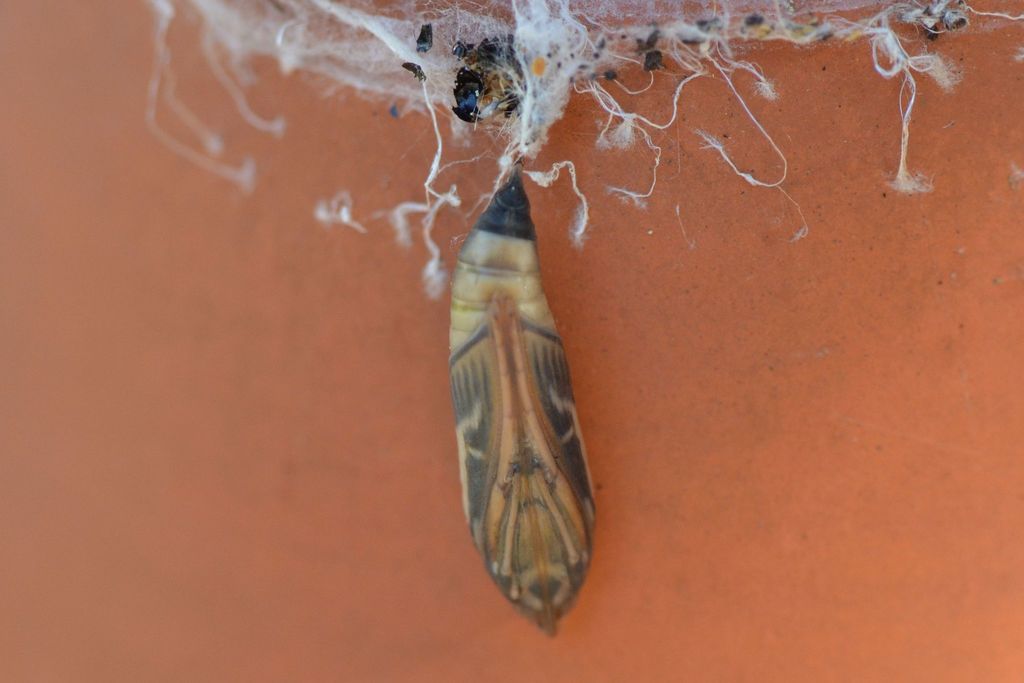
Pupation occurs in silken cocoons among leaves, bark crevices or plant litter. Pupation typically lasts 1-3 weeks but may be longer in cool conditions.
Adult (moth)
Adults are nocturnal flyers that mate and produce new egg batches; they live about 1-2 weeks and are attracted to light.
🍃Diet and predators
Young eat
Leaves and young shoots of boxwood (Buxus species)
Adults eat
Adults primarily feed on nectar or may not feed much; they are attracted to lights for dispersal
Predators of the young
Generalist predators (birds, predatory insects) and some parasitic wasps and flies; parasitoids adapted to Cydalima perspectalis are being studied in invaded regions
Predators of adults
Bats, night-flying insectivorous birds and predatory insects
🌱Effect on plants and gardens
Larvae feed almost exclusively on boxwood (Buxus spp.), stripping leaves, killing shoots and, with repeated attack, causing plant death. Ornamental and native Buxus populations can be severely impacted.
How to get rid of box tree moths
Inspect boxwood regularly from spring, especially inside the plant. Hand-pick caterpillars and remove webbing and frass, or prune out heavily infested shoots and dispose of them in sealed bags. Spray Bacillus thuringiensis kurstaki (Bt) on young larvae, covering the inside of the plant thoroughly. Use pheromone traps to monitor adult flights and time treatments. Use other approved insecticides only when necessary and according to label directions; in badly affected areas, consider replacing boxwood with alternative hedging plants.
📍Where and when to find it
Inspect boxwood hedges, shrubs and young plants. Eggs and young larvae are on the undersides of leaves; larger larvae and webbing are visible on branches and inner foliage.
Best time
Spring through autumn (varies by region); check at dusk and during warm weather when adults are active and larvae are feeding.
Observation tips
Look for silky webbing, frass deposits and grouped caterpillars inside hedges. Shake branches over white paper to dislodge and see larvae for photography. Wear gloves when handling.
✨Fun facts
- Box tree moth was first recorded in Europe in the late 2000s and spread rapidly because boxwood is widely planted in gardens and parks.
- Severe infestations can leave boxwood shrubs looking completely leafless within weeks.
- Biological control efforts include using Bacillus thuringiensis (Bt) on young larvae and researching natural parasitoids from the moth's native range.
?Frequently asked questions
Is the box tree moth dangerous to people?
No, it is not venomous or dangerous. Avoid handling caterpillars because their hairs or frass can cause mild skin irritation in sensitive people.
Do box tree moth caterpillars eat other plants besides boxwood?
They are highly specialized on boxwood (Buxus spp.) and cause little to no feeding on unrelated garden plants.
How do I know if my boxwood has box tree moth?
Look for clustered green caterpillars, silky webbing, brown frass, skeletonized leaves and adult white moths with a dark wing border near dusk.
How can I get rid of box tree moth in my garden?
For light infestations hand-pick and destroy egg masses and caterpillars, prune and remove heavily infested growth, use Bt (Bacillus thuringiensis kurstaki) sprayed on young larvae, and consider pheromone traps for monitoring. Use chemical controls only when necessary and follow label instructions. Professional arborist help is recommended for large or valuable plantings.
Will pheromone traps control box tree moth?
Pheromone traps are useful for monitoring adult males and detecting presence early, but on their own they rarely eliminate an established infestation; combine monitoring with larval control measures.
Can boxwood recover after an infestation?
Boxwood can regrow after defoliation if the root system and younger stems remain alive, but repeated severe attacks or secondary stress (disease, drought) can kill plants. Early control improves recovery chances.
📷Photos of the box tree moth
More butterflies & moths
This guide was written with AI assistance and fact-checked, last updated 2026-10-10. Identification from photos is never certain: don't handle insects you can't identify, and get medical advice for bites, stings or allergic reactions. More about the box tree moth: iNaturalist, Wikipedia.