
Cinnabar moth
Tyria jacobaeae · Tiger and woolly bear moths
A striking black-and-red day-flying moth whose caterpillars feed on ragwort and are used as a biological control for this weed.
!Is the cinnabar moth dangerous?
Only mildly. Cinnabar moths and caterpillars are not poisonous to handle for most people, but caterpillars sequester alkaloid toxins from ragwort and can cause mild skin irritation in sensitive individuals. They do not bite or sting. Wash hands after handling caterpillars or plants.
Pets
Caterpillars contain ragwort toxins and may be harmful if eaten by livestock or pets; keep grazing animals away from large infestations of ragwort. Small incidental contact with pets is unlikely to cause severe effects, but ingestion of many caterpillars could be toxic.
📖Overview
The cinnabar moth (Tyria jacobaeae) is a small, brightly coloured moth well known for its orange-red and black warning colours. It is native to Europe and parts of western Asia and has been introduced to several other regions, including North America and New Zealand, to help control ragwort (Jacobaea vulgaris and related Senecio species). Adults are diurnal (active by day) and are usually seen in late spring and early summer. The larvae are distinctive black and yellow-orange-banded caterpillars that feed gregariously on ragwort and related plants.
🔍How to identify a cinnabar moth
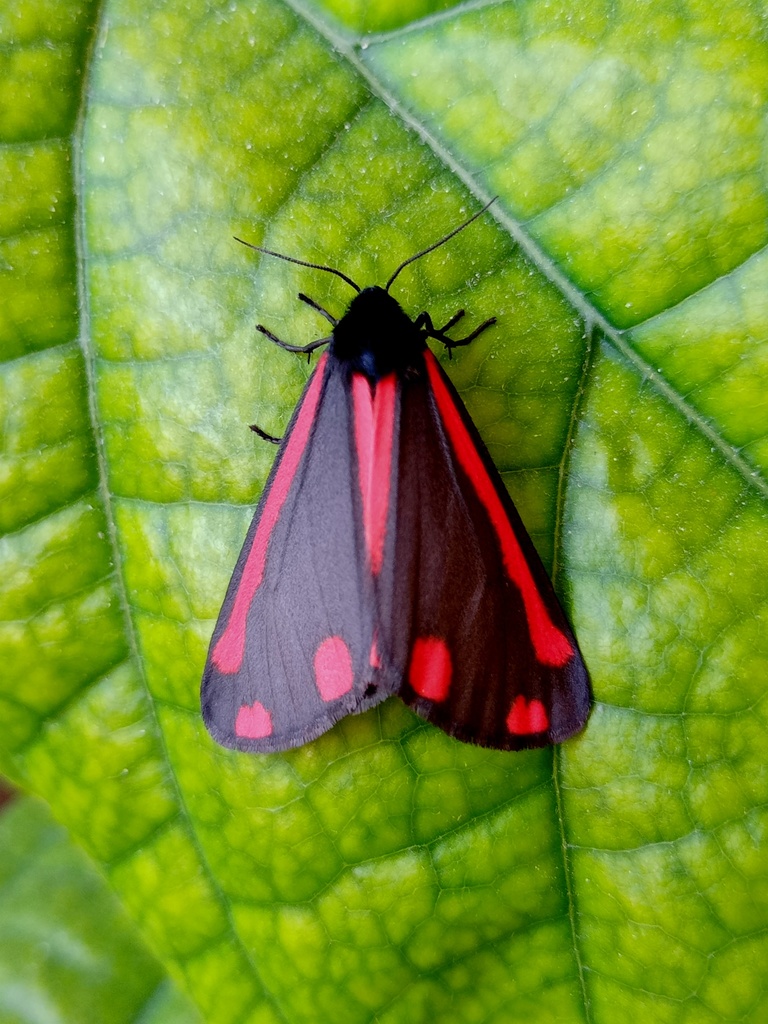
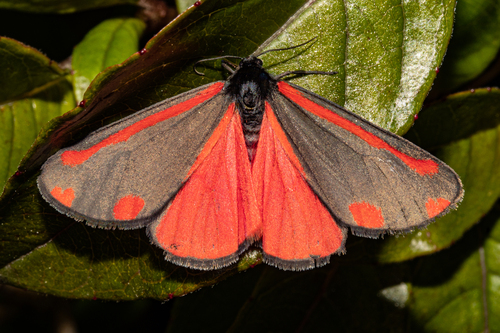
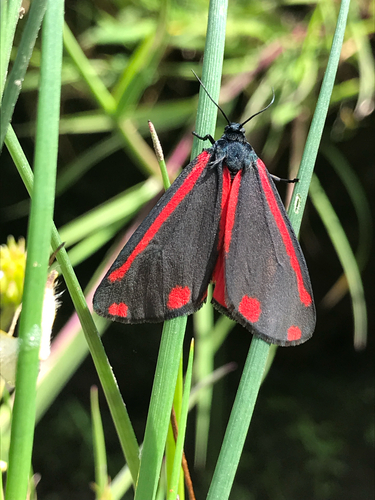
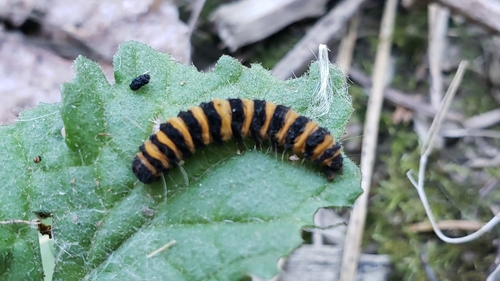
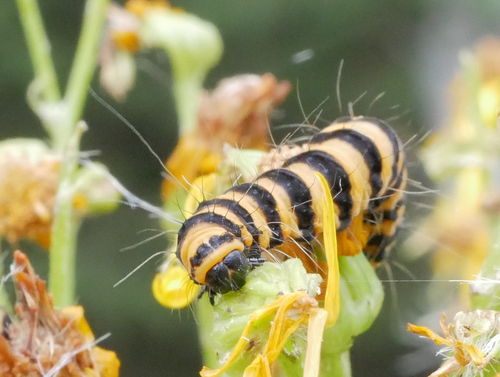
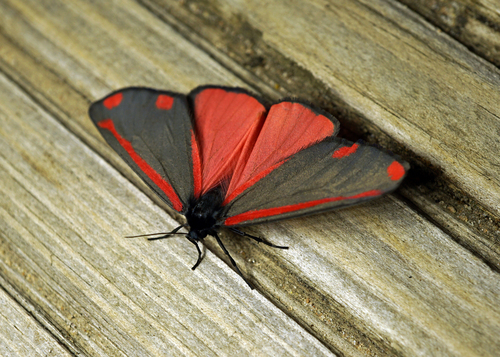
Adults have dark grey-black forewings with a red stripe along the leading edge and two red spots near the outer margin, and vivid red hindwings with a narrow black margin; the wingspan is typically 32-42 mm. The body is black. Caterpillars are cylindrical with bold alternating black and yellow-orange bands; they reach about 25-30 mm long. Pupae are dark reddish-brown and formed in a loose cocoon in leaf litter or soil.
- Adults: dark grey-black forewings with a red stripe along the leading edge and two red spots; bright red hindwings with black margin; wingspan about 32-42 mm
- Caterpillars: bold alternating black and yellow-orange bands, often in groups on ragwort
- Day-flying behaviour: adults often seen flying in daylight over ragwort patches in late spring and early summer
Lookalikes
Scarlet tiger moth Callimorpha dominula
Callimorpha dominula has black forewings with white and yellow spots and red hindwings with black blotches; the cinnabar has a red stripe and two red spots on each forewing and almost plain red hindwings.
Garden tiger moth Arctia caja
Arctia caja is larger with patterned brown/white forewings and red/orange hindwings with black spots; cinnabar is smaller with dark forewings marked only by a red stripe and two red spots.
↻Life cycle
Egg
Females lay clusters of small yellow eggs on the underside of ragwort leaves in late spring and early summer.
Larva (caterpillar)
Gregarious caterpillars with black and yellow-orange bands hatch and feed together on ragwort, sometimes destroying large parts of the plant.
Pupa
After several weeks of feeding, caterpillars pupate in a loose cocoon among plant debris or in soil; pupal stage lasts until the following spring or into summer depending on climate.
Adult (moth)
Day-flying adults with red and black wings emerge to mate and continue the cycle; adults live about 1-2 weeks.
🍃Diet and predators
Young eat
Leaves and stems of ragwort (Jacobaea/ Senecio species); occasionally other related Asteraceae
Adults eat
Adults take little nourishment; may visit flowers for nectar but feed minimally
Predators of the young
Some parasitic wasps and flies, and in some cases birds; many predators avoid them because of sequestered toxins
Predators of adults
Birds and insectivorous insects may occasionally take adults, but bright colours warn predators and reduce predation
🌱Effect on plants and gardens
Larvae feed principally on ragwort (Jacobaea vulgaris and related Senecio species), often skeletonising plants and reducing their vigour. Adults do not feed on significant amounts of foliage.
📍Where and when to find it
Look for eggs and caterpillars on underside of ragwort leaves, caterpillars feed gregariously on host plants. Adults fly by day over ragwort patches.
Best time
Best observed May to July for adults; caterpillars often seen in late spring to early summer. Daytime is best for photographing adults.
Observation tips
Search sunny ragwort stands and photograph adults during daylight. When handling caterpillars, wear gloves and wash hands afterward because of possible skin irritation and toxins.
✨Fun facts
- Cinnabar moth caterpillars feed together in groups and can rapidly strip ragwort plants.
- The species was deliberately introduced to several countries as a biological control agent for ragwort.
- Its common name likely comes from the bright red colour similar to the mineral cinnabar.
?Frequently asked questions
Are cinnabar moths dangerous?
Only mildly. Adults do not bite or sting. Caterpillars contain toxins from ragwort that make them unpalatable; they can cause mild irritation if handled and are potentially toxic if eaten in large amounts by livestock or pets.
Do cinnabar moth caterpillars bite?
No. They do not bite people. Handling may leave plant or caterpillar residue and could irritate sensitive skin.
Why are cinnabar moths in my garden?
If you have ragwort or related Senecio plants, cinnabar moths are likely present because their larvae feed on those plants. They are often welcome as natural control agents for ragwort.
How do I get rid of cinnabar moths?
If they are a nuisance, remove their food source (ragwort) by pulling or cutting plants before eggs hatch. Manual removal of caterpillar clusters is effective. Chemical control is rarely needed and not recommended if the goal is to control ragwort ecologically.
Where do cinnabar moths live?
They live where ragwort grows: grasslands, meadows, roadside verges and disturbed open ground across Europe and Asia, and in introduced ranges in North America and New Zealand.
Will cinnabar moths harm my pets or livestock?
Caterpillars contain ragwort-derived toxins and can be harmful if eaten in large numbers by livestock (horses, cattle). Keep grazing animals away from ragwort patches and consult a veterinarian if ingestion is suspected.
📷Photos of the cinnabar moth
More butterflies & moths
This guide was written with AI assistance and fact-checked, last updated 2026-10-10. Identification from photos is never certain: don't handle insects you can't identify, and get medical advice for bites, stings or allergic reactions. More about the cinnabar moth: iNaturalist, Wikipedia.