
Cinnabar moth vs Garden tiger moth
These two are easy to mix up. Here's how to tell a cinnabar moth from a garden tiger moth, and whether either one bites or stings.
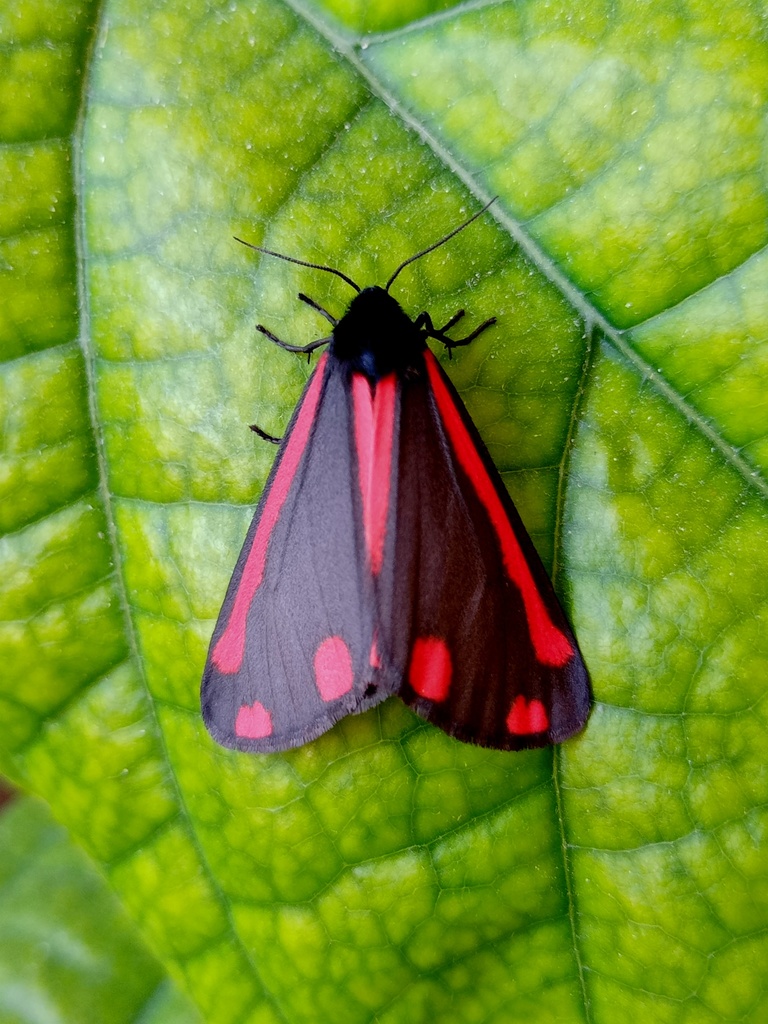
Cinnabar moth
Tyria jacobaeae
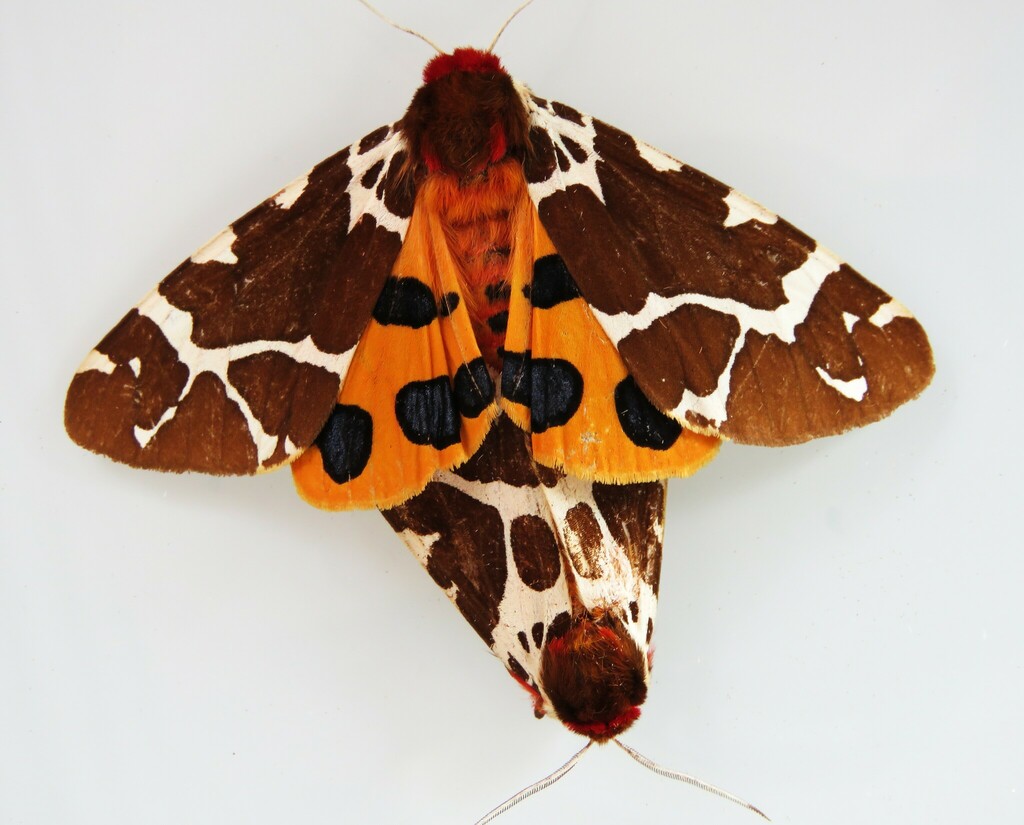
Garden tiger moth
Arctia caja
≠The key differences
Arctia caja is larger with patterned brown/white forewings and red/orange hindwings with black spots; cinnabar is smaller with dark forewings marked only by a red stripe and two red spots.
⚖︎Side by side
| Cinnabar moth | Garden tiger moth | |
|---|---|---|
| To humans | Unpalatable | Irritating hairs |
| Size | 32-42 mm wingspan | 45-65 mm wingspan |
| Colours | Black, Red (orange-red), Yellow, Orange | Brown, Cream/Off-white, Orange-red, Blue-black |
| Family | Erebidae | Erebidae |
| Habitat | Open grassland, meadows, road verges and disturbed ground where ragwort and related Senecio species grow | Gardens, meadows, marsh edges, hedgerows and other herb-rich, moderately damp places |
| Range | Native to Europe and western and central Asia; introduced populations exist in North America and New Zealand for ragwort control | Temperate Europe and northern Asia, and across much of northern North America; absent from the coldest arctic zones |
| Active | Adults flight period mainly May to July (varies with latitude); moths fly by day | Adults fly in summer (usually June-August in temperate Europe and North America); crepuscular to nocturnal |
| Pest? | No | No |
🔍How to spot a cinnabar moth
- Adults: dark grey-black forewings with a red stripe along the leading edge and two red spots; bright red hindwings with black margin; wingspan about 32-42 mm
- Caterpillars: bold alternating black and yellow-orange bands, often in groups on ragwort
- Day-flying behaviour: adults often seen flying in daylight over ragwort patches in late spring and early summer
🔍How to spot a garden tiger moth
- Forewings strongly patterned brown with cream/white patches and wavy lines
- Hindwings bright orange-red with several large round dark blue-black spots
- Medium-large wingspan (about 45-65 mm) and a hairy robust body
- Larvae are densely hairy 'woolly bears' typically dark with reddish-orange bands or tufts
?Frequently asked questions
What is the difference between a cinnabar moth and a garden tiger moth?
Arctia caja is larger with patterned brown/white forewings and red/orange hindwings with black spots; cinnabar is smaller with dark forewings marked only by a red stripe and two red spots.
Is a cinnabar moth or a garden tiger moth more dangerous?
Cinnabar moth: Unpalatable. Garden tiger moth: Irritating hairs. Cinnabar moths and caterpillars are not poisonous to handle for most people, but caterpillars sequester alkaloid toxins from ragwort and can cause mild skin irritation in sensitive individuals. Adults do not bite or sting and are not dangerous.
Identification from photos is never certain: don't handle insects you can't identify, and get medical advice for bites, stings or allergic reactions.