
Elm sawfly
Cimbex americanus · Sawflies
A large North American sawfly whose caterpillar-like larvae feed on elm and other broadleaf trees but are not dangerous to people.
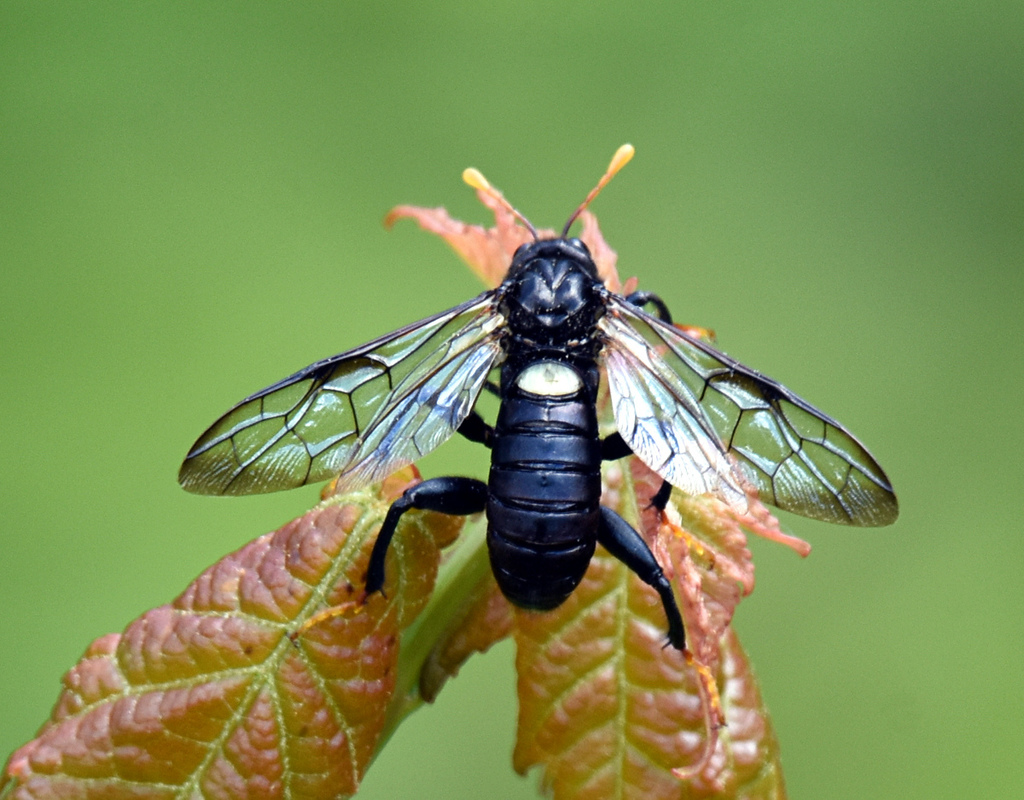
!Is the elm sawfly dangerous?
No. Adults do not sting. Females possess a saw-like ovipositor used to lay eggs in plant tissue, but it cannot sting people. Larvae do not bite, though they may squirt a harmless watery defensive fluid when disturbed. No medical treatment is needed after contact.
Pets
Not toxic to pets. Large larvae might be unappetizing but are not known to be poisonous; prevent pets from eating large numbers of any insect to avoid digestive upset.
📖Overview
Cimbex americanus is a member of the sawfly family Cimbicidae, notable for large, robust adults and big, caterpillar-like larvae. It occurs across much of North America. Females use a saw-like ovipositor to insert eggs into host leaves; larvae hatch and feed on leaves before spinning cocoons in leaf litter or soil, where they overwinter. Outbreaks can cause noticeable defoliation on individual trees, but populations are usually low and do not cause long-term tree mortality.
Adults are non-aggressive and do not sting people. The species has one generation per year in most of its range. Larvae are most often seen in late spring and summer when feeding, while adults are present briefly for mating and egg laying.
🔍How to identify an elm sawfly
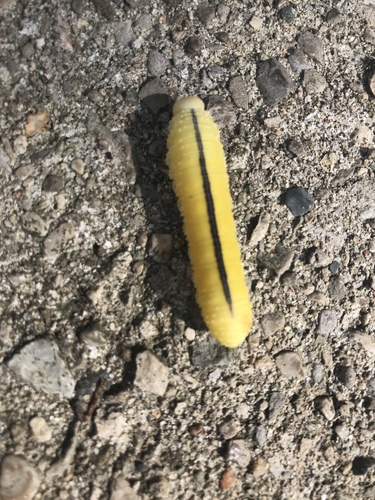
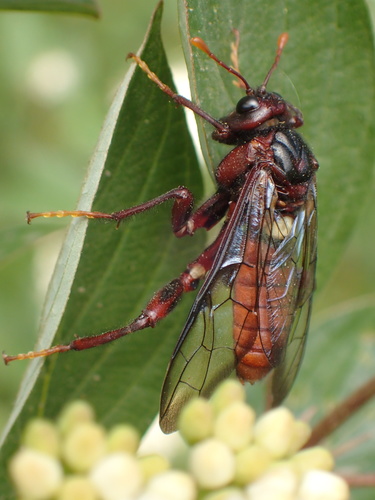
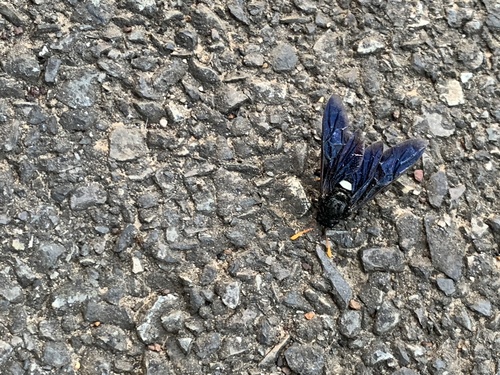
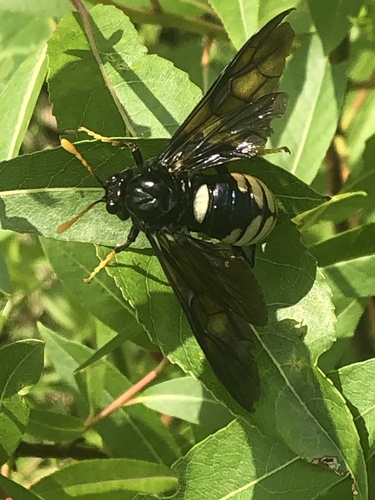
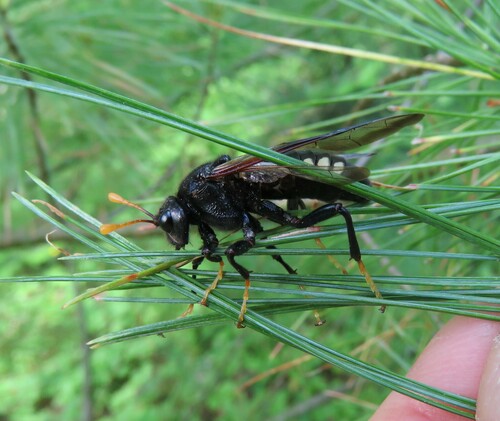
Adults are large, robust, wasp-like sawflies with clubbed antennae. The body is dark steel-blue to black; females usually have a row of yellow spots along each side of the abdomen, and wings are smoky brown. Adult body length is typically about 18-25 mm. Larvae resemble moth caterpillars: plump and pale yellow-green with a black stripe down the back and black spiracles along the sides. They often rest curled in a spiral and can squirt a harmless defensive fluid, and they reach about 4-5 cm when mature.
- Large, robust adult sawfly with a dark steel-blue to black body, clubbed antennae and smoky wings; females have yellow spots along the abdomen.
- Larvae are plump, pale yellow-green, with a black stripe down the back and black spots along the sides; they often rest curled in a spiral.
- Larvae feed openly on the leaves of elm, willow and other deciduous trees.
- Adults lack the constricted "wasp waist" seen in wasps and bees (sawflies are broad-waisted).
Lookalikes
Other Cimbex sawflies Cimbex spp.
Related Cimbex species are similar in size and life cycle; species-level ID usually requires examination of adult markings and geographic range.
Forest tent caterpillar Malacosoma disstria
Forest tent caterpillars are hairy, with a row of pale keyhole-shaped spots down the back, and feed in groups; Cimbex larvae are smooth, hairless and plump.
Sawfly larvae (other families) Various
Other sawfly larvae feed on different host plants or have different stripe/spot patterns; check host tree and larval pattern for separation.
↻Life cycle
Egg
The female cuts slits in leaf tissue with her saw-like ovipositor and inserts eggs. Eggs hatch in about one to two weeks depending on temperature.
Larva (sawfly caterpillar)
Larvae feed on foliage for several weeks, mostly singly, growing through several instars; they are the stage that causes visible leaf damage.
Pupa
Mature larvae spin a tough cocoon in leaf litter or loose soil, overwinter inside it and pupate in spring.
Adult
Adults emerge in spring to mate and the females lay eggs on host trees, completing the annual cycle.
🍃Diet and predators
Young eat
Leaves of elm and other deciduous trees (folivores)
Adults eat
Adults feed little; they may chew bark from twigs to feed on sap.
Predators of the young
Birds, predatory insects and parasitic wasps and flies
Predators of adults
Birds and predatory insects
🌱Effect on plants and gardens
Larvae feed on the leaves of elm, willow and other deciduous trees such as birch, maple and basswood; adults sometimes chew strips of bark from twigs. Heavy localized feeding can cause defoliation, but healthy mature trees usually recover.
How to get rid of elm sawflies
Usually no treatment is needed. For small numbers, handpick larvae from branches and drop them into soapy water. Encourage natural enemies (birds, predatory insects, parasitoid wasps and flies). For larger infestations on small or valuable trees, use an insecticide labeled for sawfly larvae, such as insecticidal soap or spinosad, following label directions; note that Bacillus thuringiensis kurstaki (Btk) does not work on sawflies because they are not caterpillars. Consult an arborist for large trees.
📍Where and when to find it
Look on the leaves and branch tips of elm and nearby deciduous trees for feeding larvae; adults may be seen on foliage or flying nearby in spring.
Best time
Late spring to summer for larvae; adults appear briefly in late spring to early summer. Daytime is best for observing feeding larvae.
Observation tips
Photograph both the larval body pattern and the host tree leaves; if collecting, place larvae into a jar with fresh leaves and keep cool for later identification.
✨Fun facts
- Sawflies are in the same order as wasps and bees (Hymenoptera) but lack the narrow waist of most wasps.
- Despite their caterpillar-like appearance, sawfly larvae are not butterflies or moths and have more prolegs than true caterpillars.
- Cimbex adult sawflies are unusually large compared with most other sawfly species.
?Frequently asked questions
Are elm sawflies dangerous to people?
No. They do not sting or transmit disease. Females have an ovipositor used on plant tissue only.
Do elm sawfly larvae bite?
No. Larvae do not bite people; they are leaf feeders and may be handled gently but can be crushed.
Why are they on my elm tree?
Females lay eggs on elm; larvae feed on elm leaves. You may notice them if a group of larvae is feeding and defoliating branches.
How can I get rid of elm sawflies?
For small numbers, remove larvae by hand. Encourage birds and parasitoids. For larger infestations, use targeted insecticides labeled for sawflies or consult an arborist.
Will elm sawflies kill my tree?
Occasional defoliation is usually tolerated by healthy mature trees. Repeated heavy defoliation over several years can weaken a tree and increase susceptibility to other problems.
📷Photos of the elm sawfly
More bees, wasps & ants
Bites and formic acid
Painful sting
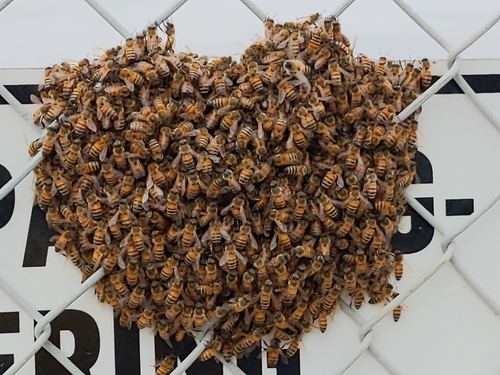
Stinging insect
Can sting
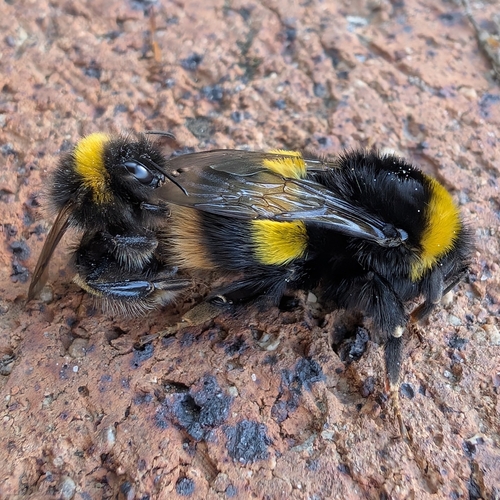
Can sting
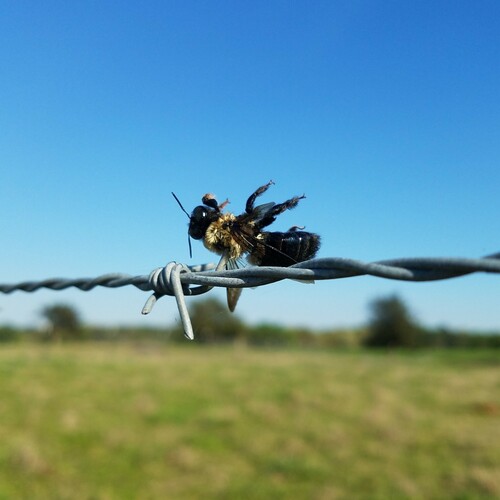
Can sting
This guide was written with AI assistance and fact-checked, last updated 2026-10-10. Identification from photos is never certain: don't handle insects you can't identify, and get medical advice for bites, stings or allergic reactions. More about the elm sawfly: iNaturalist, Wikipedia.